GRP Ladders
Universal Industrial Services designs, fabricates and installs fixed GRP access ladders, cat ladders, caged ladders and step-overs, for industrial sites UK-wide.
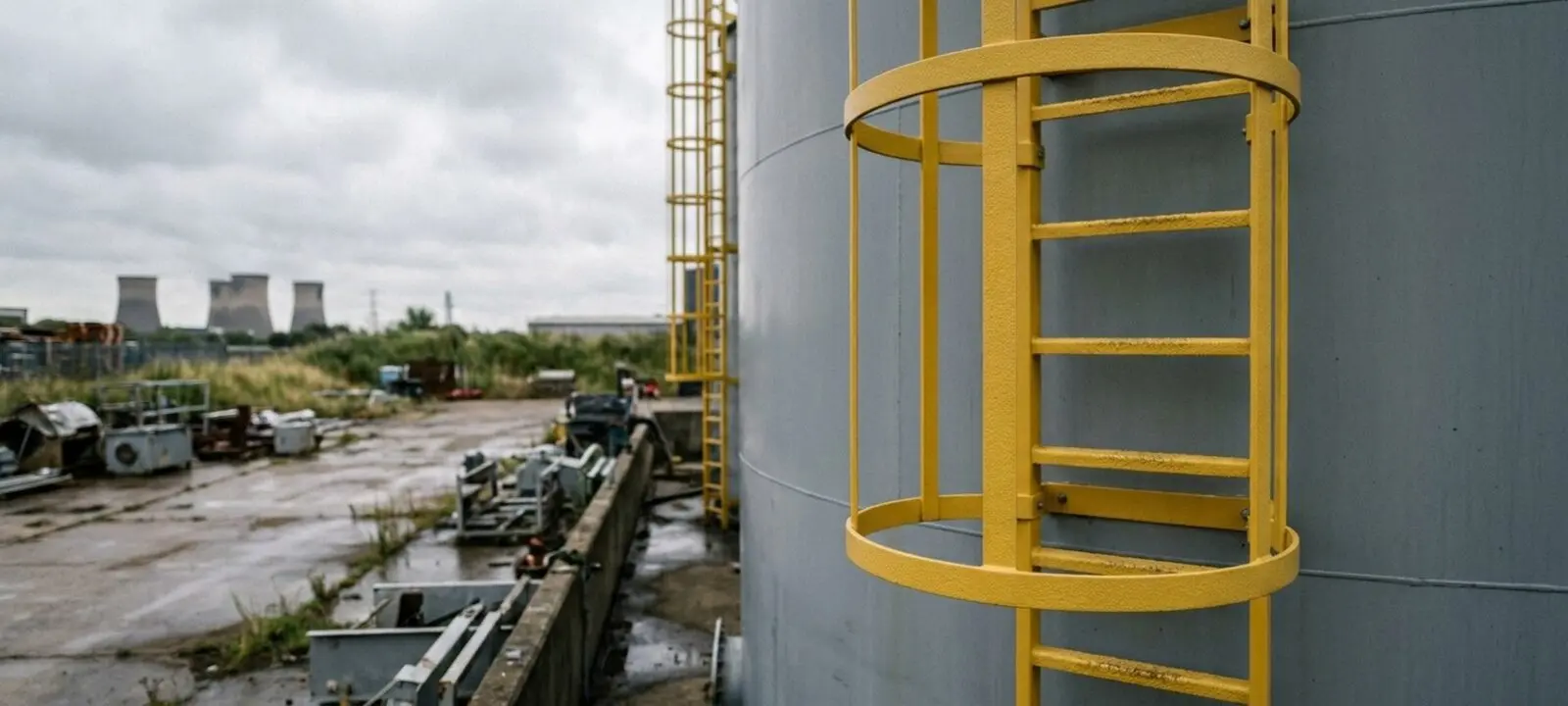


What we deliver.
If you are specifying permanent access for a plant deck, a riser or a tank top, you are not after a portable ladder off a shelf. You need a fixed run that fits the opening you actually have, will not corrode or conduct, and arrives with the documentation your audit will ask for. We design, fabricate and install that access ourselves, with our own teams, so we own the survey, the drawings, the fabrication and the fit.
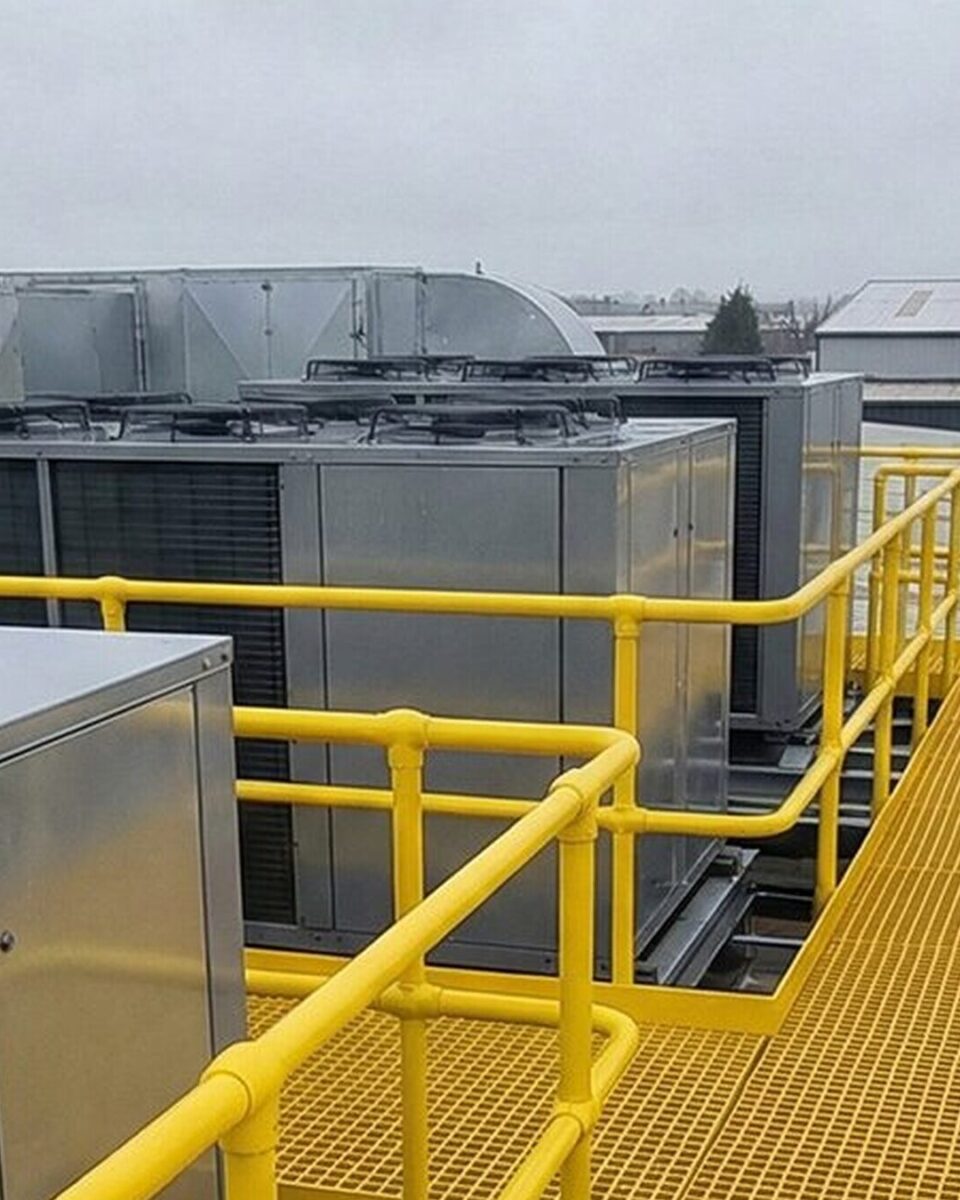
GRP suits the settings where steel fails: beside live electrical equipment, and in corrosive conditions such as coastal rooftops and chemical plant.
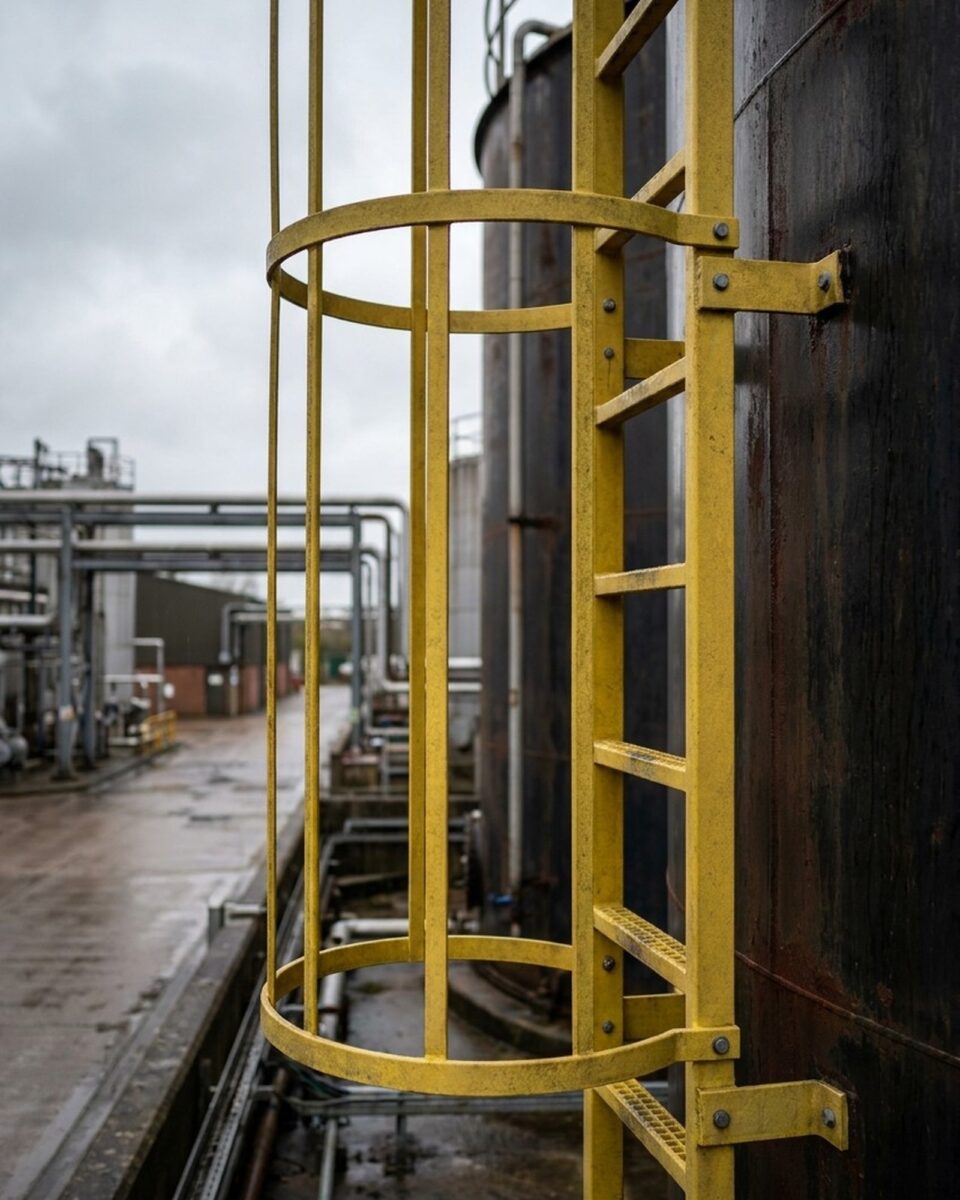
From survey to installed access.
One team owns the ladder from the site survey through fabrication to sign-off.
Specification and site survey
You send us the access requirement or your drawings, and we survey the openings, parapets and risers as they actually are, with a 3D scan where the site is tight or an existing ladder is being replaced. On a large commercial package, you have an itemised quotation within 1 to 2 weeks of the take-off, built from the survey rather than a catalogue line, so what we quote is what you pay.
Design and detailing
We design the ladders, cages, hoops, step-overs and any landing guarding to the surveyed dimensions and to the loadings your structural engineer has specified, then issue the drawings for your approval before anything is cut. The loadings and the access configuration come from your engineer; we design and fabricate to meet them.
Fabrication
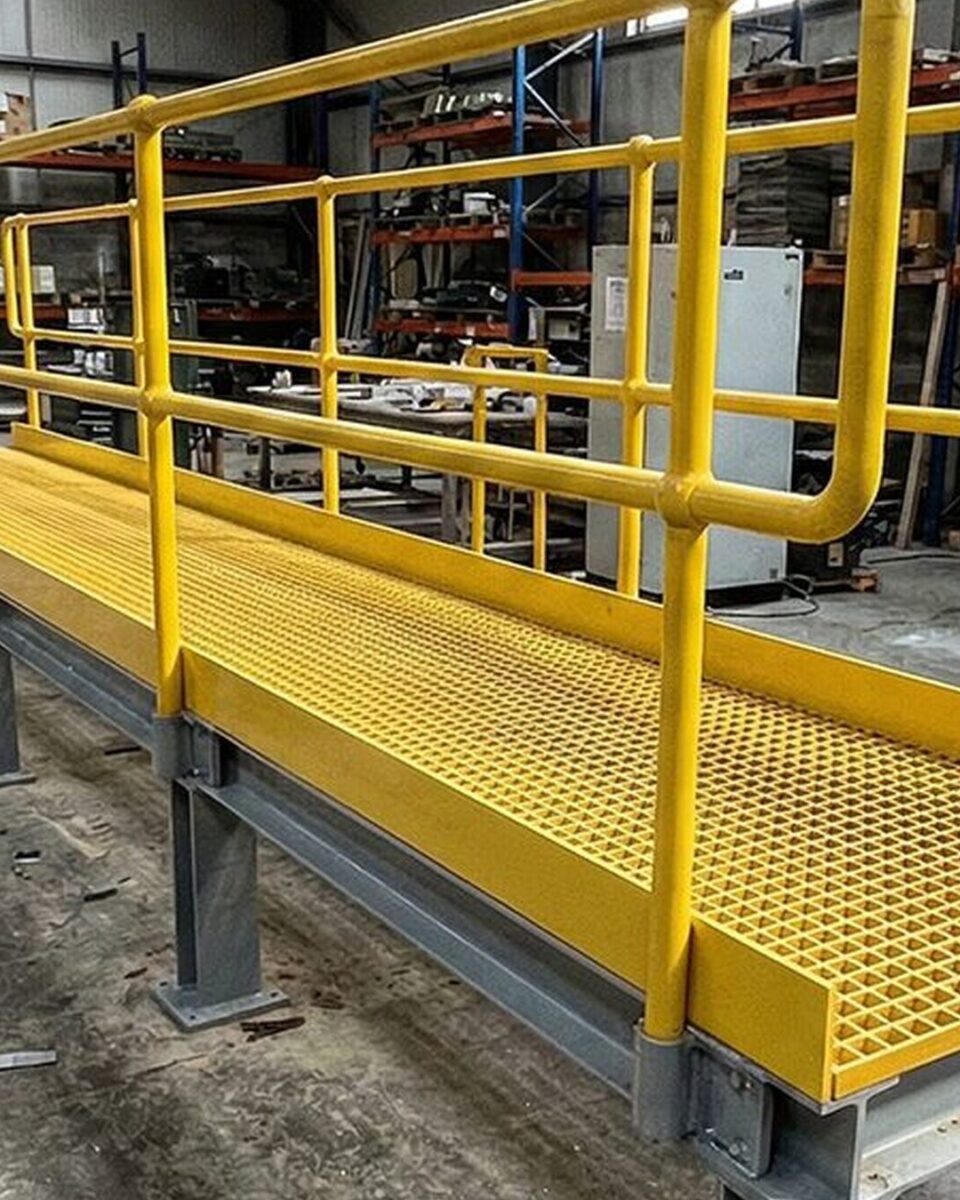
We cut, drill and assemble the pultruded and moulded GRP sections and fixings into the finished ladders in our own workshop at Hellaby, Rotherham. We supply, specify and fabricate the sections into the completed ladder; the raw GRP profiles are pultruded and moulded by the material manufacturer, not by us, and we are clear about that scope from the outset.
Installation
Our own site team installs the ladders to an agreed method statement, and our in-house Appointed Person plans every lift. Where your operation cannot stop, we programme the work around it, including out-of-hours and night-shift installation, the way we worked around a live supermarket at Oban.
Handover and aftercare
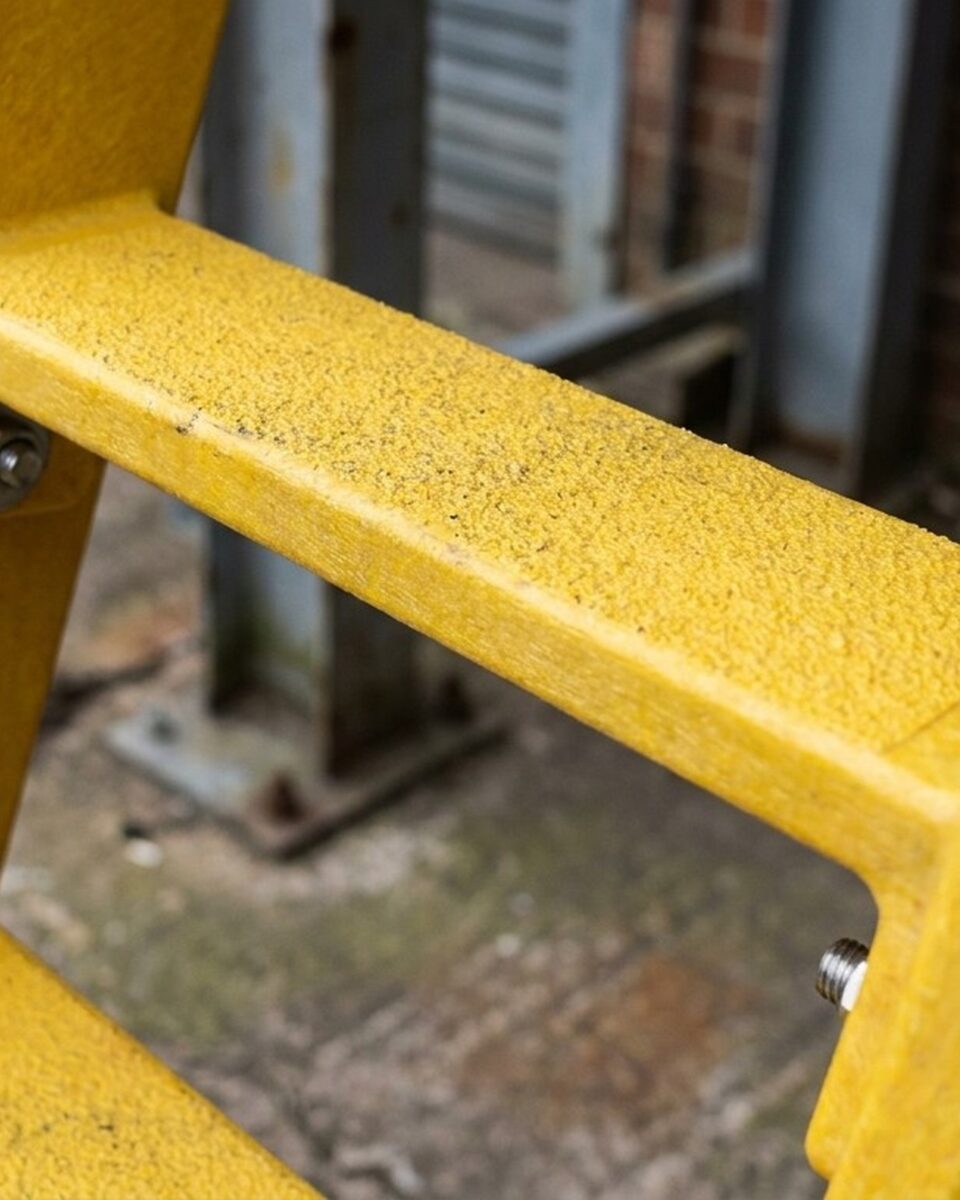
At handover you receive the O&M pack, which includes the BS EN 16165 pendulum slip-resistance values for the rungs and the fire classification documentation for the GRP grade used on your project. We run a defect liability period of 12 months from practical completion, in line with standard JCT terms, and if something is not right in that first year we return and put it right.
The two jobs a steel ladder cannot do well.
GRP earns its place in two situations a steel ladder cannot handle well: beside live electrical equipment, where a non-conductive ladder removes a shock risk that steel and aluminium do not, and in salt or chemical exposure, where steel corrodes and needs recoating on a schedule no one has time for. It is also far lighter than steel, which eases handling and fixing at height. Outside those conditions steel is often the better and more cost-effective answer over its life, and we will tell you so.
Request a quote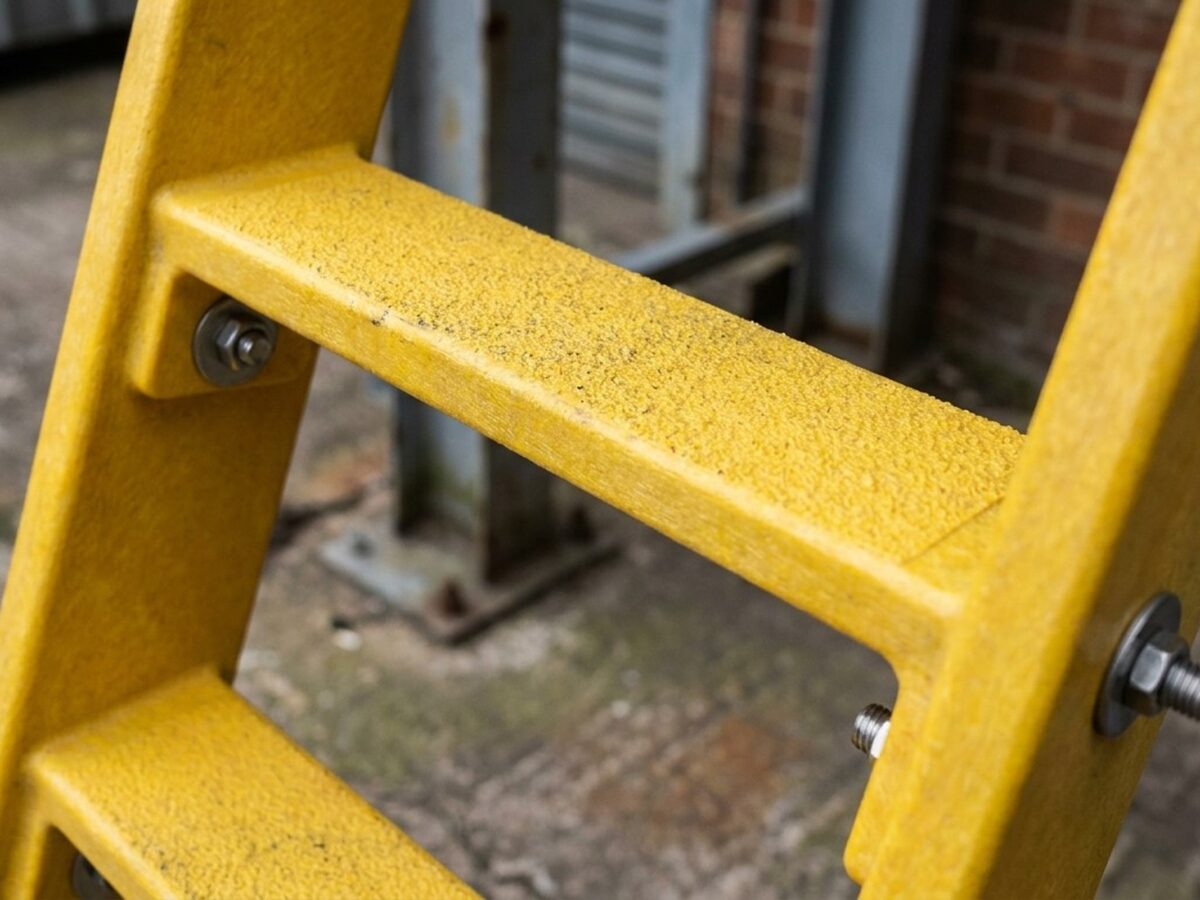
Project & sample images.
← Drag / swipe to browse · click to expand →
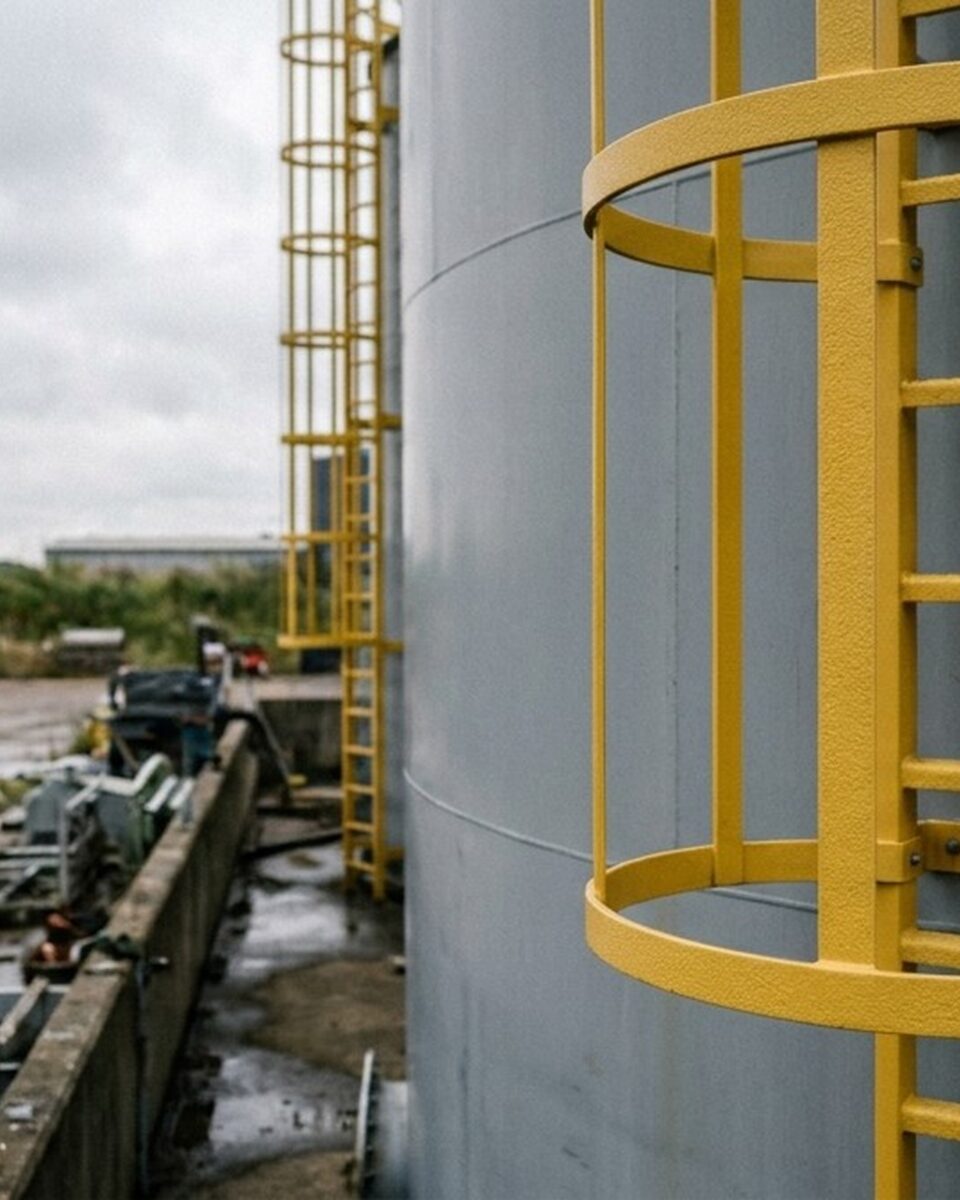
Why one team should own the whole ladder.
We make the ladder to the opening you actually have, and install it with our own carded crews.
About UIS-
01
One team owns the whole ladder, from survey to sign-off
Buy GRP ladder sections from a distributor and the installation becomes your problem, and the day a supplied length does not match the as-built opening, the supplier and the fitter blame each other while your programme slips. We do the lot ourselves. We survey the site, design and detail the access, fabricate it in our own Rotherham workshop, and install it with our own people. One point of contact, no subcontractors, and one O&M pack at the end.
-
02
Ladders made to the opening you have, not a catalogue size
A standard ladder rarely lands cleanly against a real parapet, riser or tank top, and a corroded steel ladder is never quite the size the original drawing claims. Before we fabricate, we carry out a detailed geometrical survey and, where the site is constrained or we are replacing existing access, a 3D scan, then overlay the proposed ladder onto the scan in CAD. We fabricate to that scan, so the ladder matches the building as built and fits first time on site rather than being trimmed and packed to suit.
-
03
Non-conductive, corrosion-proof access where steel is the wrong answer
GRP earns its place in two situations a steel ladder cannot handle well: beside live electrical equipment, where a non-conductive ladder removes a shock risk that steel and aluminium do not, and in salt or chemical exposure, where steel corrodes and needs recoating on a schedule no one has time for. It is also far lighter than steel, which eases handling and fixing at height. Outside those conditions steel is often the better and more cost-effective answer over its life, and we will tell you so, because the right material matters more to us than selling more of any one of them.
-
04
Our own installers, who plan the work rather than improvise it
Your installers are UIS employees, not subcontractors, carrying CSCS cards, with an SSSTS-qualified supervisor on every job and PASMA and IPAF certification for access and powered-access work. Our own in-house Appointed Person plans the lifts rather than handing them to the crane-hire contact, so whoever signs off the lift already knows how the ladder was fabricated and how the site is sequenced. We have installed plant-deck steelwork inside a live, operating supermarket on night shifts at Oban in Scotland, so an occupied site that cannot stop is familiar ground for our teams.

"I've worked with UIS for several years on some high profile and very complex projects. Their attitude and work ethic are second to none - providing high quality services and products which are delivered safely and on time every time. Overall they are a pleasure to do business with and wouldn't hesitate recommending UIS for any steelwork or metalwork packages."
Questions clients ask us.
We do both, as one service. We survey your site, design and detail the access, fabricate it in our own Rotherham workshop, and install it with our own teams. We supply, specify and fabricate the GRP sections into the finished ladder; we do not mould the raw profiles ourselves, and we are clear about that scope from the start.
Choose GRP where access sits beside live electrical equipment or in corrosive conditions such as coastal, chemical or water-treatment exposure. GRP is non-conductive and does not corrode, and it is far lighter than steel, which eases handling at height. Outside those conditions steel is often the better and more cost-effective choice, and we will say so.
Yes. We regularly install on live, occupied sites, including a plant deck inside an operating supermarket at Oban that we installed on night shifts. Our teams hold CSCS, SSSTS, PASMA and IPAF certification and work to a full method statement, with every lift planned by our in-house Appointed Person.
Your O&M pack includes the BS EN 16165 pendulum slip-resistance values for the rungs and the fire classification for the GRP grade used on your project, because that rating depends on the grade specified rather than a single figure that fits every job. The access and its edge protection are designed in line with HSE guidance and the Work at Height Regulations 2005.
Yes. We design and fabricate fall-protection hoops, safety cages, step-overs and intermediate rest platforms as part of the ladder, sized to the surveyed access and to the heights and loadings your engineer specifies. Where a landing guard also acts as a barrier, we design it to BS 6180.
Recent project deep-dives.
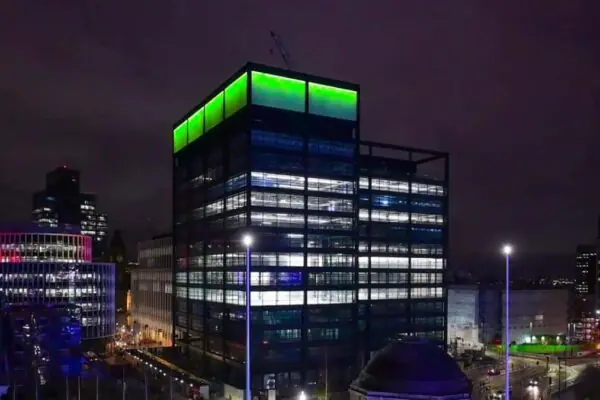
One Centenary Way
On this Project, we were contracted by our construction partners Sir Robert Macalpine, to design, supply, and Install numerous bespoke metal...
Read case study →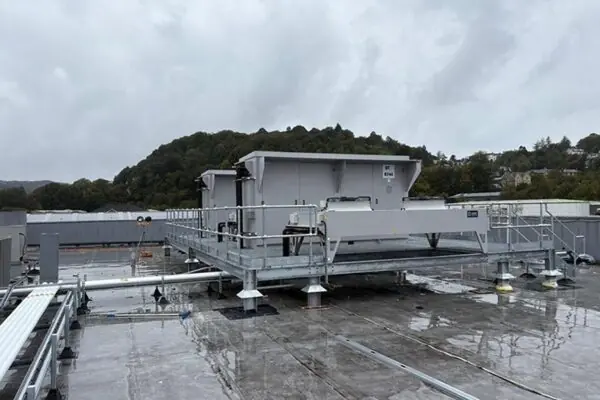
Oban Plant Deck Platform, Scotland
We're proud to announce the successful completion of our latest project - the installation of a plant deck platform in Oban, Scotland....
Read case study →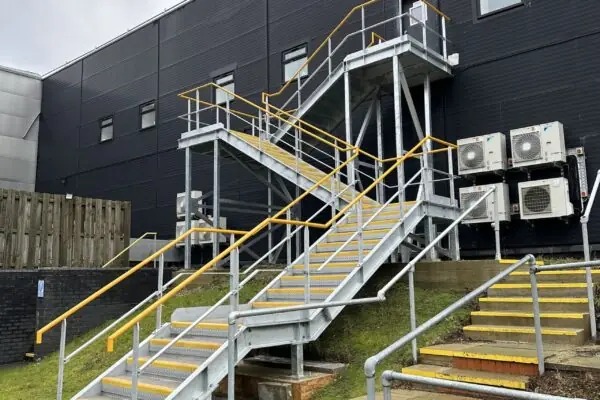
Access Stairway at Thermo Fisher Scientific
We are proud to announce the successful completion of another project here at UIS for Thermo Fisher Scientific in Horsham. Our team was t...
Read case study →