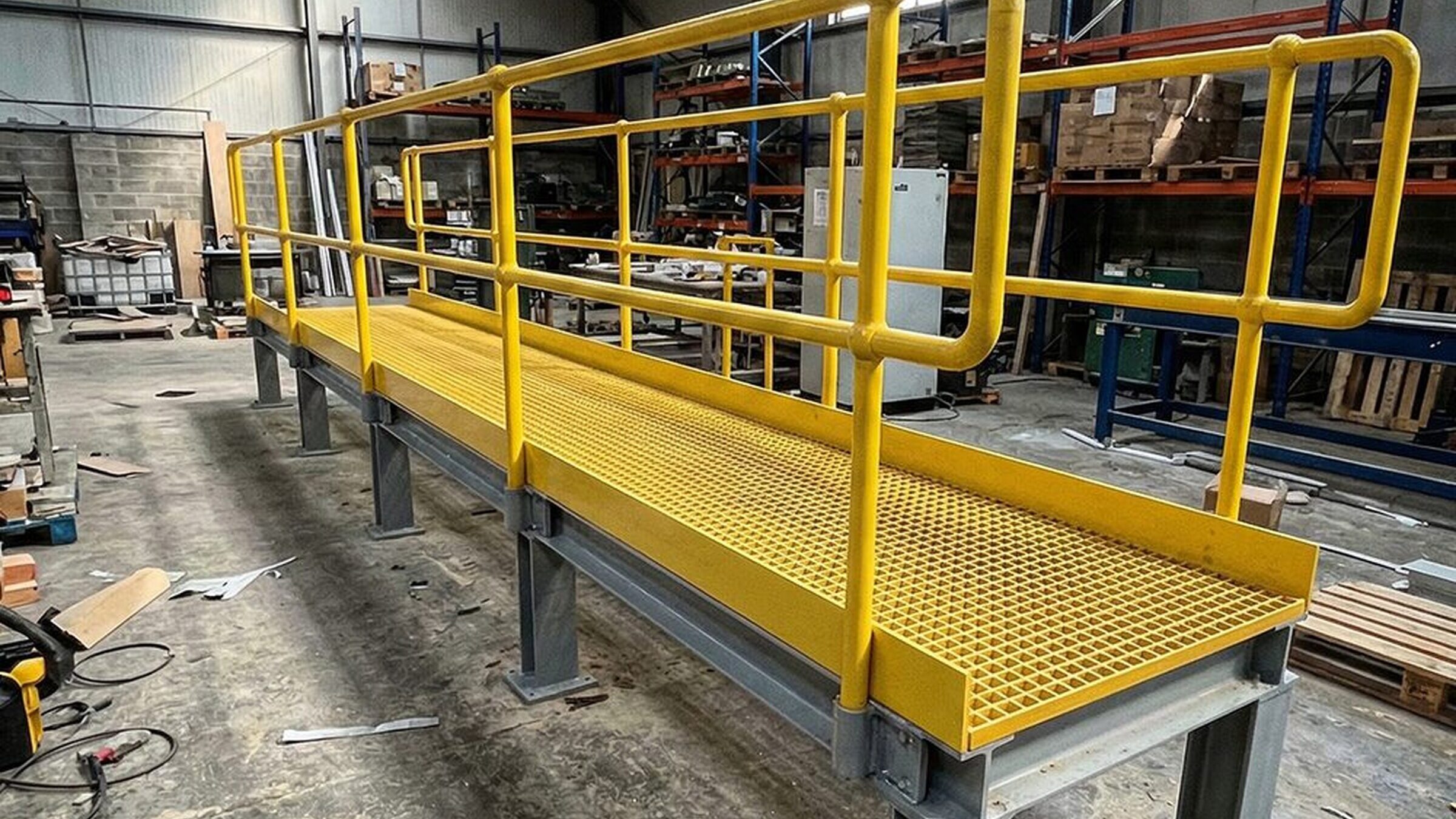
GRP stands for glass-reinforced plastic, also called glass-reinforced polymer or, in plain English, fibreglass. It is a composite: fine glass fibres set in a hardened resin, which together make a material that is light, rust-proof and strong for its weight.
In industrial access, GRP turns up as walkways, gratings, platforms, handrails, stair treads and riser flooring, usually where weight, corrosion or electrical conductivity rule steel out.
This guide covers what GRP is made of, how it is made, its main properties, where it is used and how it compares with steel and the wider FRP family. The standards and figures below are general guidance, not engineering or legal advice; confirm the requirements for your own project with your structural engineer or Building Control.
What does GRP stand for, and what is it made of?
GRP stands for glass-reinforced plastic, sometimes written as glass-reinforced polymer and widely known as fibreglass. All three names describe the same thing: glass fibre reinforcement set in a thermosetting resin matrix.
The material does its job through two parts working together. The glass fibres carry the tensile load and give the material its strength.
The resin binds the fibres, transfers load between them and protects them from water, chemicals and impact. On its own, the resin would be brittle; the glass turns it into a material that is strong for its weight.
The resin grade decides a lot about how the finished GRP behaves. Three are common in industrial work:
- Polyester resin is the standard, general-purpose choice for everyday access work.
- Vinyl ester resin holds up better against aggressive chemicals and higher temperatures.
- Phenolic resin is specified where fire performance is the priority.
The grade chosen for a project sets its chemical resistance and its fire classification, so the right resin has to be matched to where the GRP will live.
How is GRP made?
GRP for industrial access is made two main ways: pultrusion and moulding. The manufacturing method, not just the material, decides which product suits a job.
Pultrusion pulls continuous glass fibres through a resin bath and then a heated die, which cures the resin and forms a constant cross-section. It produces straight profiles in long, repeatable lengths: handrail tube, channels, angles, box sections and the bars used in some grating. Because the fibres run mainly along the length, pultruded profiles are strong along their span.
Moulding builds the product up around layers of glass inside a mould. It is the usual route for open-mesh grating, where the glass runs in two directions, so the panel carries load both ways and leaves an open area for drainage and light.
The choice between moulded and pultruded grating comes down to span, load direction and how much open area the deck needs, which is a comparison worth its own walk-through.
What are the main properties of GRP?
Four properties explain why GRP gets specified for access: it is lightweight, corrosion-resistant, electrically non-conductive and low maintenance.
It is light. Industry literature from GRP manufacturers puts GRP at around 80% lighter than the steel equivalent, which makes panels and sections easier to handle, quicker to install and often workable without the craneage a steel deck would need. On a rooftop plant deck, that lower dead load can be the deciding factor.
It does not corrode. GRP resists damp, salt spray and many chemicals without rusting, so it removes the recoating cycle that carbon steel needs in wet or chemical environments. The one condition is that the resin grade has to be matched to the specific exposure; the right grade resists the chemicals on that site, and the wrong one will not.
It is non-conductive. GRP does not conduct electricity, which makes it a sensible choice for walkways and platforms near live electrical equipment where a steel deck would be a risk.
It is low maintenance, and the walking surface is usually finished with a gritted, anti-slip top layer that holds its grip in the wet.
GRP has real limits, and they matter at design stage. It is less stiff than steel, so spans have to allow for more deflection. Standard grades can degrade under years of direct UV unless they carry a gel coat or a UV-stable resin.
Cutting and drilling GRP releases glass dust and fibres, so site teams need the right PPE and dust control. And for the heaviest structural loads, steel or aluminium is often still the better answer.
Where is GRP used in industrial access and construction?
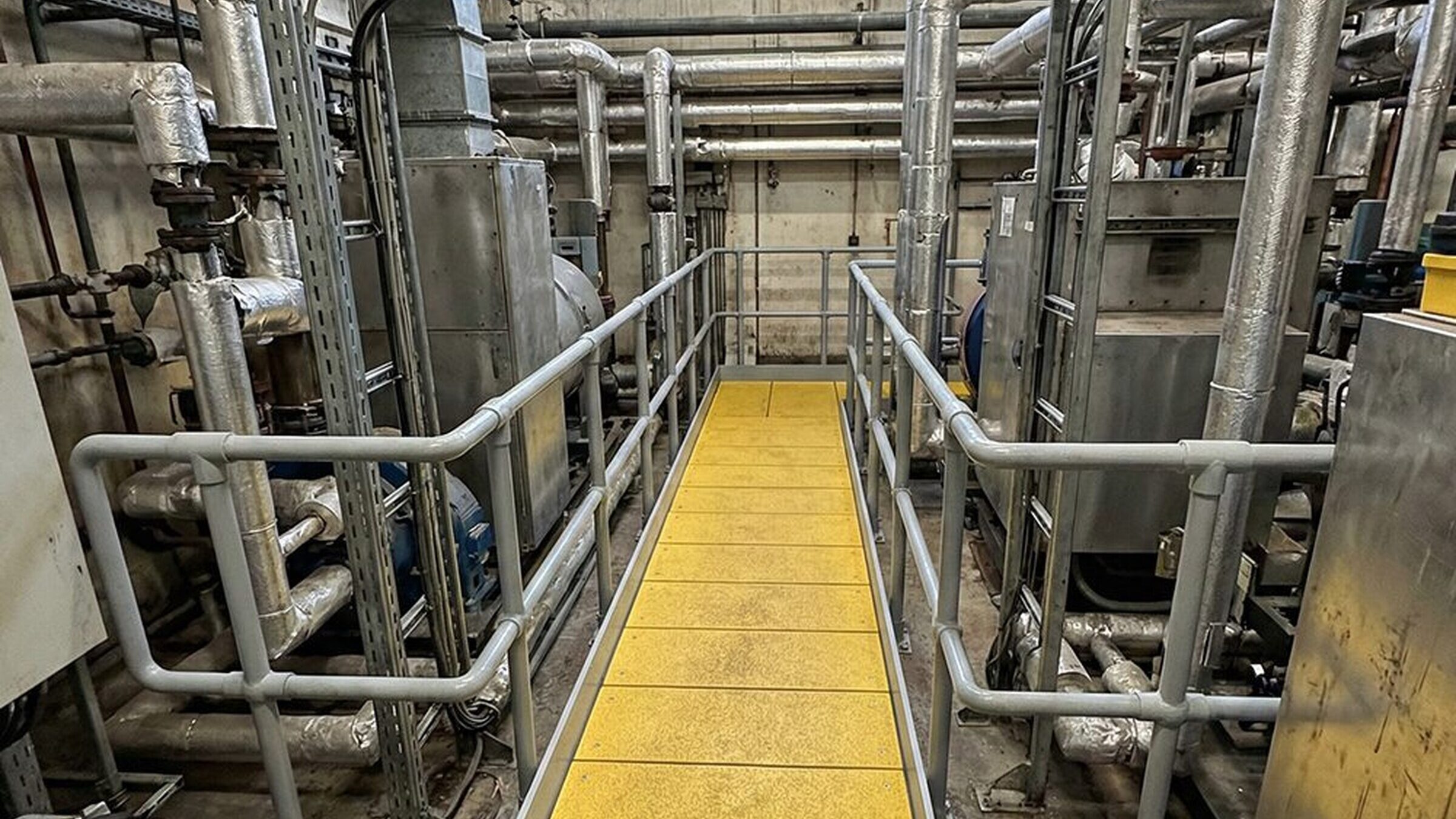
In industrial access, GRP appears as walkways and access decks, open-mesh and solid flooring, maintenance platforms, handrails and edge protection, stair treads and riser flooring, along with cable trays and enclosures.
It earns its place in a few environments in particular. In corrosive settings such as wastewater treatment and chemical processing, GRP avoids the recoating that steel would need on a schedule no maintenance team has time for. On rooftop plant decks, its low weight keeps the dead load down.
On coastal and marine-exposed sites, it resists salt corrosion. And around live electrical equipment, its non-conductivity removes a hazard a steel walkway would add. If the access has to survive any of those conditions, GRP is usually worth pricing against steel.
GRP vs steel: which should you choose?
The honest answer is that it depends on the environment, the loads the structure has to carry and the whole-life maintenance cost. GRP wins where corrosion, weight or electrical conductivity drive the decision.
Steel is usually the better answer everywhere else, because it is stiffer, carries higher structural loads and can be cut, welded and repaired on site. If your walkway sits over a chemical bund or on an exposed rooftop, GRP is usually the better call, because it removes the recoating cycle that steel would need in that setting. If it carries heavy plant loads in a dry indoor bay, steel usually wins, because its stiffness keeps deflection in check at longer spans.
A quick comparison of where each material sits:
| Factor | GRP | Steel |
|---|---|---|
| Weight | Much lighter for the same job | Heavier; often needs craneage |
| Corrosion | Resists rust and many chemicals | Rusts without coating; needs recoating |
| Electrical conductivity | Non-conductive | Conductive |
| Stiffness and heavy loads | More flexible; spans must allow for it | Stiffer; better for high loads |
| On-site repair | Cut and fixed, but not welded | Welded and adapted on site |
| Maintenance | Low; no recoating cycle | Periodic recoating in exposed settings |
A note on terminology: you will also see the term FRP, which stands for fibre-reinforced polymer. FRP is the broad family of resin-plus-fibre composites; GRP is the type that uses glass fibre specifically. Carbon and aramid fibres make other FRPs, but in industrial access the fibre is almost always glass.
Whichever material a project uses, the load capacity is set by the lead structural engineer, not by the material in the abstract. The engineer specifies the loadings, and the walkway, platform or grating is designed and fabricated to meet them.
What standards and fire requirements apply to GRP?
This section is general guidance, not professional advice. For any specific project, confirm the requirements with your structural engineer, Building Control or a qualified fire engineer.
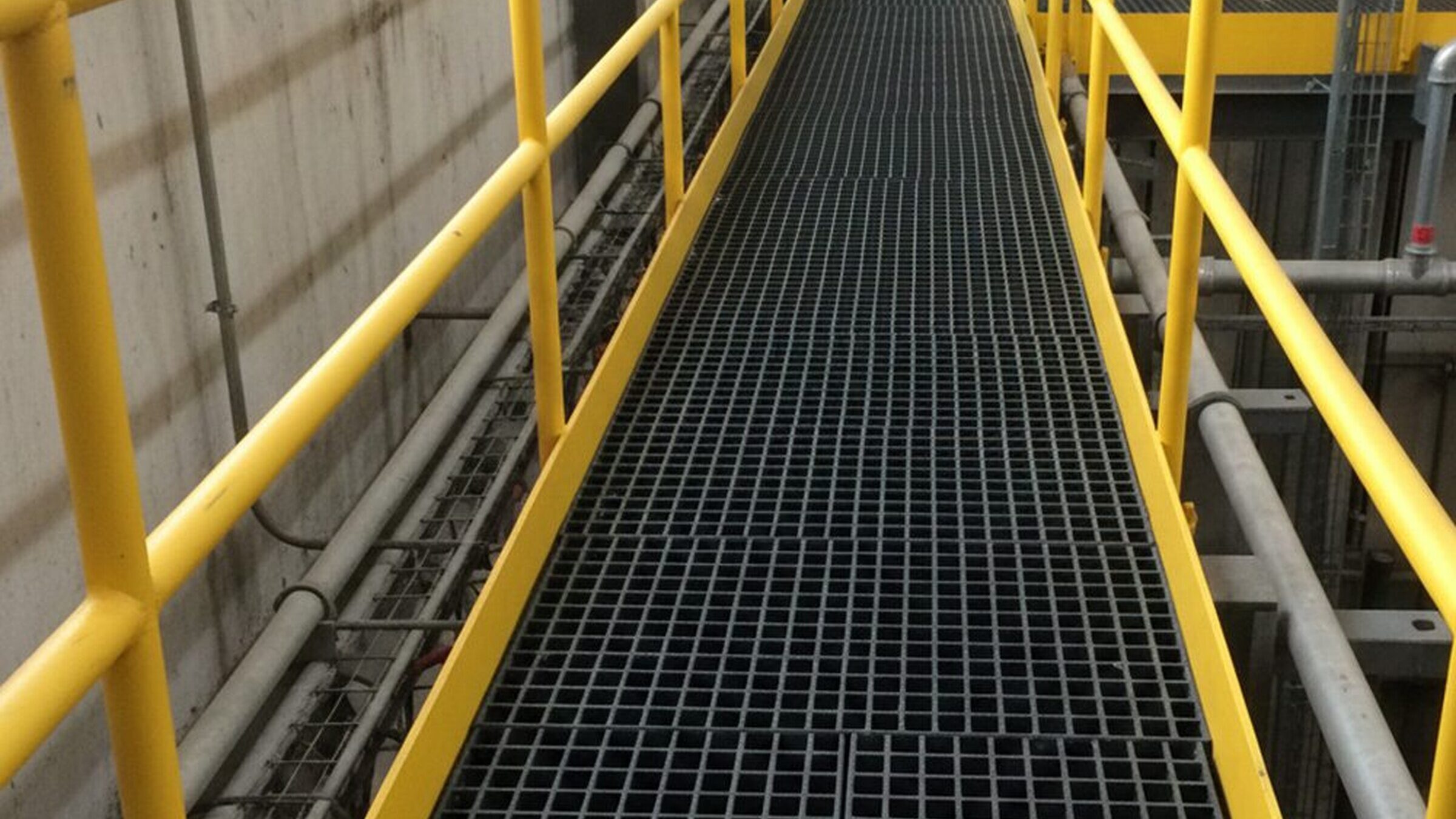
In the UK, GRP industrial flooring, walkways and stair treads are made to BS 4592-0:2006+A1:2012, the standard for industrial-type flooring and stair treads. It is the benchmark a GRP access deck is specified against.
Fire performance is the area where GRP is most often misunderstood. There is no single fire rating for GRP, because fire performance depends on the resin grade. Standard polyester-resin GRP and fire-retardant grades reach different classifications, and the rating is assessed under BS EN 13501-1, the European standard referenced by Approved Document B of the Building Regulations. Because the classification follows the grade specified for a project, fire performance should be confirmed grade by grade and issued as project documentation, never assumed from a blanket figure.
Slip resistance is measured by the pendulum test to BS EN 16165, and the test values for a finished walkway are part of the documentation a facilities team should receive at handover.
Bringing it together
GRP is a glass-fibre-and-resin composite that is light, rust-proof and non-conductive, which makes it a genuine alternative to steel for access in corrosive, weight-constrained or electrically sensitive settings. Outside those conditions, steel usually remains the better structural choice, and the right call is the material that fits the environment and the loads, confirmed by your engineer.
When GRP is the right answer, we supply, fabricate and install GRP walkways, access platforms, handrails, stairs and riser flooring, made to BS 4592, with slip-resistance pendulum values and any fire classification issued in the project operations and maintenance pack. We cut and assemble pultruded and moulded GRP sections with our own teams, and fit them alongside the structural steel where a project needs both. When steel is the better answer, we will tell you that too. Since 1994 we have designed, fabricated and installed steelwork and GRP access systems across the UK.
Related reading: GRP handrails and safety barrier systems, GRP access platforms, stairs and step-overs, GRP riser flooring and service-shaft safety systems, and steel access platforms where a scheme combines steel and GRP.
To scope a GRP or steel access package against your drawings, request a quote.

Written by
Jacob Hughes
Jacob Hughes is a Director at Universal Industrial Services, one of the UK's leading specialists in structural steelwork, architectural metalwork, and bespoke fabrication. With over a decade of leadership experience in the industry, Jacob oversees all aspects of project delivery - from strategic planning and compliance to client relations and operational excellence. Following the vision set by his father, company founder Neil Hughes, Jacob plays a critical role in maintaining the high standards, safety practices, and innovative approaches that Universal Industrial Services is known for. He is deeply committed to upholding the company's BS EN 1090 certification and CHAS Advanced accreditation, ensuring that every project meets the highest quality and regulatory benchmarks. While Jacob’s day-to-day role focuses on business development and project oversight, he works closely with Universal’s highly skilled engineering and fabrication teams to deliver complex projects across the UK. His leadership supports the company’s mission to invest in people, technology, and sustainable practices, helping clients achieve outstanding results in every project. Outside of work, Jacob is passionate about driving innovation within the steel and metalwork sectors and continues to champion professional development within the Universal Industrial Services workforce.