If you are specifying access for a plant that runs wet, corrosive or live, you have probably watched steelwork lose the argument. A walkway over an effluent channel that needs grinding back and recoating every couple of years. A rooftop plant deck where every extra kilo of dead load eats into what the roof structure can carry.
A gantry near live switchgear where a conductive surface is a hazard waiting to happen. In each of those cases there is a material that was developed for exactly that problem, and the reason it fits changes from one sector to the next.
GRP, or glass-reinforced plastic, is a composite of glass fibres set in a cured resin, pulled into structural profiles or moulded into open-mesh gratings. We supply, specify, fabricate and install GRP access systems to BS 4592 across industrial and commercial sites, alongside our structural steelwork, so the call between the two gets made on what actually survives in service rather than on what is easiest to quote.
This guide maps where GRP earns its place sector by sector, and the genuine engineering reason it wins in each one. It is written for facilities and maintenance managers, process and project engineers, contractors and specifiers weighing the material choice on a real project.
What makes GRP the right choice for some industrial settings?
GRP earns its place when one of four properties decides the job.
- The first and most common is corrosion resistance: it does not rust, and it resists most acids, alkalis, salt and chlorinated water that would eat through carbon steel or run up the bill on a stainless grade.
- The second is weight. A GRP section is far lighter than the steel equivalent, with industry figures putting it at around 80% lighter, which matters wherever dead load or manual handling is the constraint.
- The third property is electrical non-conductivity. GRP is an insulator, so it is specified for access near live equipment where a steel walkway would be a risk.
- The fourth is slip resistance: the gritted anti-slip surface is bonded into the grating at manufacture, so it holds its rating in wet, oily or icy conditions instead of polishing smooth underfoot.
Behind all four sits the low-maintenance case. There is no repainting cycle and no cathodic protection to manage, so the whole-life cost stays flat once the access is installed.
Where does GRP fit in water and wastewater treatment?
Water and wastewater is the sector where corrosion decides it outright. Tanks, channels, filter beds and dosing areas keep steelwork permanently wet and chemically loaded, and a painted carbon-steel walkway in that setting is on a recoating programme from the day it goes in.
GRP gratings, walkways and access platforms over those structures simply take the exposure and carry on, which removes a recurring maintenance line that nobody on a treatment site has time for.
The anti-slip surface matters here as much as the corrosion resistance, because the access sits directly over open water and effluent. Light panels also help on remote or awkward plants, where a two-person crew can carry and fit grating by hand without bringing lifting gear to a tank deck.
Where is GRP used in chemical and process plants?
Chemical and process plants ask two things of an access material at once, and GRP answers both. It resists the acids, alkalis and aggressive process media that attack steel, and because it does not conduct, it gives you safe walkways, stair treads and platforms around electrical equipment and instrumentation. That combination is hard to get from a single metal specification.
The honest framing is that GRP is the right answer in the corrosive, instrument-dense parts of a plant, not a blanket replacement for structural steel across the whole site. Where a run of access threads past live panels or sits in a bunded chemical area, GRP removes both the recoating cycle and the conductivity risk in one move.
Why is GRP chosen for oil, gas and offshore energy?
Offshore and coastal energy sites are the harshest corrosion case there is. Salt-laden air attacks steel from every direction, and access that sits in that atmosphere needs either a heavy protective regime or a material that ignores the problem. GRP riser flooring, handrails and platforms hold up in salt exposure without the coating maintenance that carbon steel demands in the same conditions.
Weight is the second reason here. On structures where every tonne of dead load has a cost and craneage is limited, the weight saving over steel eases both the structural design and the install. The loadings themselves are always set by the project engineer, and the access is designed to meet them rather than the material dictating capacity.
How is GRP used on rooftop plant decks and in building services?
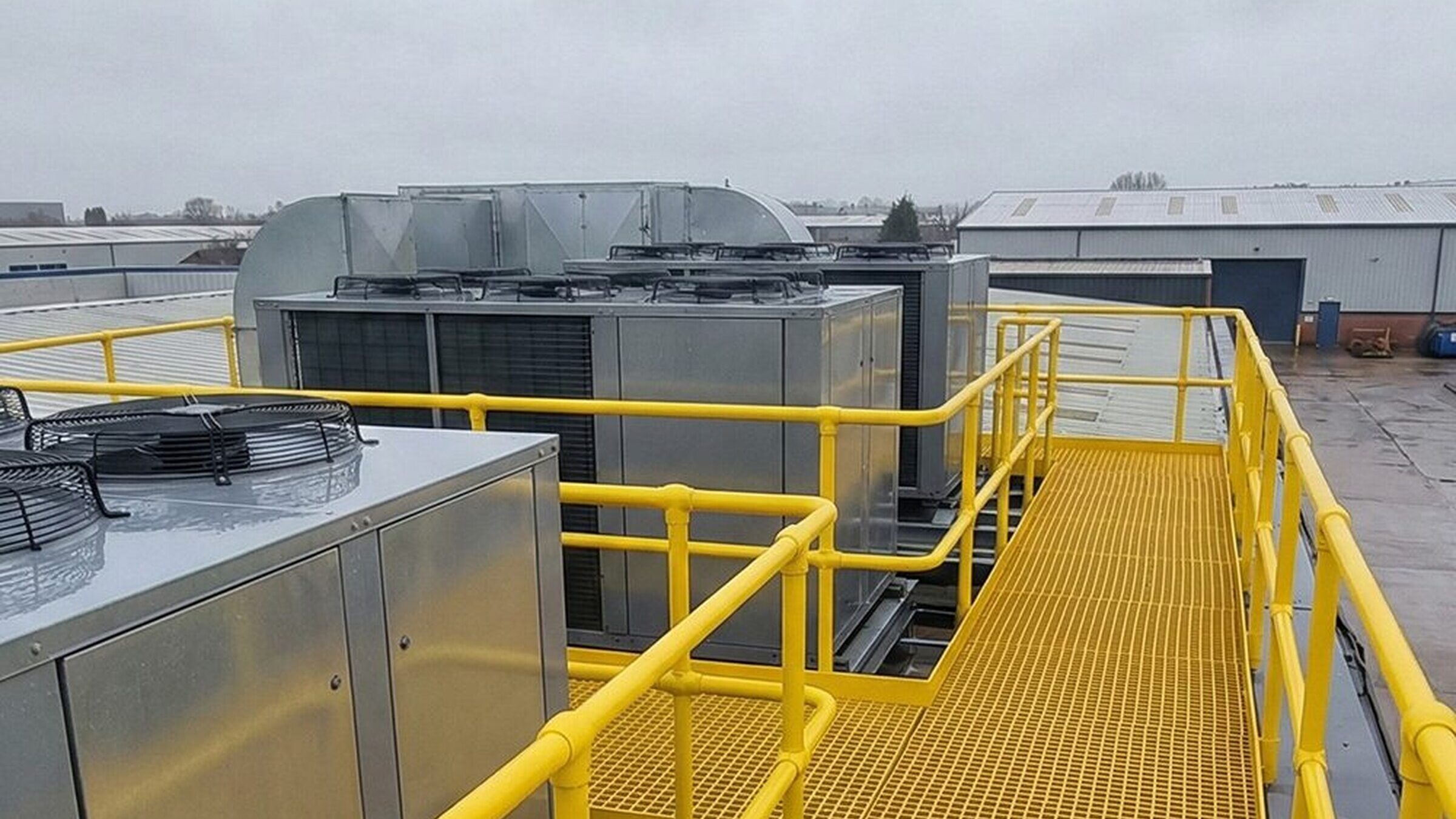
On a rooftop plant deck the deciding property is weight. The existing roof structure has a finite load allowance, and a steel walkway and support frame can use up more of it than the plant the deck is there to carry. GRP walkways and platforms keep the dead load down, which is often what makes a retrofit deck viable on a building that was never designed for one.
Inside building services, GRP also suits riser flooring and service-shaft access covers, where damp, enclosed shafts would corrode steel over time and a lighter panel is easier to handle in a confined space. One of our own examples sits here: at One Centenary Way we delivered GRP flooring to the risers as part of a wider steelwork and metalwork package, alongside stair-core balustrades and access protection on the same project.
Where does GRP fit in rail, transport and infrastructure?
Rail and transport infrastructure leans on non-conductivity above all else. Trackside walkways, platform access, stair treads and dagger boards often sit close to live conductors, and a non-conductive walking surface takes one hazard out of the environment. The same logic carries into electrical substations and utility sites, where non-conductive walkways and cable-tray access keep crews clear of a conductive path near live equipment. The corrosion resistance is a second benefit, because much of this access is outdoors and exposed year-round.
GRP also handles the wear of constant foot traffic without the surface polishing smooth, so the slip rating that was specified on day one is the slip rating the access still has years later.
How is GRP used in food and beverage processing?
Food and beverage production runs on aggressive wash-down regimes, and that is what makes GRP fit. Caustic cleaning chemicals and constant hot-water washing degrade steel and rot timber, while GRP flooring and access take the daily cleaning cycle in their stride. The bonded anti-slip surface holds up in wet, greasy production and packing areas where slips are a genuine risk.
The result is hygienic access that survives the cleaning routine rather than being worn down by it, which keeps both the maintenance and the safety case stable in a high-turnover environment.
What role does GRP play in general industrial maintenance access?
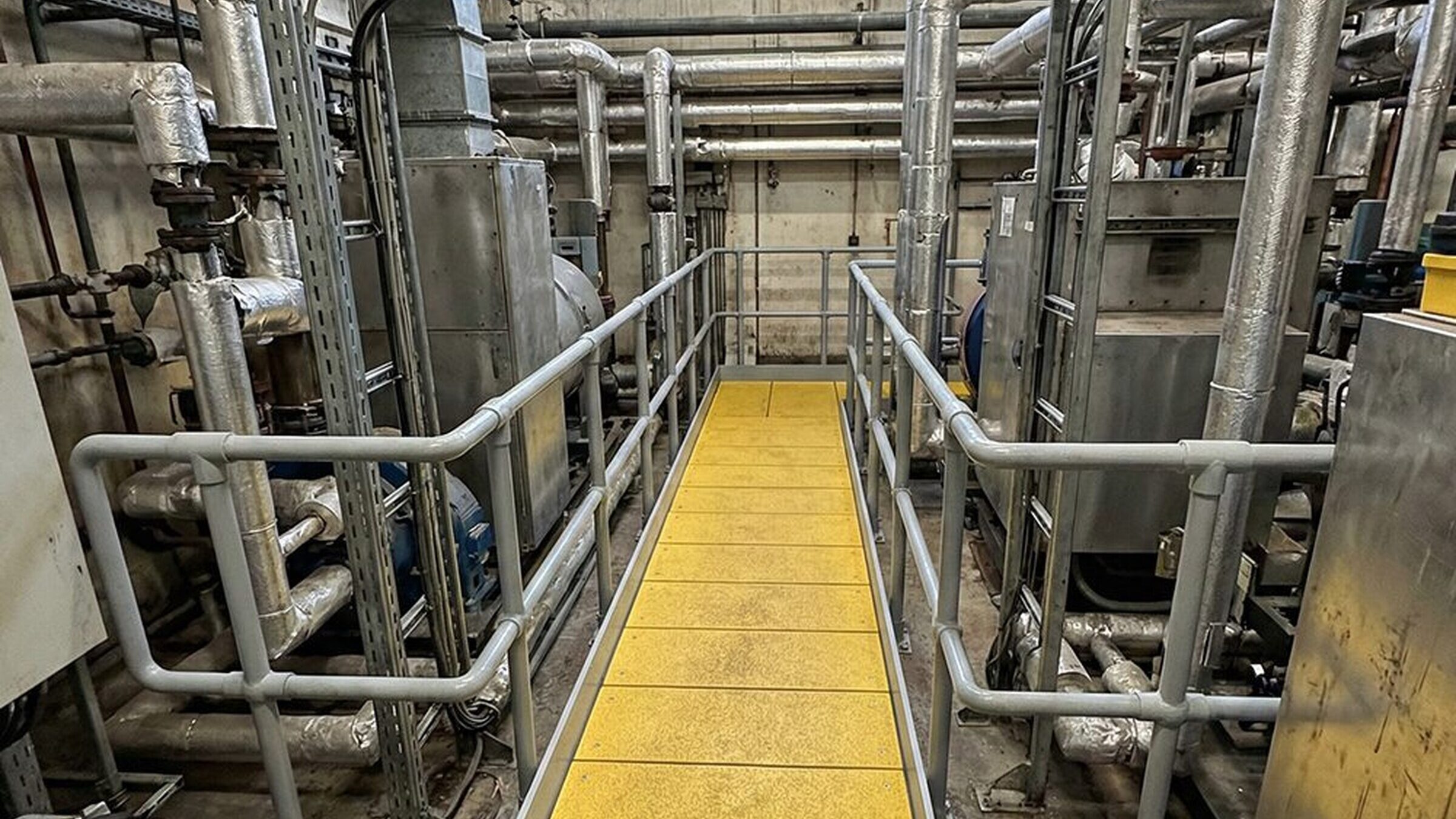
Across general industry, GRP is the practical answer wherever lightweight, low-maintenance access has to go into a working site. Up-and-over access platforms that bridge pipework, stair access to a mezzanine, handrails and safety barriers around plant: all of these suit a material that two people can carry and fit without heavy lifting, often on a site that stays live while the work goes on.
The low-maintenance case is the quiet advantage here. Once the access is in, it does not feed back into the maintenance schedule the way coated steel access can, so the asset stays available and the cost stays predictable.
When is steel still the better answer than GRP?
GRP is not a better material than steel in the abstract, and treating it as one does the reader a disservice. Outside the corrosive, live-electrical and weight-constrained settings above, steel is usually the right call. It is stiffer, it spans further between supports, it tolerates higher temperatures and it carries a lower up-front material cost.
The useful way to read the choice is by environment. Where corrosion, conductivity or dead load would otherwise dominate the whole-life cost, GRP earns its place and pays back the higher material price.
Everywhere else, steel does the job better, and we will tell you so rather than push GRP onto a project that does not need it. Matching the material to the conditions is what keeps the whole-life cost down, which is the number that matters most on a long-lived asset.
What standards and documentation apply to GRP access systems?
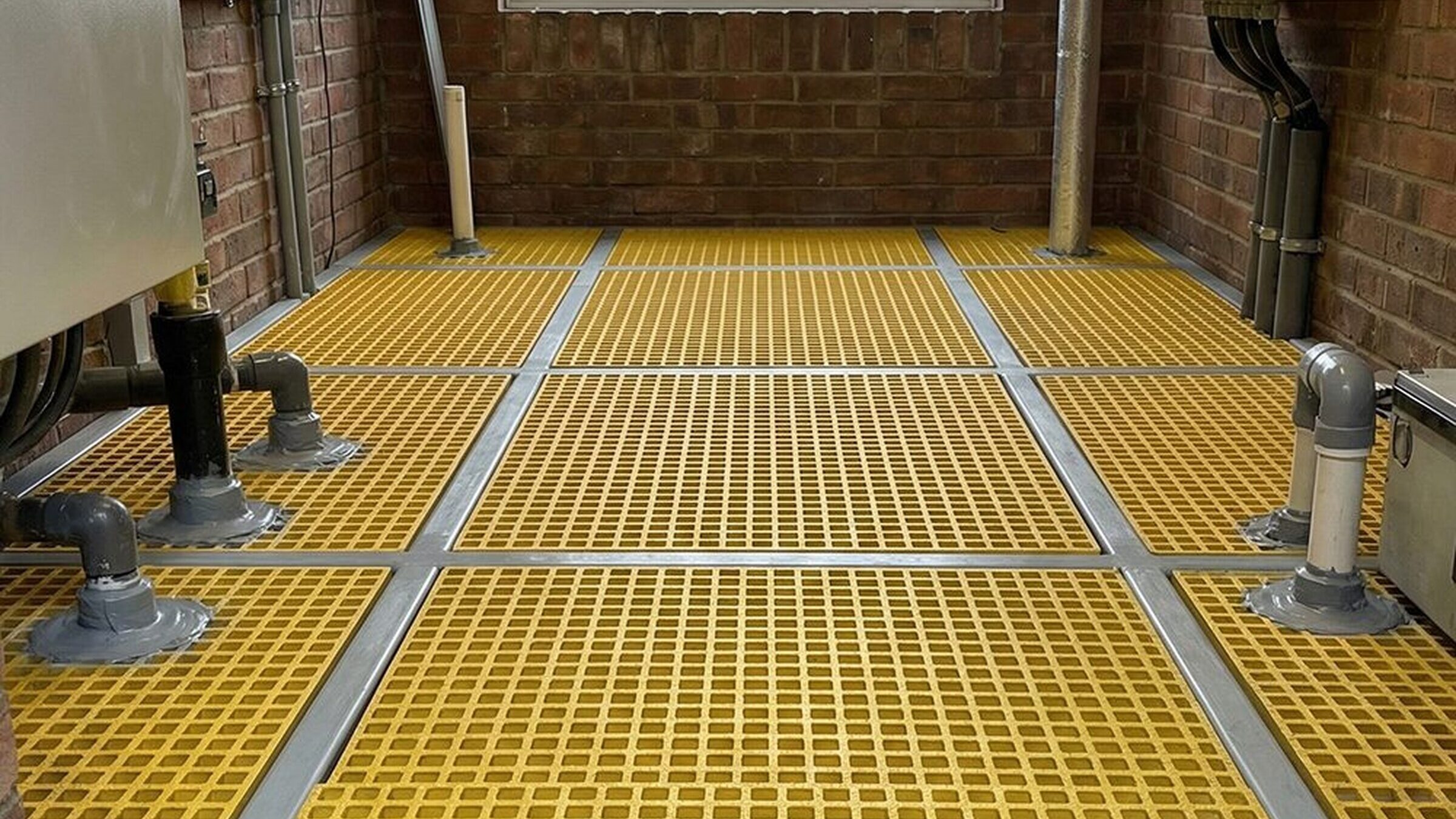
GRP industrial flooring, gratings and stair treads are specified to BS 4592-0:2006+A1:2012, the UK standard that covers industrial-type flooring and treads. Slip resistance is evidenced by pendulum test values to BS EN 16165, and those values are issued with the project documentation rather than quoted as a single headline number, so the specification is auditable from handover.
Fire performance is the area to be careful with, because there is no single fire class for GRP. The classification depends on the resin grade: standard grades and fire-retardant grades reach different ratings under BS EN 13501-1, and the applicable class is matched to the grade specified for your project and documented in the O&M pack. Loadings work the same way, in that they are set by your structural engineer and the access is designed to meet them.
Treat all of the above as general guidance rather than professional or legal advice. The figures, classifications and loadings for any given project are project-specific, and they should be confirmed with a qualified structural or fire engineer and the relevant authority before anything is fabricated. Where GRP is the right call, we design, fabricate and install the access to BS 4592, with the slip values and fire classification issued in the project O&M pack, and where steel access platforms are the better answer we build those instead.

Written by
Jacob Hughes
Jacob Hughes is a Director at Universal Industrial Services, one of the UK's leading specialists in structural steelwork, architectural metalwork, and bespoke fabrication. With over a decade of leadership experience in the industry, Jacob oversees all aspects of project delivery - from strategic planning and compliance to client relations and operational excellence. Following the vision set by his father, company founder Neil Hughes, Jacob plays a critical role in maintaining the high standards, safety practices, and innovative approaches that Universal Industrial Services is known for. He is deeply committed to upholding the company's BS EN 1090 certification and CHAS Advanced accreditation, ensuring that every project meets the highest quality and regulatory benchmarks. While Jacob’s day-to-day role focuses on business development and project oversight, he works closely with Universal’s highly skilled engineering and fabrication teams to deliver complex projects across the UK. His leadership supports the company’s mission to invest in people, technology, and sustainable practices, helping clients achieve outstanding results in every project. Outside of work, Jacob is passionate about driving innovation within the steel and metalwork sectors and continues to champion professional development within the Universal Industrial Services workforce.