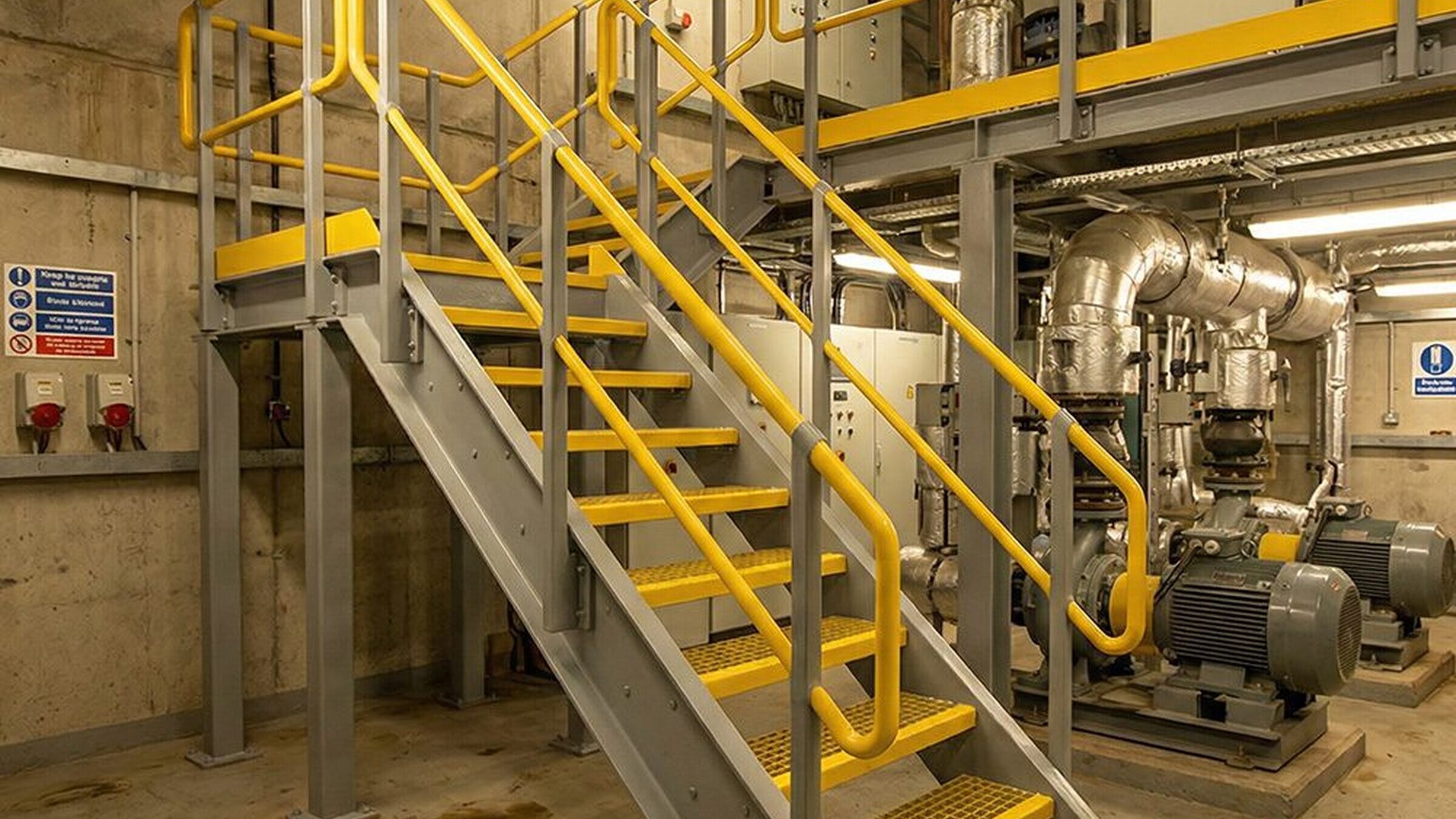
If you are specifying GRP for a walkway, a riser or a plant-room platform, the first question is usually a blunt one: will it burn? The answer is that standard GRP is combustible, and how it behaves in a fire depends almost entirely on the resin grade you specify.
This guide explains how GRP fire performance is classified, why the grade decides the outcome, where a fire-rated grade is needed, and how to ask for the right one. It is general guidance to help you scope a specification, not fire-safety or legal advice, so confirm the requirement for your project with your fire engineer and Building Control.
We fabricate and install GRP access systems across industrial and commercial sites, and the fire classification for each job is issued with the project handover documentation, matched to the grade specified.
Is GRP fireproof, or will it burn?
No. Standard GRP is not fireproof, and it is fair to call it combustible. GRP, or glass-reinforced plastic, is made from glass fibres set in a thermosetting resin matrix. The glass reinforcement does not burn, but the resin holding it together is an organic material, and in a hot enough fire it will ignite and add fuel.
That distinction sits underneath everything else: fire performance is a property of the grade you choose, not a fixed property of GRP as a single material. A standard catalogue grating and a fire-retardant grating can look identical and behave very differently in a fire.
Because fire requirements are project-specific and carry real safety and legal weight, treat everything below as general background for scoping a specification. The class your project actually needs is set by your fire engineer and Building Control.
How is the fire performance of GRP classified?
GRP is assessed on its reaction to fire, which describes how readily a material ignites and how fast flame spreads across its surface. Two classification systems show up in UK specifications, and it is worth knowing both because a spec may cite either.
The current system is BS EN 13501-1, which sorts materials into the European reaction-to-fire classes, or Euroclasses. The older British system is BS 476 Part 7, which rates surface spread of flame.
One distinction trips people up: reaction to fire is not the same as fire resistance. Reaction to fire is about ignition and flame spread on the material itself, which is what governs GRP access products. Fire resistance is about how long a building element holds back a fire, measured in minutes, and it applies to walls, floors and doors rather than to a walkway grating.
| Classification | What it measures | Best to worst |
|---|---|---|
| BS EN 13501-1 | Reaction to fire (Euroclass) | A1 is the highest class, F the lowest |
| BS 476 Part 7 | Surface spread of flame | Class 1 is the lowest spread, Class 4 the highest |
A class is only meaningful when it is tied to a tested grade. Rather than quote a number from memory, ask the supplier for the test certificate that states the resin system and the class it achieved, and check the fire requirement for your building against Approved Document B of the Building Regulations and the standards themselves, BS EN 13501-1 and BS 476, published by BSI.
Why does the resin grade decide how GRP behaves in a fire?
The resin grade decides the outcome because the resin is the part of the composite that burns. Move along the range of resins and you move along the fire-performance scale.
- Standard polyester resin, usually an orthophthalic grade, sits at the combustible end and reaches the lower classes.
- Fire-retardant grades sit higher up. These use additives, such as aluminium trihydrate or brominated compounds, blended into a polyester or vinyl ester resin. The additives slow ignition, hold back flame spread, and help the material self-extinguish once the ignition source is removed.
- Phenolic resin is the strongest inherent performer of the common options and is chosen where the highest reaction-to-fire performance is needed.
The practical consequence is simple. A standard catalogue product should never be assumed to carry a fire-retardant grade. If your location needs one, it has to be written into the specification, because the better fire classes are reached only by the fire-retardant and phenolic grades, and only when the specific grade has been tested and certified.
What about smoke and toxic fumes, not just flame spread?
Flame spread is only half the question, because burning resin also generates smoke and toxic combustion gases. In an enclosed plant room, a riser or an escape route, the smoke a material produces can matter as much as how fast flame travels across it.
The Euroclass system recognises this. Alongside the main reaction-to-fire class, BS EN 13501-1 adds sub-classifications for smoke development and for flaming droplets, so a full classification describes more than a single letter.
Where low smoke and low toxicity are the governing concern, phenolic resin systems are often the grade of choice, because they tend to produce less smoke than standard polyester. As with flame spread, the smoke and toxicity data belongs on the test certificate for the grade you specify, not in a general claim about GRP.
Where does fire-rated GRP matter, and where is standard grade acceptable?
The location drives the requirement. Escape routes, protected stairways, risers and service shafts, and some plant areas typically call for a fire-rated grade, while many open external walkways and lower-risk industrial access positions accept a standard grade.
The building and its use set the bar, which is why the same GRP product can be specified to different grades on different projects. If the access sits on an escape route or inside a riser, treat a fire-rated grade as the starting assumption, because those enclosed routes carry people out during a fire and any extra flame spread there is a direct safety risk.
Risers and service shafts are a good example. They are enclosed vertical routes that often run alongside escape provision, so the reaction-to-fire performance of any flooring or access inside them is scrutinised closely. GRP riser flooring and service-shaft access in those positions is exactly where a fire-rated grade is needed, and where the supporting documentation has to be in order.
On higher-risk buildings, the Building Safety Act 2022 raises the level of scrutiny on materials and on the records that prove their performance. That raises the assessment bar rather than signalling a problem. It does mean the grade decision and its supporting paperwork carry more weight, so settle both early with your fire engineer rather than at handover.
How do you specify the right fire grade of GRP?
Tell your supplier the location and its fire requirement, ask for the grade that meets it, and ask for the test certificate that proves it. That short conversation prevents most fire-grade errors, because it forces the requirement to be stated before anything is fabricated rather than discovered afterwards.
Before fabrication starts, confirm four things:
- The application and location, including whether it sits on an escape route, in a riser or service shaft, or in a plant area.
- The required reaction-to-fire class, set by your fire engineer for that location.
- The resin system, whether standard, a fire-retardant grade or phenolic, that meets the class.
- The supporting fire classification documentation, issued with the project handover.
A fire-retardant grade usually costs more than a standard grade, which is worth budgeting for, though the full cost picture belongs in a dedicated cost guide rather than here. What matters at specification stage is matching the grade to the requirement and getting the certification that backs it. On our projects the fire classification for the grade supplied is issued with the handover documentation, so the specification is auditable from day one.
How does GRP compare with steel on fire performance?
Neither material is a blanket winner on fire, and the right call depends on the location and the fire requirement. Steel is non-combustible, so it adds no fuel to a fire, but it loses strength as it heats, and an unprotected loaded steel element can soften and fail in a sustained fire. Standard GRP is combustible, but a fire-retardant grade resists ignition and slows flame spread, while still degrading under prolonged heat as the resin approaches its decomposition temperature.
A loaded GRP walkway is not a substitute for a fire-rated structural steel element. Where the structure itself must hold under fire, that is a job for fire-protected steel, designed by the project engineer. Where the requirement is access flooring or a maintenance platform with a controlled reaction to fire, a correctly specified GRP grade can be the better answer, particularly when corrosion resistance and weight also matter.
We supply and install both materials, so the recommendation can follow the requirement rather than the inventory. When steel is the right answer, we say so. When a fire-rated GRP grade fits the location better, we say that too.
Specifying GRP for a fire-sensitive location
The short version is that GRP is not fireproof, its fire performance is set by the resin grade, and the class your project needs comes from your fire engineer and the test certificate for the grade, not from a single figure that applies to all GRP. Get the location, the required class and the certification settled before fabrication, and the rest follows.
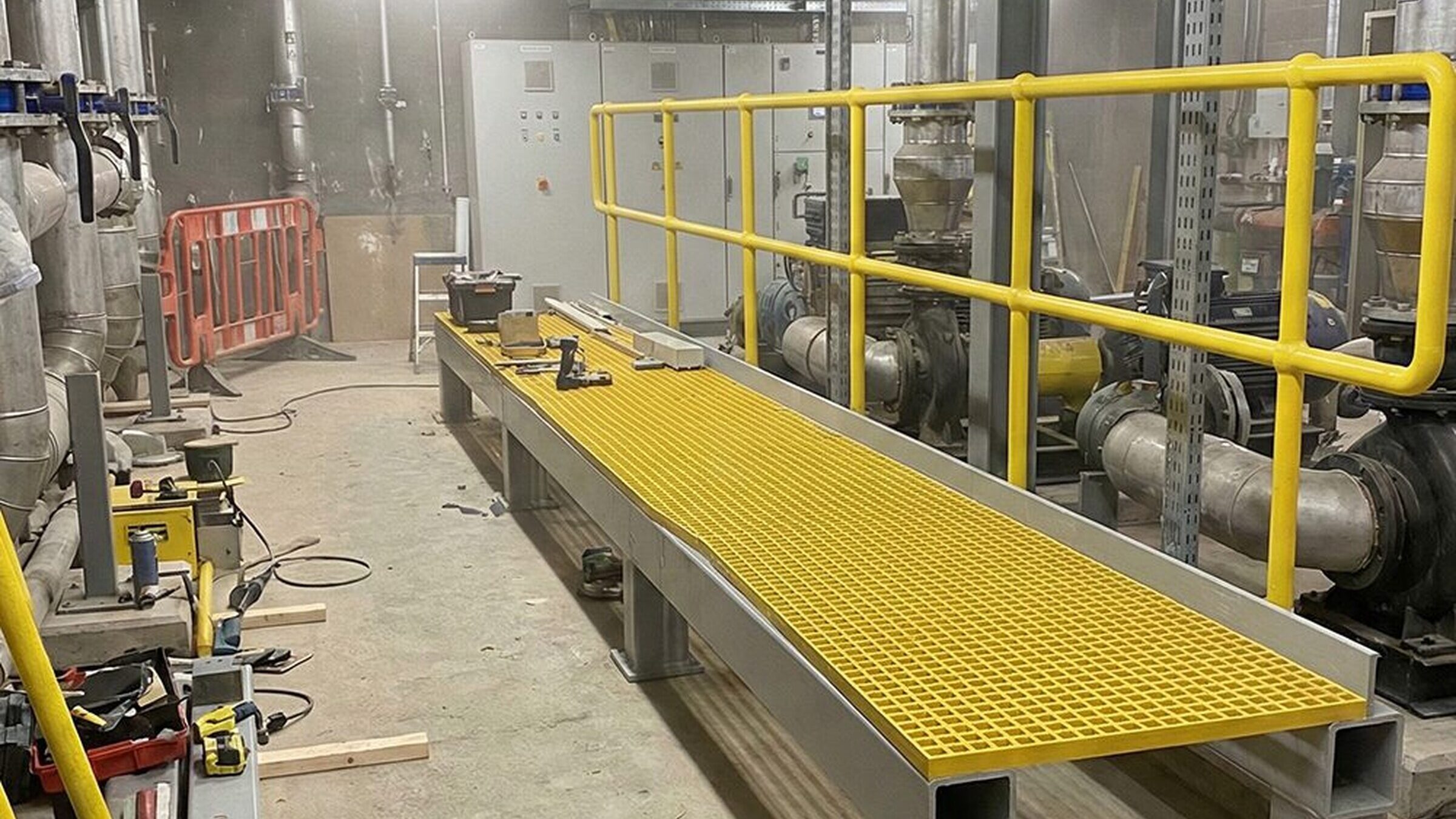
We design, fabricate and install GRP walkways, access platforms, handrails, and riser and service-shaft flooring across the UK, alongside steel access platforms where steel is the better fit. The fire classification, slip-resistance values and supporting documentation for the grade supplied are issued with the project handover, so the specification stands up to audit.
For guidance on the grade that suits your location, or a quote against your drawings, contact us. Universal Industrial Services has designed, fabricated and installed steelwork and GRP access systems across the UK since 1994.

Written by
Jacob Hughes
Jacob Hughes is a Director at Universal Industrial Services, one of the UK's leading specialists in structural steelwork, architectural metalwork, and bespoke fabrication. With over a decade of leadership experience in the industry, Jacob oversees all aspects of project delivery - from strategic planning and compliance to client relations and operational excellence. Following the vision set by his father, company founder Neil Hughes, Jacob plays a critical role in maintaining the high standards, safety practices, and innovative approaches that Universal Industrial Services is known for. He is deeply committed to upholding the company's BS EN 1090 certification and CHAS Advanced accreditation, ensuring that every project meets the highest quality and regulatory benchmarks. While Jacob’s day-to-day role focuses on business development and project oversight, he works closely with Universal’s highly skilled engineering and fabrication teams to deliver complex projects across the UK. His leadership supports the company’s mission to invest in people, technology, and sustainable practices, helping clients achieve outstanding results in every project. Outside of work, Jacob is passionate about driving innovation within the steel and metalwork sectors and continues to champion professional development within the Universal Industrial Services workforce.