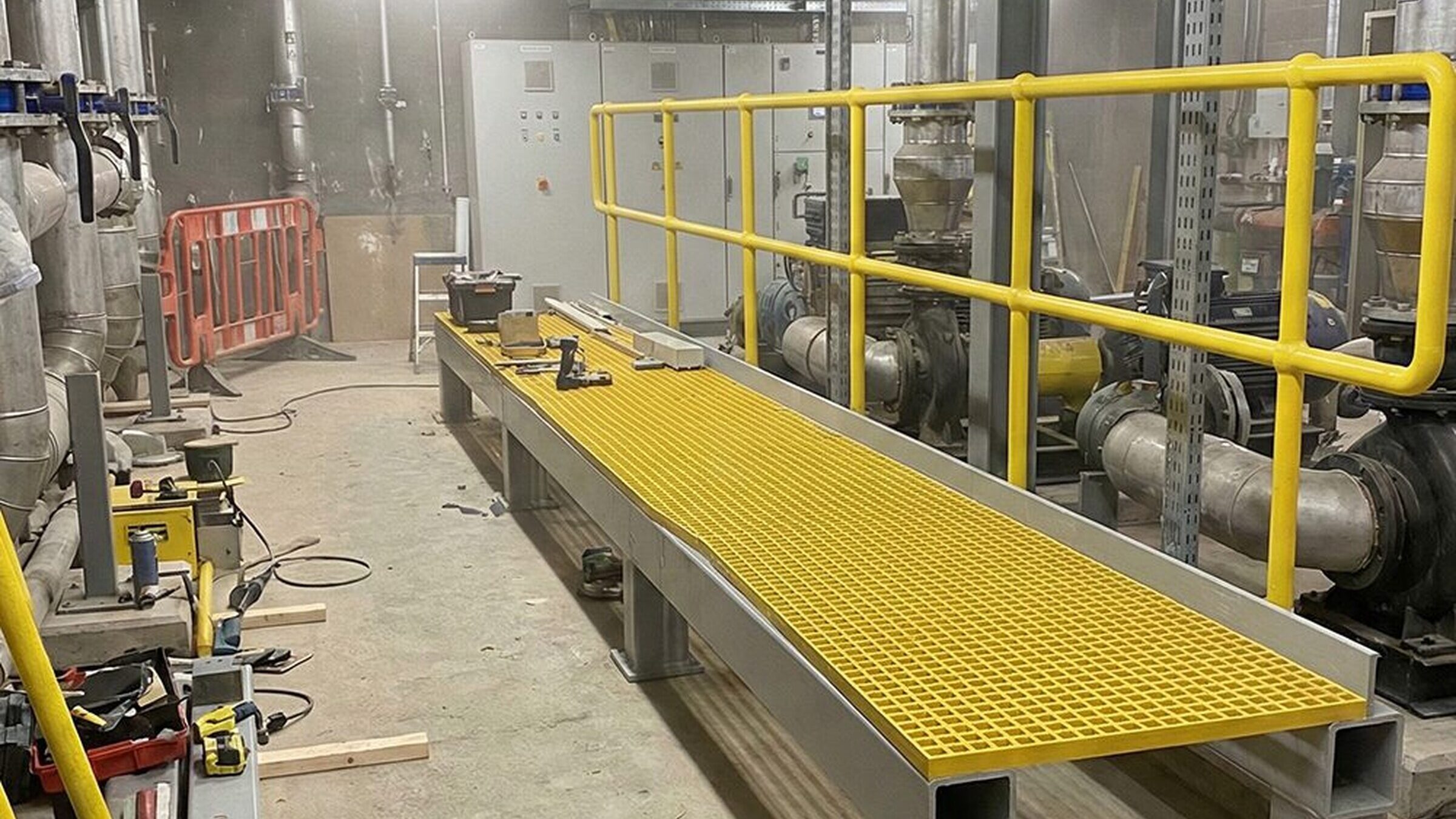
Glass-reinforced plastic, or GRP, is a composite of glass-fibre reinforcement set in a thermosetting resin. That make-up is the whole story behind its properties: change the resin, or the way the glass is laid up, and you change how the material behaves.
GRP's mechanical, physical, durability and safety properties all matter when you are specifying it for industrial access, and the grade you choose moves each one. It is general guidance to help you scope a specification, not a substitute for the manufacturer datasheet or your project engineer's figures.
We have specified, supplied, fabricated and installed GRP walkways, gratings, handrails and riser flooring to BS 4592 across the UK since 1994, in GRP or steel as the application demands.
The short version: GRP is light, it does not rust, it does not conduct electricity, and a gritted GRP surface stays slip-resistant when wet. The catch is lower stiffness than steel, so it deflects more and needs supports at closer centres. Its corrosion, temperature and fire behaviour all depend on the resin grade, which is why the datasheet for the specified grade, not a generic table, governs the numbers your engineer signs off.
What is GRP, and why does its make-up decide its properties?
GRP is a composite: glass fibres carry the load and strength, while a cured thermosetting resin binds those fibres together, transfers load between them and forms the weather-facing surface. The plain-English synonym is fibreglass, and you will also see it written as glass-reinforced polymer.
The reason GRP is better thought of as a family of materials than a single one is the resin. The common choices are:
- Polyester (the general-purpose default, in orthophthalic or the slightly tougher isophthalic forms)
- Vinyl ester (better chemical and temperature resistance)
- Phenolic (better fire and smoke behaviour)
The glass content and lay-up matter too. Two products that both count as GRP can sit a long way apart on corrosion, temperature and fire performance because they use different resins. Across all of these properties, the resin grade is the lever.
What are the mechanical properties of GRP?
GRP has a high strength-to-weight ratio and useful tensile and flexural strength, but it is less stiff than steel, and that lower stiffness drives most of the design decisions. Because GRP has a lower modulus, a given section deflects more than the steel equivalent under the same load, so a GRP walkway or platform is usually supported at closer centres, or built from a deeper section, to keep deflection within limits.
It also fatigues well and resists repeated loading without the work-hardening steel can suffer, though it has lower impact resistance, so a dropped tool dents or stars GRP where it might bounce off steel.
None of these are fixed numbers you should carry between projects. Strength and stiffness figures come from the manufacturer's datasheet for the specific profile and grade, and the allowable loadings for your project come from your structural engineer.
What are the physical and electrical properties of GRP?
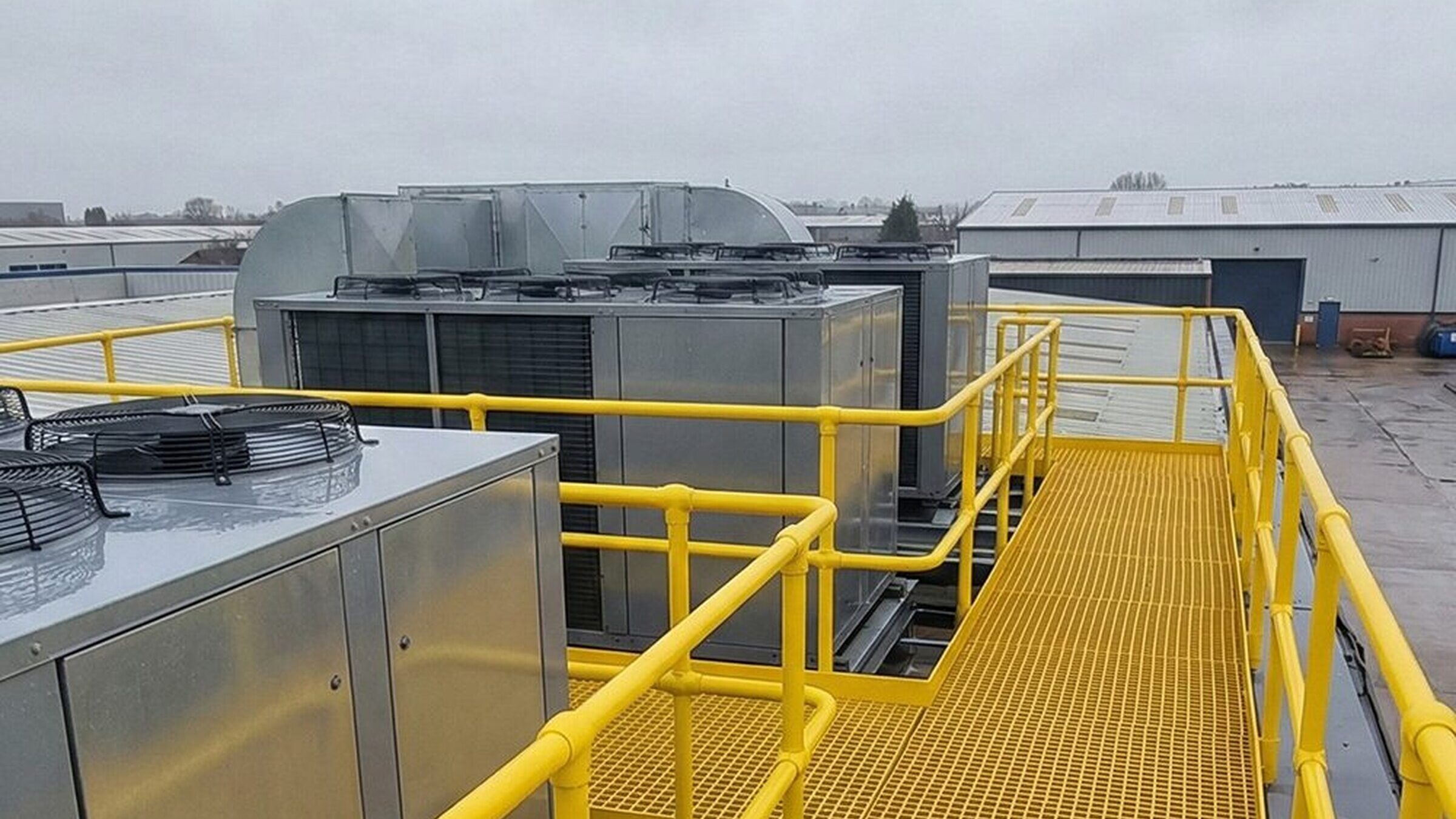
The headline physical property is weight: GRP is around 80% lighter than the steel equivalent, a figure widely cited across GRP manufacturer literature and best treated as directional rather than precise. That weight saving is why a GRP grating panel can be carried and fixed by hand where steel would need lifting equipment, and why GRP suits rooftop plant decks and live retrofits where dead load or craneage is tight. Those are exactly the conditions our GRP walkways, access decks and maintenance platforms are built for.
GRP is also non-conductive, non-magnetic and non-sparking. The non-conductivity is the reason it is specified for access near high-voltage equipment, rail electrification and substations, where an earthed metal walkway would be a hazard. GRP does not spark under impact, but one caution applies in flammable-atmosphere (ATEX) zones: standard GRP is an insulator, so friction and foot traffic can build static charge on the surface, and a static discharge is itself an ignition source. Those zones call for anti-static or conductive GRP grades, earthed so the charge drains, specified against the site's hazardous-area assessment.
It has low thermal conductivity, so it does not get burning hot or freezing cold underfoot. GRP also expands and contracts more than steel for the same temperature swing, so expansion gaps and fixings have to allow for it. Standard polyester grades have a lower service-temperature ceiling than vinyl ester or phenolic, so for hot or steam-adjacent areas the grade matters as much as it does for chemical exposure. Take the exact temperature limit from the resin datasheet rather than a generic figure.
How corrosion-resistant and durable is GRP?
GRP does not rust, and it resists a wide range of acids, alkalis, salts and solvents, which is the property that decides most material choices in its favour. In a wastewater works, a chemical-process area or a coastal installation, steel needs a recoating cycle no maintenance team has time for, and GRP simply does not. That is a genuine whole-life benefit: no recoating, no corrosion-driven replacement, and a service life that runs into decades.
How much chemical resistance you get depends on the resin. Standard polyester handles general industrial exposure; vinyl ester and phenolic grades stand up to more aggressive chemistry. UV resistance comes from a surface veil and a UV-stabilised resin, which protect the fibres from sunlight over the years, and water absorption stays low as long as cut edges are sealed so moisture cannot wick into exposed glass. GRP is the right call where corrosion is the problem to solve, which is the test we apply rather than reaching for it on every job.
What are the safety-relevant properties of GRP: slip resistance and fire?
Two properties carry the safety case for GRP access: slip resistance and fire behaviour, and both are widely misunderstood.
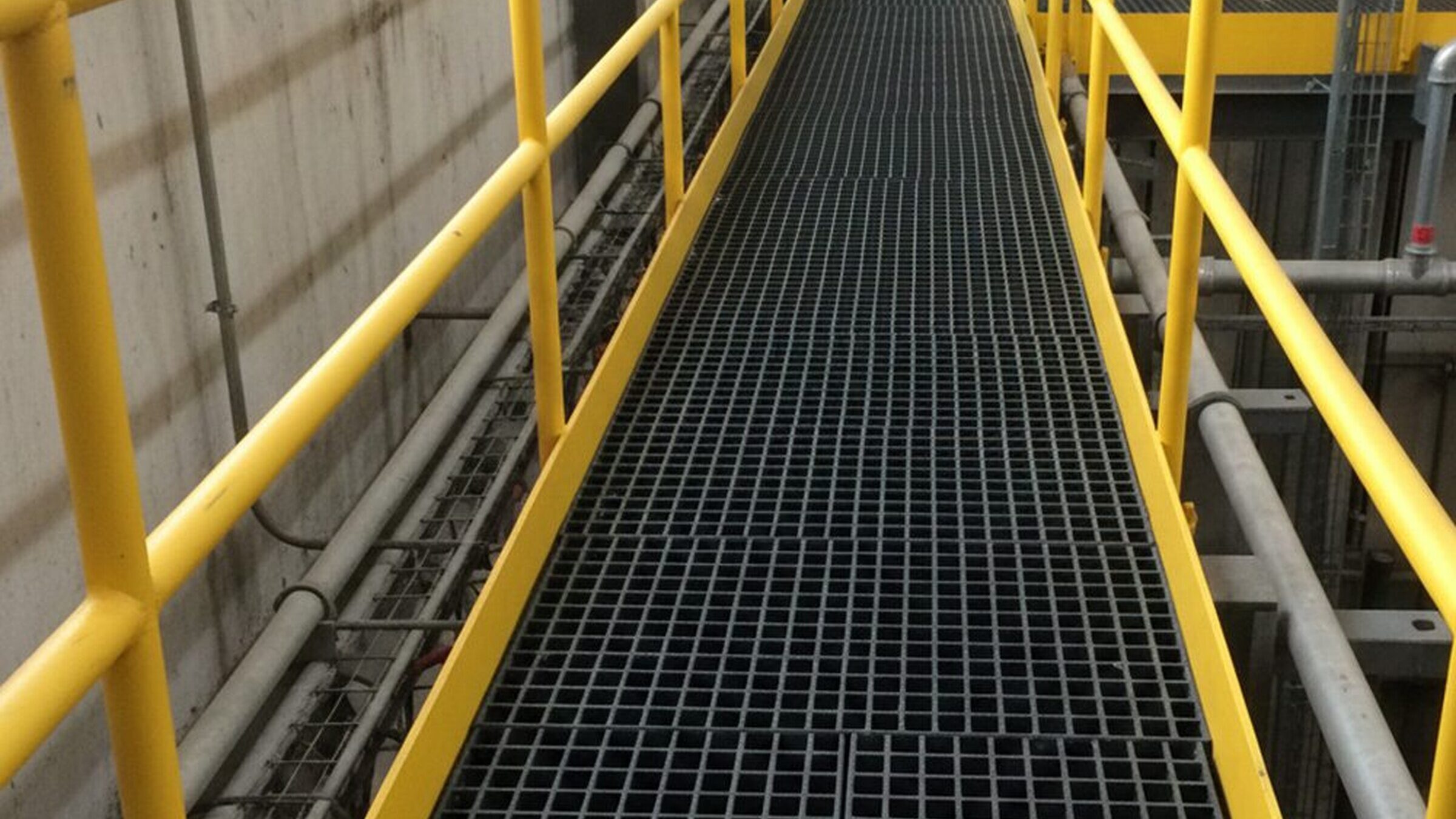
Slip resistance is built into the surface, not added afterwards. A GRP grating top is finished with a gritted surface, usually silica or carborundum bonded into the resin during cure, and that grit grips when the surface is wet, oily or icy. Slip performance is measured by the BS EN 16165 pendulum test, the standard that superseded BS 7976-2, and reported as a pendulum test value, so it is an auditable figure for the actual surface rather than a claim.
Fire is the property to handle carefully, because it is the easiest place to over-claim. GRP is not inherently fireproof: standard polyester GRP is combustible. UK fire performance is classified under BS EN 13501-1 (the Euroclass system) and the older BS 476 Part 7 (surface spread of flame), and the class a GRP product reaches depends entirely on its resin grade.
As general guidance, standard polyester grades typically reach the lower classes, while fire-retardant additives and phenolic resins reach the higher ones. This is general information, not fire-safety advice, so confirm the class your project needs with your fire engineer and against Approved Document B of the Building Regulations. Fire performance matters most in enclosed access such as service risers, which is exactly where our GRP riser flooring and service-shaft safety systems are specified. We issue the pendulum slip values and the fire classification for the grade supplied as part of the project O&M pack, matched to what was actually installed.
How does the choice of resin change GRP's properties?
The resin is the single biggest lever on GRP's property set, so a quick map helps before you specify. The pattern, in plain terms: polyester is the general-purpose default, vinyl ester adds chemical and temperature resistance, and phenolic adds fire and smoke performance.
| Resin grade | Typical use | Chemical resistance | Fire behaviour |
|---|---|---|---|
| Polyester (orthophthalic / isophthalic) | General industrial access | Good for general exposure | Combustible unless a fire-retardant grade |
| Vinyl ester | Aggressive chemical and immersion environments | High | Combustible unless a fire-retardant grade |
| Phenolic | Fire-sensitive areas, escape routes, risers | Good | Best of the three, lower smoke |
The manufacturing method shapes the mechanical side in parallel. Moulded grating gives balanced strength in both directions and is well suited to corrosive immersion and complex cut-outs, while pultruded grating gives higher strength along the bar for longer clear spans. The same grating goes into our GRP mezzanines, stairs and up-and-over access platforms, where the span and the access dictate the choice. That decision deserves its own treatment, and the moulded-versus-pultruded question is worth reading up on before you settle a grating spec.
How do GRP's properties compare with steel?
Set side by side, the two materials win on different axes. GRP wins on weight, corrosion resistance and electrical non-conductivity. Steel wins on stiffness, high point loads, long unsupported spans and impact resistance. Neither is the better material in the abstract; the right answer is set by the environment the access has to survive, the loads it has to carry and the maintenance budget over the asset's life.
That is why we will recommend GRP where it fits and steel where it does not, rather than pushing one material over the other. Whichever you specify, the loadings come from your structural engineer and we fabricate and install to meet them, in GRP or in steel access platforms. For the full head-to-head, the GRP versus steel comparison goes deeper than there is room for here.
Why are GRP's exact figures specified per project rather than published as fixed numbers?
A published property table gives you typical values, not the numbers that govern your project. The allowable load, the deflection limit, the fire class and the slip value all depend on the specific grade and profile, the support arrangement and the loading your engineer sets, so the figures that matter come from the datasheet for the chosen grade and from the project's structural engineer, not from a generic chart.
This is where the scope sits in practice. Loadings are engineer-specified, and we design and fabricate the GRP to meet them rather than publishing capacity numbers of our own. The fire classification and the BS EN 16165 pendulum slip values are issued with the project handover documentation, matched to the grade actually supplied. Treat that as a transparency feature: the specification for what you installed is auditable from day one, against BS 4592-0:2006+A1:2012 for the flooring and treads.
How should you use GRP property data when writing a specification?
Use any general property table as a scoping aid, then confirm the exact figures against the chosen manufacturer's datasheet and the relevant British or European standard before anything is fabricated. The governing standard for GRP industrial flooring and stair treads is BS 4592-0:2006+A1:2012, and fire and slip requirements should be confirmed with your structural and fire engineers and the relevant authority for your project. This is general information for scoping, not professional engineering or legal advice, and the sign-off on loadings, fire ratings and slip values belongs with your engineers and Building Control.
When the spec is settled, we design, fabricate and install GRP walkways, gratings, handrails and riser flooring to the grade and standard specified, with the slip and fire documentation issued in the project O&M pack. When steel is the better answer for the job, we will tell you that too. If you want a number against your drawings, you can request a quote and we will work to whatever your engineer has specified. UIS has designed, fabricated and installed steelwork and GRP access systems across the UK since 1994.

Written by
Jacob Hughes
Jacob Hughes is a Director at Universal Industrial Services, one of the UK's leading specialists in structural steelwork, architectural metalwork, and bespoke fabrication. With over a decade of leadership experience in the industry, Jacob oversees all aspects of project delivery - from strategic planning and compliance to client relations and operational excellence. Following the vision set by his father, company founder Neil Hughes, Jacob plays a critical role in maintaining the high standards, safety practices, and innovative approaches that Universal Industrial Services is known for. He is deeply committed to upholding the company's BS EN 1090 certification and CHAS Advanced accreditation, ensuring that every project meets the highest quality and regulatory benchmarks. While Jacob’s day-to-day role focuses on business development and project oversight, he works closely with Universal’s highly skilled engineering and fabrication teams to deliver complex projects across the UK. His leadership supports the company’s mission to invest in people, technology, and sustainable practices, helping clients achieve outstanding results in every project. Outside of work, Jacob is passionate about driving innovation within the steel and metalwork sectors and continues to champion professional development within the Universal Industrial Services workforce.