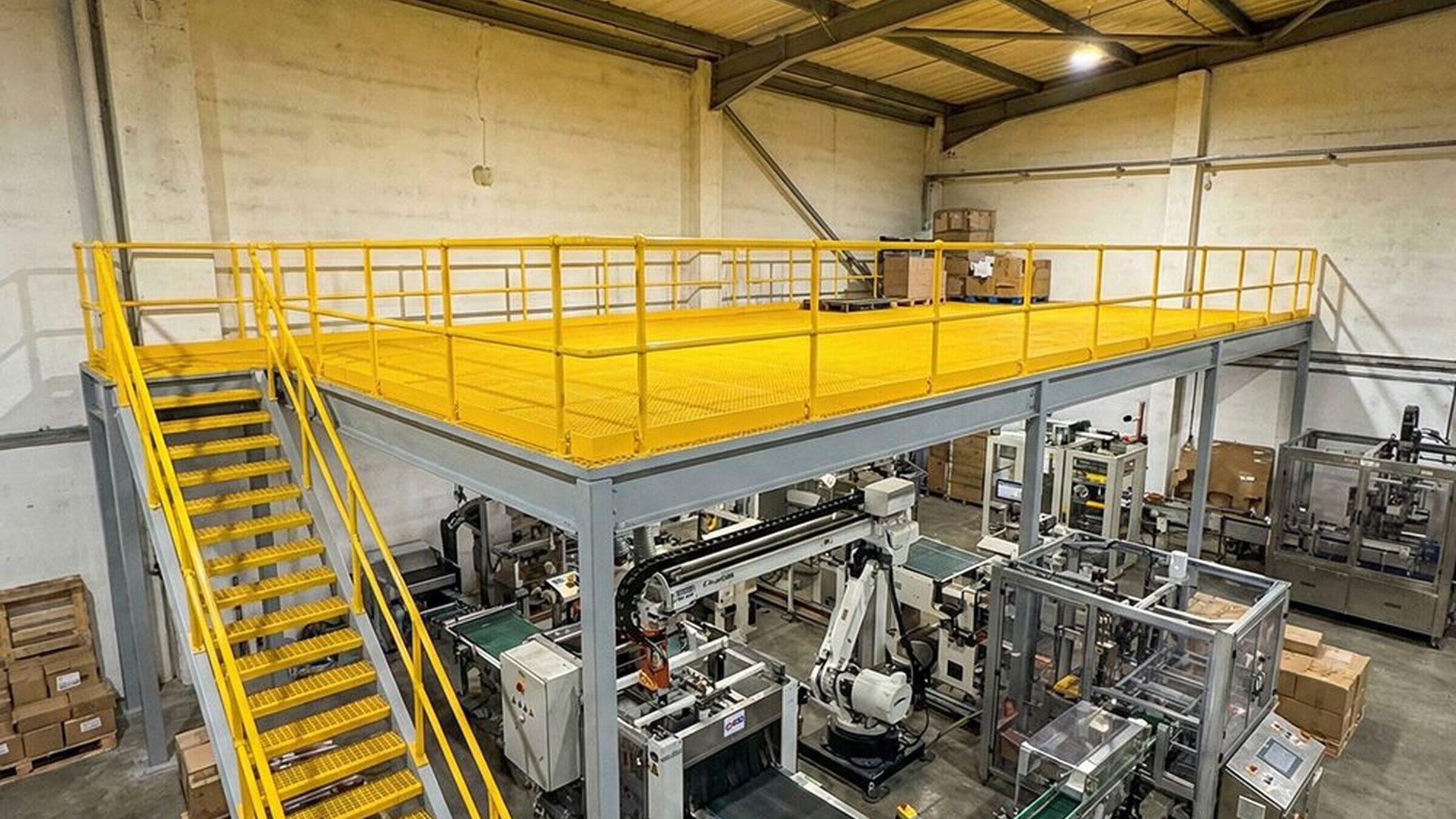
Choosing between GRP and steel for an industrial walkway, access platform or structural frame is rarely a question of which material is better. It is a question of where the access has to survive, what it has to carry, and what the maintenance budget looks like over the asset's life.
We have designed, fabricated and installed both materials across UK industrial and commercial sites since 1994, so the comparison here comes from a team that works in both, not a supplier with one product to push.
These are general tendencies to help you scope a decision, not a specification for your project. The loadings, the fire ratings and the final material call all need sign-off from your structural engineer and Building Control before anything is fabricated.
Is GRP or steel the right choice for industrial access and structural work?
It depends on three things: the environment, the loading and the whole-life cost. GRP usually wins where corrosion, weight or electrical conductivity are the deciding factors. Steel usually wins for primary structure, heavy or long-span loads, and fire-critical routes. For most projects, one material is clearly right for the job in front of you, and the work is matching the material to the conditions rather than defending a preference.
The comparison runs across the dimensions that actually move a specification: weight, corrosion resistance, strength and span, fire behaviour, electrical conductivity, slip resistance and cost. None of it is structural-engineering advice, and the loadings and the final material call belong to your structural engineer.
GRP vs steel at a glance
Before the detail, here is how the two materials tend to compare on the properties that decide most access and structural jobs. These are general material tendencies, not figures for your project.
| Property | GRP | Steel |
|---|---|---|
| Weight | Around 80% lighter than equivalent steel | Heavy; larger sections need craneage |
| Corrosion resistance | Inert in wet, chemical and coastal settings | Corrodes; needs galvanising or a stainless grade |
| Strength and stiffness | Lower; deflects more, needs closer supports | Higher; longer spans, higher point loads |
| Fire behaviour | Grade-dependent; standard grade is combustible | Non-combustible |
| Electrical conductivity | Non-conductive, non-sparking | Conductive |
| Slip resistance | Integral gritted anti-slip surface | Open grid or chequer plate, may need treatment |
| Up-front cost | Usually higher per unit | Usually lower to buy |
| Whole-life cost in corrosive settings | Often lower, no recoating cycle | Higher where recoating or replacement is needed |
How much lighter is GRP than steel, and when does that matter?
GRP is roughly 80% lighter than the equivalent steel section. That figure is widely cited across GRP manufacturer literature and is best treated as directional rather than exact, but the order of the saving is real, and it changes what the access weighs before it changes anything else on site.
That weight saving matters most in three situations:
- Tight dead-load budgets. On a rooftop plant deck where the structural allowance is limited, a lighter walkway leaves more of it for the plant itself.
- Limited or no craneage. On a live retrofit where a crane cannot reach, GRP sections can often be carried in and assembled by hand.
- Remote or access-restricted spots. Manual handling beats mobilising lifting gear for a job that does not need it.
Where none of those apply, the weight saving is genuine but rarely the deciding factor.
Which lasts longer in corrosive, wet or coastal environments?
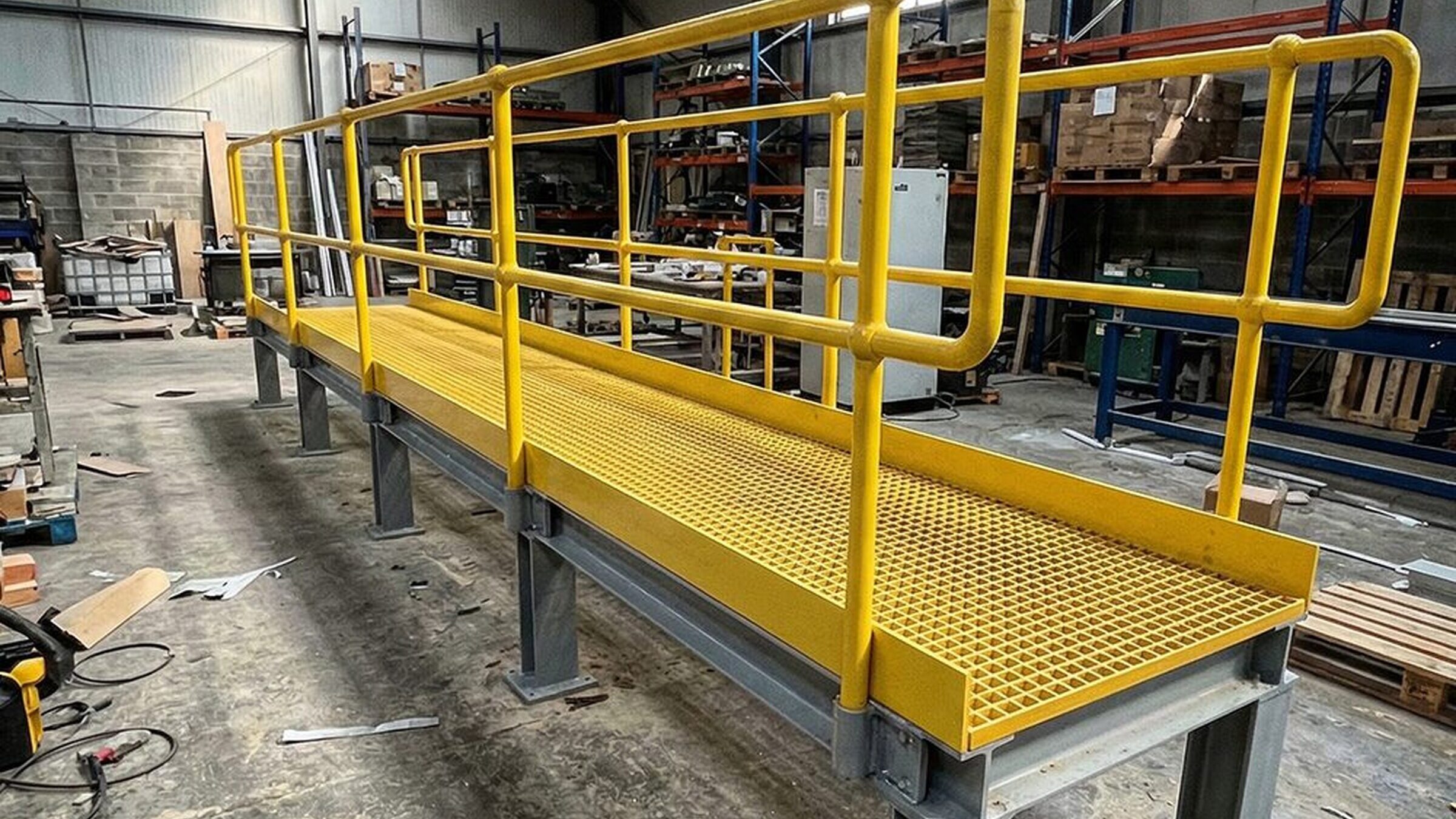
GRP, in most aggressive environments. It is effectively inert in wet, chemical, wash-down and coastal exposure, which is why it is so common on wastewater treatment access, chemical process plants and food-industry wash-down areas. It does not rust and it does not need a protective coating, so there is no recoating cycle to budget for.
Steel is not out of the running here, but it needs help. Hot-dip galvanising buys decades in mild conditions, and stainless grades such as 304 and 316 handle aggressive ones. Both add cost, and both have limits: coatings degrade at cut edges, and chloride-rich coastal air attacks over time. This is the single biggest factor separating the two materials. If the access spends its life over a chemical bund or in salt air, GRP usually removes a maintenance problem that steel would carry for the life of the structure.
Which is stronger and spans further under load?
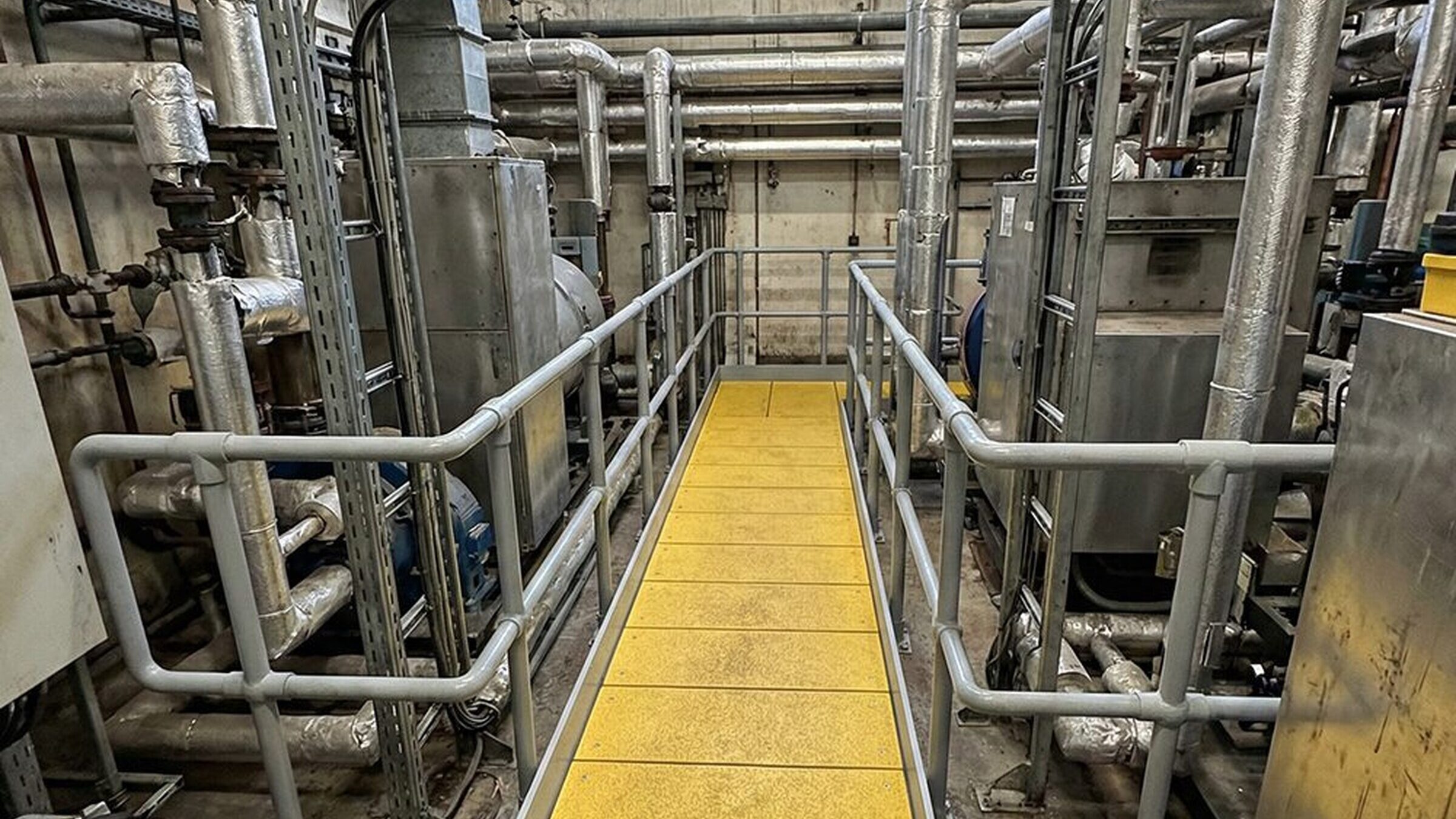
Steel, clearly. It carries higher point and distributed loads, spans further between supports and is far stiffer, so a GRP section deflects more and needs closer support centres to do the same job. That is why steel remains the default for primary structural frames, columns and beams and any long unsupported span, and why GRP sits naturally at the walkway, grating, platform and handrail end of the scale, carrying pedestrian and light-equipment loads.
The loadings are not ours to set. They come from the project's structural engineer, who designs to the relevant standard, and we design and fabricate the steelwork or the GRP to meet whatever they specify. GRP grating for industrial flooring and walkways is specified against BS 4592-0:2006+A1:2012. We do not publish a house load table, because a generic capacity figure means little without the span, the support arrangement and the deflection limit your engineer is working to.
How do GRP and steel perform in a fire?
This section is general information, not fire-safety or legal advice. Confirm what your project actually requires with your fire engineer and Building Control, and check it against the relevant standards and Approved Document B of the Building Regulations.
The short version: steel is non-combustible, and GRP fire performance depends entirely on the resin grade. In broad terms:
- Standard polyester-resin GRP is combustible, typically reaching the lower surface-spread classes (around Class C to D under BS EN 13501-1, or Class 2 to 3 under the older BS 476 Part 7).
- Fire-retardant and phenolic-resin grades reach the higher classes such as Class B or Class 1.
- Steel is non-combustible, though it still loses strength at high temperature and may need fire protection on a structural frame.
There is no single Euroclass that applies to GRP as a material, so treat any blanket fire-rating claim with caution. Smoke behaviour is a separate consideration that also varies by grade. Where fire performance matters, on escape routes, in risers, or in plant areas, the grade has to be specified deliberately and signed off. On our projects, the fire classification for the grade actually supplied is issued as part of the O&M pack at the end of the project, matched to what was installed rather than quoted as a headline number.
Is GRP non-conductive, and is it more slip-resistant underfoot?
Yes on both counts, and both are real reasons to choose GRP for the right setting.
GRP is electrically non-conductive and non-sparking. On access near electrical equipment, instrumentation or rail systems, that removes an earthing and arc risk that steel brings with it. Steel conducts, which is an advantage only where you actually want bonding and earthing, and a liability where you do not.
GRP grating also comes with an integral gritted anti-slip surface, formed as the panel cures rather than added afterwards, so it holds its grip when wet, oily or washed down. A plain steel surface is either an open grid or chequer plate, and often needs an added anti-slip treatment to match it. Slip resistance is measured by the pendulum test to BS EN 16165, and rather than quote a single headline value, we issue the pendulum test data for the grating supplied as part of the project O&M pack, so the specification is auditable from day one.
Which costs less, up front and over the asset's life?
This is general budgeting guidance, not a quote, and there is no single price for either material. Steel usually has the lower up-front cost. GRP often costs more per unit, but in a corrosive setting it can win over the asset's life by removing the recoat-and-replace cycle that steel would need.
In a dry, benign indoor environment the whole-life payback for GRP often never arrives, and steel usually wins on cost there too. The material should follow the environment, not a rule of thumb that GRP always saves money in the long run. What actually drives the cost of an installed solution is the environment, the loading, the span and the access conditions, far more than the material name on the drawing. An engineered, installed solution is also a different thing from a panel-only price, because it carries the design, the supports, the fixings and the installation with it.
So when should you choose GRP, and when should you choose steel?
The right answer is application-specific, and it usually becomes obvious once the environment and the engineer's loadings are on the table. As a working steer, choose GRP when:
- The access is in a corrosive, wet, coastal or wash-down environment.
- It sits near electrical equipment or instrumentation and needs to be non-conductive.
- The dead-load budget on a roof or an existing structure is tight.
- Limited craneage on a live retrofit makes a lightweight, hand-assembled system the practical choice.
Choose steel when:
- You are dealing with primary structure, or heavy or long-span loads.
- The route is fire-critical and needs a non-combustible material.
- The access is in a high-impact environment where it takes knocks.
- The setting is dry and benign, where steel usually wins on whole-life cost too.
The two are not mutually exclusive. A common and sensible answer is a mixed design: a steel support frame carrying GRP decking or grating, which gives you steel's strength and stiffness underneath and GRP's corrosion resistance and slip performance on the walking surface.
This is where working with a supplier that handles both materials earns its place. We design, fabricate and install steel access systems to BS EN 1090 Execution Class 2, UKCA marked and welded by coded welders. We supply and install GRP walkways, gratings, handrails and platforms to BS 4592, with the slip-resistance data and any fire classification issued in the project O&M pack. Because the survey, the design, the fabrication and the installation sit with one team, there is no gap for a problem to fall into, and we can recommend GRP where it is genuinely the right answer and steel where it is not.
When you are ready to put a number against your own drawings and loadings, you can request a quote, and we will scope it in whichever material fits the job.

Written by
Jacob Hughes
Jacob Hughes is a Director at Universal Industrial Services, one of the UK's leading specialists in structural steelwork, architectural metalwork, and bespoke fabrication. With over a decade of leadership experience in the industry, Jacob oversees all aspects of project delivery - from strategic planning and compliance to client relations and operational excellence. Following the vision set by his father, company founder Neil Hughes, Jacob plays a critical role in maintaining the high standards, safety practices, and innovative approaches that Universal Industrial Services is known for. He is deeply committed to upholding the company's BS EN 1090 certification and CHAS Advanced accreditation, ensuring that every project meets the highest quality and regulatory benchmarks. While Jacob’s day-to-day role focuses on business development and project oversight, he works closely with Universal’s highly skilled engineering and fabrication teams to deliver complex projects across the UK. His leadership supports the company’s mission to invest in people, technology, and sustainable practices, helping clients achieve outstanding results in every project. Outside of work, Jacob is passionate about driving innovation within the steel and metalwork sectors and continues to champion professional development within the Universal Industrial Services workforce.