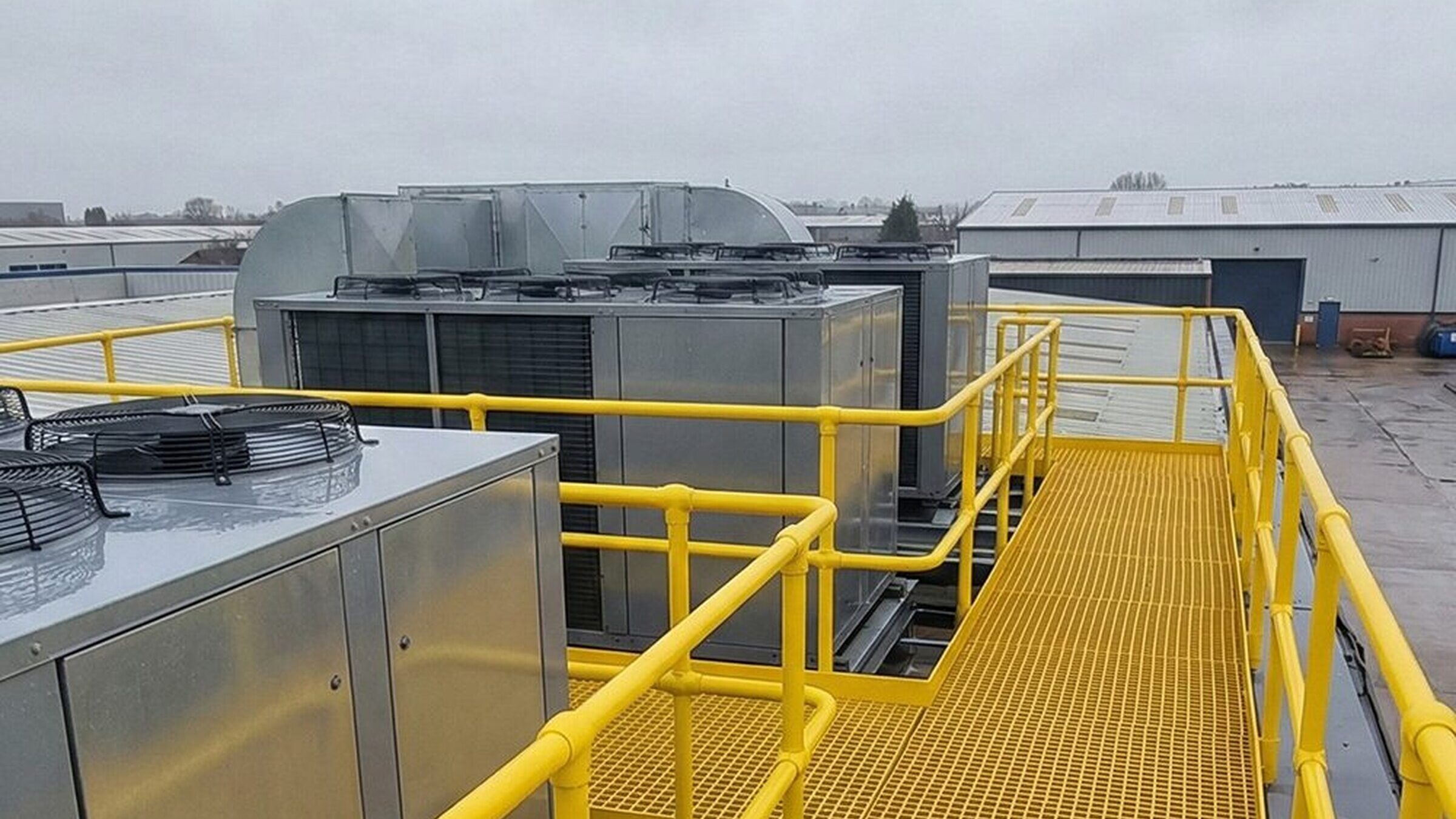
You might be costing a walkway over a wastewater tank where the existing steel keeps rusting back. You might be told to shave dead load off a rooftop plant deck, or to value-engineer a run of access platforms without losing the safety case.
In all three, someone has put GRP on the table, and the question is whether it suits the job.
Glass-reinforced plastic, also called fibreglass, is a composite of glass fibres set in a resin matrix. It has real advantages over steel in the right setting and real limits in the wrong one.
We supply, fabricate and install both GRP and steel access systems, so this weigh-up is not a push toward one material. The aim is to help you put GRP where it works and steel where it works.
What are the advantages and disadvantages of GRP at a glance?
GRP is corrosion-proof, light and non-conductive, which makes it the better answer in wet, chemical, coastal and electrically sensitive environments. Its limits are lower stiffness than steel, a higher up-front material cost in many cases, and fire performance that depends entirely on the resin grade.
Where corrosion drives the whole-life cost, GRP usually wins. Where the job needs high point loads, long unsupported spans or fire-rated structure, steel usually wins.
At a glance:
| Advantages | Disadvantages |
|---|---|
| Corrosion-proof; no rust, no recoating cycle | Higher up-front material cost than mild steel in many cases |
| Roughly 80% lighter than equivalent steel | Lower stiffness, so it deflects more and may need closer supports |
| Electrically and thermally non-conductive | Fire performance is grade-dependent; standard polyester grade is combustible |
| Inherent slip resistance from a gritted surface | Surface can degrade under decades of unshielded UV exposure |
| Low lifetime maintenance | On-site cutting releases glass dust that needs PPE and edge sealing |
What are the advantages of GRP?
The case for GRP rests on five material properties that each carry a consequence on site.
- Corrosion resistance is the headline. GRP does not rust or rot, so in a wastewater channel, a chemical bund or a coastal walkway it removes the recoating and replacement cycle that mild steel needs in those settings. That is the property that most often justifies the spend, because corrosion is what drives steel's whole-life cost in those settings.
- Light weight changes how the job is handled. GRP weighs roughly 80% less than the steel equivalent, a figure drawn from GRP manufacturer literature rather than a measurement of ours, so treat it as directional. The practical effect is concrete: panels can often be carried in and fixed by hand, which matters on a rooftop where dead-load budget is tight, or on a live retrofit where craneage is limited.
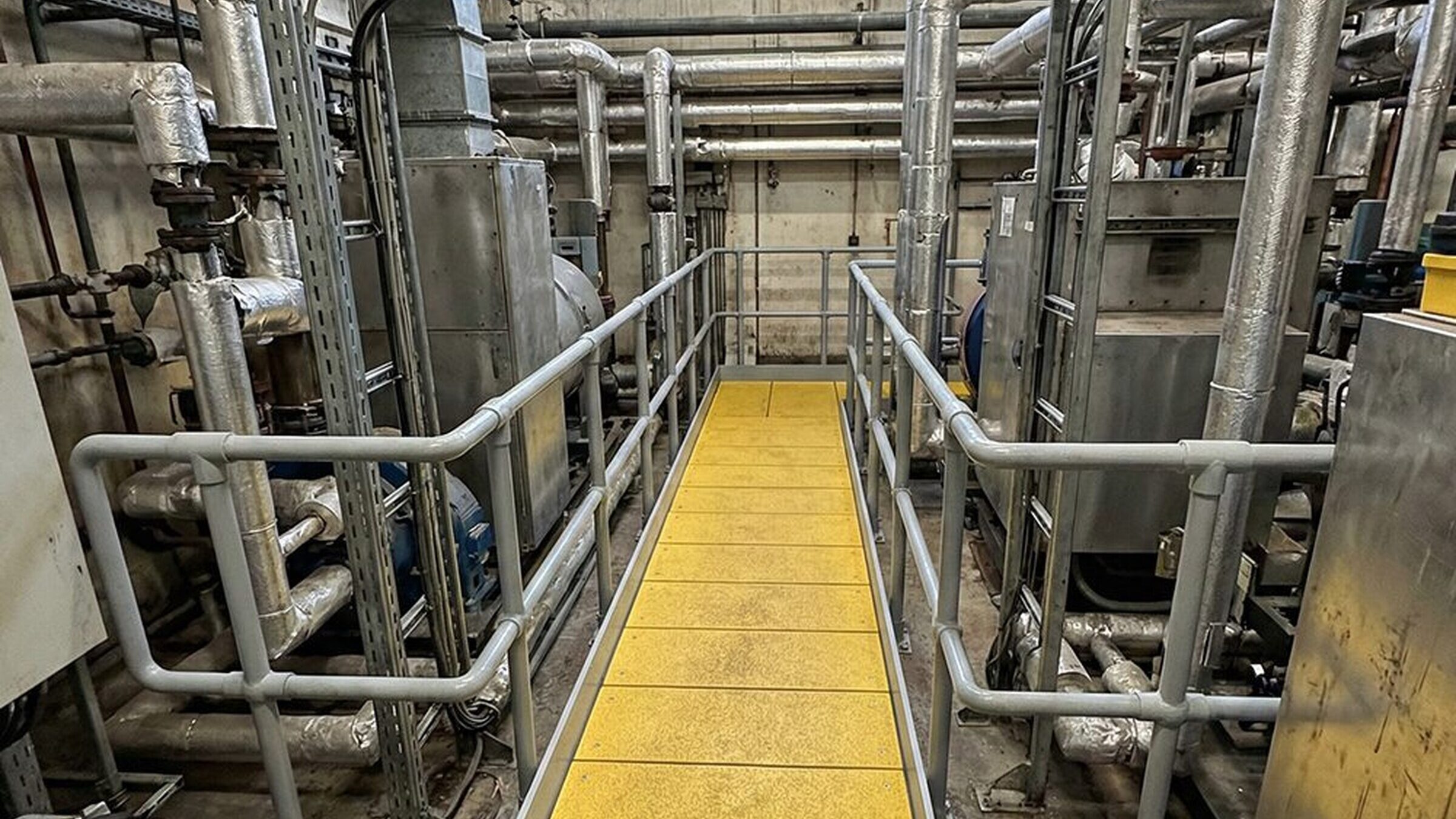
- Non-conductivity is a safety property steel cannot match. GRP is electrically and thermally non-conductive, so it suits access near electrical equipment, instrumentation or trackside power where an earthing or arc-flash risk rules out a steel grating.
- Slip resistance is built into the surface. Most GRP grating and plate is supplied with a gritted top that grips wet or dry, with covered-top options for wash-down areas where loose grit would trap product.
- Low maintenance follows from all of the above. No painting, no galvanising, no cathodic protection to schedule, which is why GRP riser flooring and service-shaft access tend to be specified where getting back in to maintain steel would be slow and disruptive.
What are the disadvantages and limitations of GRP?
The honest counterweight matters as much as the case for it, and most of these are risks a budget holder has not yet priced in.
- Up-front cost is the first. GRP usually costs more per metre to buy than mild steel, so on a dry, sheltered job where corrosion is not the issue, steel can cost less and still be entirely correct.
- Lower stiffness is the one that catches people out. GRP has a lower modulus than steel, which means it deflects more under the same load. This is a design factor to allow for, and standard practice handles it: pultruded sections and closer support spans bring deflection back inside limits, though they can reduce the weight saving. Allowable loads and spans are set by your structural engineer; we design and fabricate the access to meet whatever they specify, rather than reading numbers off a generic chart.
- Fire performance depends on the resin grade, and this is where overclaiming is easiest. Standard polyester GRP is combustible. UV exposure is the slower limit: over decades of unshielded sunlight the resin surface can degrade and expose fibres, which a UV-stabilised resin and a surface veil are there to hold off.
- Cutting on site releases glass dust, so installation needs the right PPE and dust control, and cut edges should be sealed.
None of these rules GRP out. They define where it fits and what good installation has to account for.
Is GRP strong enough to replace steel?
For many access and walkway duties, yes; as a wholesale replacement for structural steel, no. The strength-to-weight ratio of GRP is genuinely high, but its lower stiffness means a design has to allow for more deflection than the steel equivalent. Pultruded profiles and closer supports handle that for most pedestrian and light-trolley access.
Where the load case turns to high point loads, long clear spans, structural frames or heavy impact, steel keeps the edge. GRP industrial flooring and walkways are specified against BS 4592-0:2006+A1:2012, and the allowable loads for your project come from the lead structural engineer, not from us. We fabricate and install the access to meet those loadings in either material. We recommend GRP where it genuinely fits and steel where it does not, rather than stretching a strength claim past where it holds.
How does GRP perform in a fire?
GRP is not fireproof, and this is the part to get right rather than gloss. The following is general guidance, not fire-safety or legal advice; confirm the requirement for your project with a qualified fire engineer and against the relevant authority.
Standard polyester GRP is combustible. Fire performance is classified under BS EN 13501-1, the Euroclass scale, and under the older BS 476 Part 7 surface-spread-of-flame classes. A standard polyester grade typically reaches the lower end of those scales, while fire-retardant additives and phenolic resins are what reach the higher classes; only a fire-retardant grade gets you to Class B or Class 1. Smoke and toxicity also matter on escape routes and inside risers, not just the spread of flame.
There is no single Euroclass that describes GRP as a material, because the rating is a property of the resin grade and the finish specified for a given job. On our projects, the fire classification for the grade supplied is issued with the O&M pack rather than offered as a headline number, and Approved Document B of the Building Regulations is the place to check what the building itself requires.
How slip-resistant is GRP underfoot?
GRP grating is one of the more reliably slip-resistant access surfaces, because the grit is part of the panel rather than a coating applied afterwards. The gritted top is formed in the cure, grips wet or dry, and holds up under traffic; covered-top and concave finishes exist for oily or wash-down areas where an open grit would clog.
Slip resistance is measured by the BS EN 16165 pendulum test and reported as a pendulum test value for the finish you actually choose, against the wet and dry cases. On our projects those values are issued with the O&M pack as auditable documentation rather than a single cherry-picked figure, so the specification can be checked on day one. It is the same reason slip resistance belongs on any access platform or walkway where a fall from height is the risk being designed out.
Does GRP's higher up-front cost pay back over time?
Often yes in a corrosive or hard-to-reach setting, and not always elsewhere. The honest comparison is whole-life cost, not the price of the panel.
In a wastewater plant, a chemical area or a coastal walkway, steel needs recoating and eventual replacement on a cycle that GRP simply removes, and the recoating downtime in a live facility frequently costs more than the steel itself. On a dry, sheltered, easily accessed job, a painted steel section can cost less over its life and we will say so.
The cost of an installed GRP system moves with the profile, the load and span, the resin grade, the surface finish, the panel quantity and the access conditions, so a single per-square-metre price is misleading. This is general budgeting guidance rather than a price list. For a number against your drawings we quote large commercial packages inside one to two weeks, and the more you can tell us about area, span, loading, environment and finish, the closer the first figure lands.
When is GRP the right choice, and when should you stick with steel?
The environment and the duty decide the material. As a rule of thumb:
- Choose GRP for corrosive, wet, chemical, coastal and wash-down environments, for non-conductive access near electrical or instrumentation equipment, and where dead load or craneage is constrained, such as rooftop plant decks and live retrofits.
- Choose steel for high point loads, long unsupported spans, structural frames, heavy impact and any element that has to be fire-rated structure.
The soundest next step is to settle the choice with a qualified engineer against your actual loadings, environment and fire requirements, rather than on a material preference carried over from the last job.
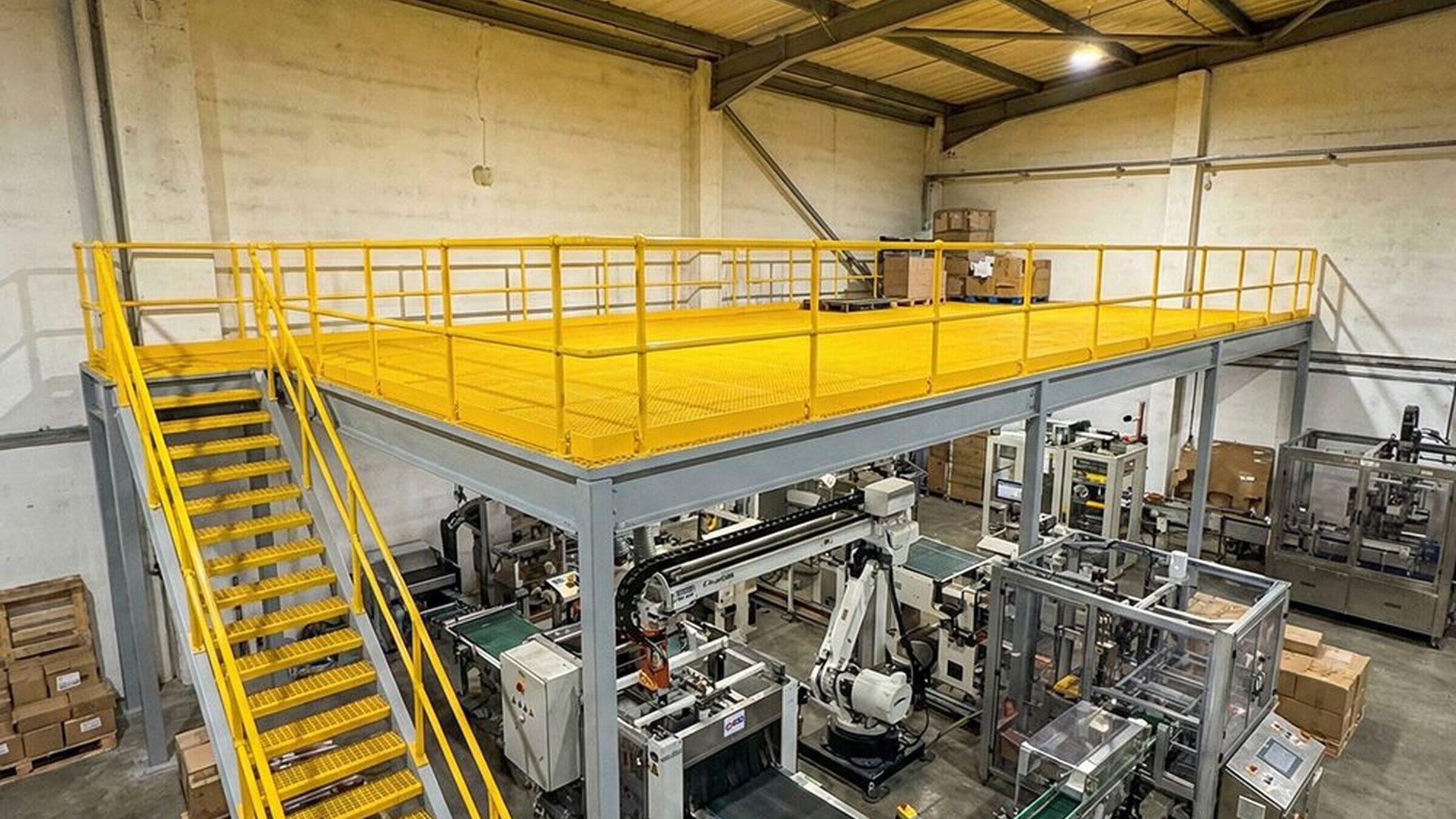
When GRP is the right call, we design, fabricate and install GRP walkways, access decks, handrails, stairs and riser flooring to BS 4592, with the slip-resistance pendulum values and any fire classification issued in the project O&M pack. When steel is the better answer, whether that is a run of structural steelwork, secondary steelwork or steel access platforms, we will tell you that too and fabricate it instead. Universal Industrial Services has designed, fabricated and installed steelwork and GRP access across the UK from our Rotherham base since 1994.

Written by
Jacob Hughes
Jacob Hughes is a Director at Universal Industrial Services, one of the UK's leading specialists in structural steelwork, architectural metalwork, and bespoke fabrication. With over a decade of leadership experience in the industry, Jacob oversees all aspects of project delivery - from strategic planning and compliance to client relations and operational excellence. Following the vision set by his father, company founder Neil Hughes, Jacob plays a critical role in maintaining the high standards, safety practices, and innovative approaches that Universal Industrial Services is known for. He is deeply committed to upholding the company's BS EN 1090 certification and CHAS Advanced accreditation, ensuring that every project meets the highest quality and regulatory benchmarks. While Jacob’s day-to-day role focuses on business development and project oversight, he works closely with Universal’s highly skilled engineering and fabrication teams to deliver complex projects across the UK. His leadership supports the company’s mission to invest in people, technology, and sustainable practices, helping clients achieve outstanding results in every project. Outside of work, Jacob is passionate about driving innovation within the steel and metalwork sectors and continues to champion professional development within the Universal Industrial Services workforce.