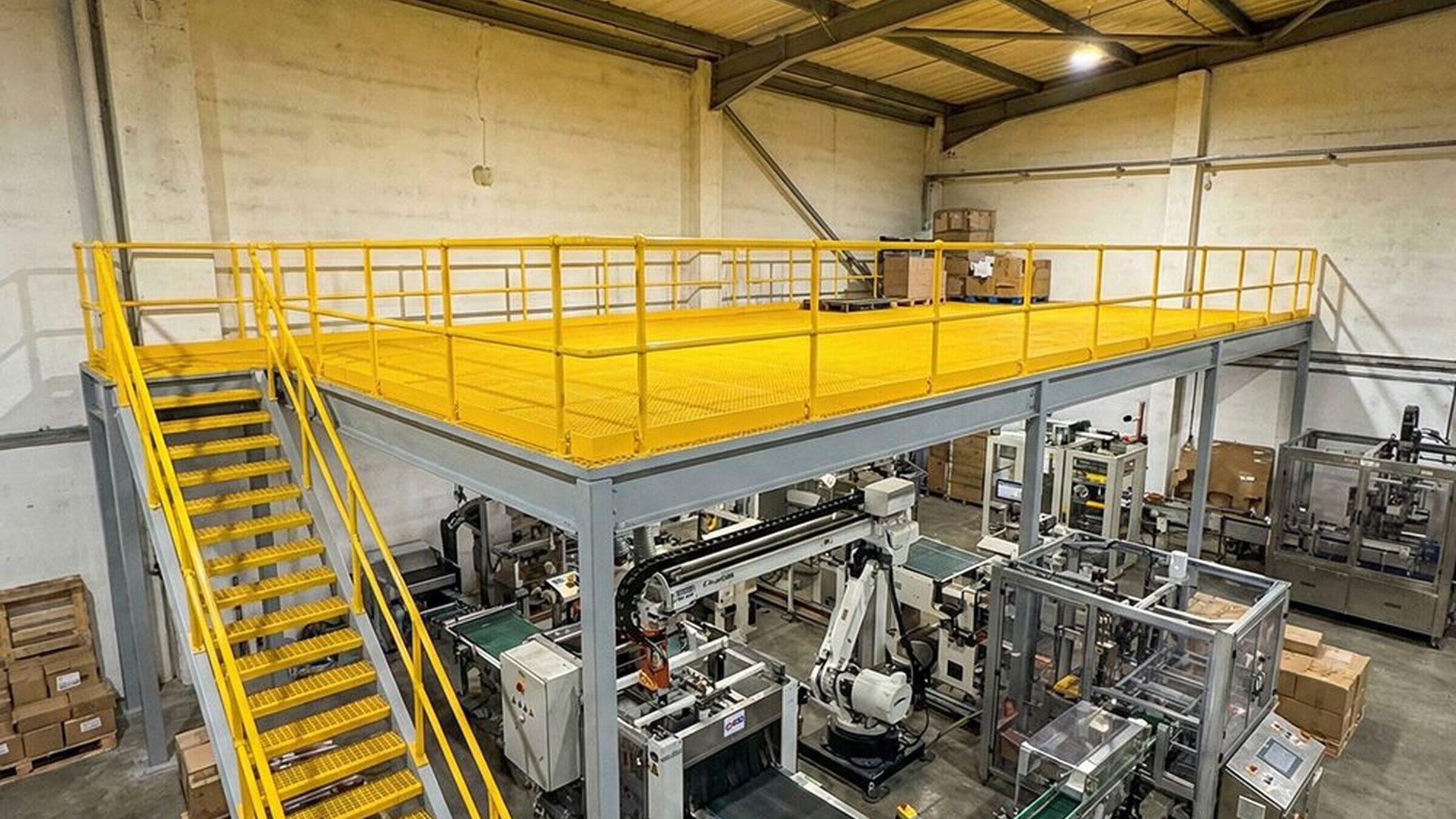
GRP outlasts steel in the wet, corrosive places where unprotected steelwork rusts through fastest, yet the same material is a thermoset that cannot be melted down and remade at the end of its life. That single tension is the whole sustainability story.
Steel is the opposite: harder to protect against corrosion, but one of the most recycled materials in UK construction. We specify, supply, fabricate and install both, and we have replaced enough corroded steelwork on wastewater and coastal sites to know where each material genuinely earns its place.
This guide lays out the honest balance, dimension by dimension, so you can make a defensible case rather than a green one.
A note before the detail: this is general guidance to help you scope a material decision, not structural-engineering or legal advice. Whole-life carbon, loadings and material selection are project-specific and should be confirmed with your structural engineer and your sustainability adviser before anything is specified.
In short:
- Where GRP wins: in use. It does not corrode, so it can serve for decades with no recoating and no corrosion-driven replacement, and it weighs far less to transport and install.
- Where GRP loses: at end of life. As a thermoset it cannot be remelted, so most GRP is currently landfilled or burned for energy recovery, where steel is recycled.
- The honest verdict: in aggressive environments where steel would need constant maintenance, GRP's whole-life footprint can come out ahead. In benign settings where steel lasts and gets recycled, steel is usually the more sustainable choice.
Is GRP a sustainable material, or not?
The answer depends on which stage of the life cycle you weigh most, and on the environment the access has to survive in. GRP is strong in the use phase and weak at the end of life, and an honest assessment has to hold both at once.
In a wastewater channel, on a rooftop plant deck, or on a coastal access platform, GRP earns its keep because it does not rust, does not need recoating and does not drive the replacement cycle that corrosion forces on unprotected steel. Against that, glass-reinforced plastic is a thermoset composite, and once cured a thermoset cannot be melted down and reformed. So the same property that makes it durable in service makes it difficult to recycle when the asset is retired.
Treat anyone who calls GRP simply green, or simply not green, with caution. The defensible position is the whole-life one, taken environment by environment. The sections below work through each part of that balance: durability and maintenance, embodied carbon, weight and end of life.
How does GRP's durability and low maintenance reduce its whole-life impact?
The strongest environmental argument for GRP is the maintenance it removes. In corrosive settings, carbon steel needs galvanising, a paint system or a stainless upgrade to survive, and even then it is on a recoating schedule. GRP resists that corrosion without a coating, so the recoating cycle and the corrosion-driven replacement cycle largely disappear.
Every recoating avoided is paint, solvents, access equipment, labour and downtime avoided, along with the emissions that go with them. Over an asset that stays in service for decades, those avoided cycles add up to a real saving, even though it is one that is hard to put a single number against.
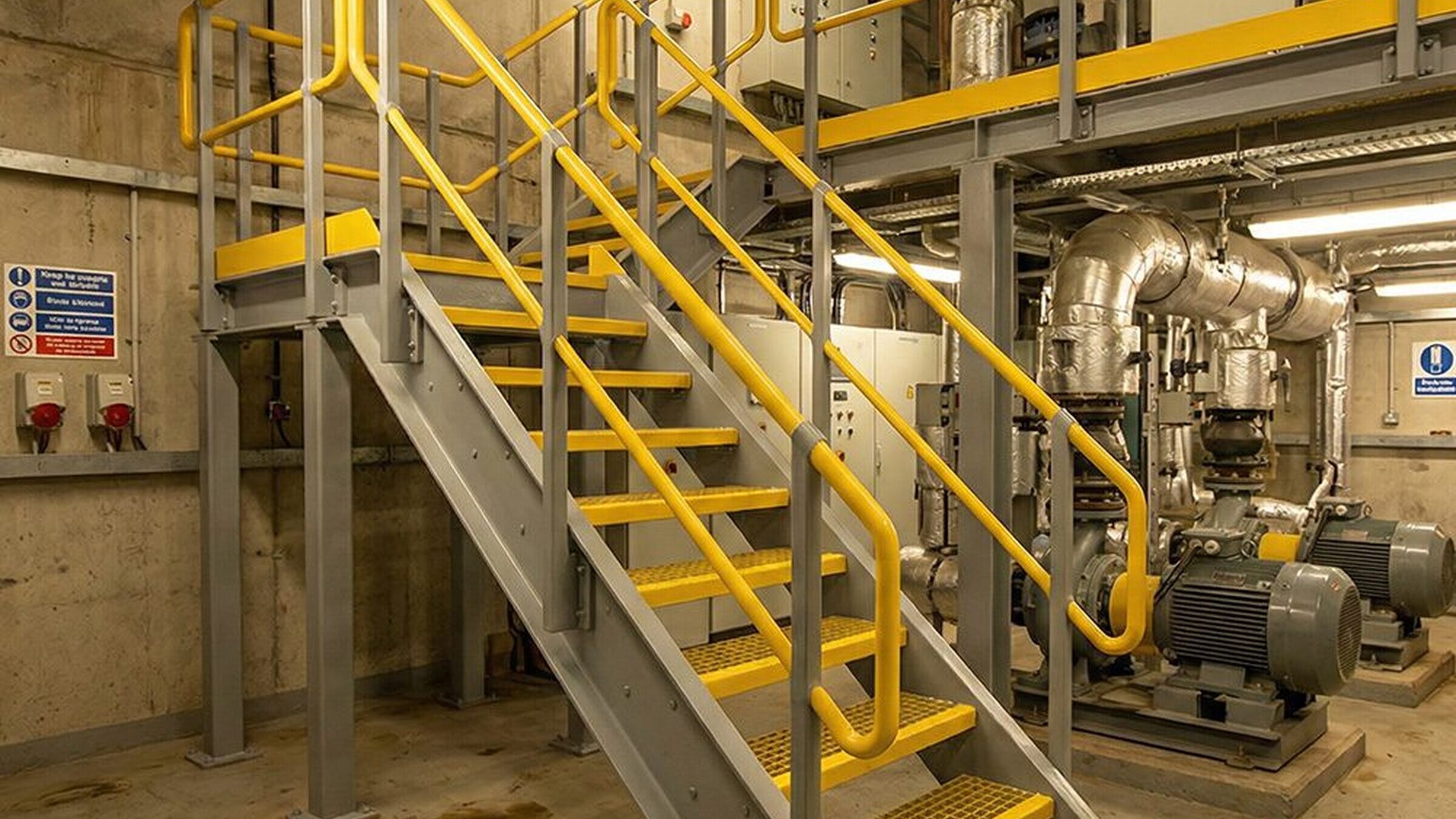
This matters most exactly where steel struggles: wastewater treatment, chemical processing, food-industry wash-down areas and coastal or marine exposure. We specify GRP walkways and access platforms for exactly those settings, and we have pulled enough rust-failed steel off wastewater and coastal jobs to know the recoating cycle GRP removes is a genuine one. In those environments the case for GRP is a whole-life one, and it stands on durability that a green label adds nothing to.
The honest qualifier is that durability is not free of impact. GRP earns its low-maintenance benefit over a long life, so the case only holds where the asset genuinely stays in place for the long term. A GRP walkway swapped out after a few years never repays its upfront footprint, and that upfront footprint is where the carbon comparison gets closer.
How does GRP's embodied carbon compare with steel?
This is the most even-handed part of the comparison, and the place where steel pulls back ahead. GRP is made from glass fibre set in a petrochemical thermoset resin, so its raw materials are fossil-derived and energy-intensive to produce. Measured per tonne, GRP can carry a higher embodied-carbon figure than structural steel.
Two things complicate that headline. First, a GRP job uses far less material by weight than the steel equivalent, so the per-tonne figure is not the whole comparison. Second, the long maintenance-free life can offset a higher upfront footprint over the decades the asset is in service. Steel, for its part, is energy-intensive to make but carries a high recycled content, particularly through the electric arc furnace route, and it stays recyclable at the end of its life.
A single-stage figure misleads here. The fair comparison is whole-life carbon, made through a lifecycle assessment and supported by an Environmental Product Declaration for the specific products on your project. Bodies such as the Steel Construction Institute and the UK Green Building Council publish the steel-side carbon and whole-life assessment guidance these comparisons draw on. Do not quote an embodied-carbon figure you have not verified against a current source for the exact grade and product. On the embodied-carbon and recyclability axis alone, steel is the more circular material; the GRP case is built on the use phase, not on this one.
Does GRP's light weight cut transport and installation emissions?
Yes. GRP sections weigh roughly 80% less than the equivalent steel, a figure widely quoted across GRP manufacturers' technical literature, and that weight difference shows up at every stage of getting the access into place. Lighter sections mean fewer wagons to site, which cuts transport emissions directly.
The weight saving also changes the install. Pultruded GRP is light enough that craneage can often be reduced or avoided entirely, which is a genuine benefit on constrained urban sites, on live sites where a crane is hard to schedule, and on retrofits where the existing structure has a limited dead-load budget to give. We install GRP access on exactly that kind of site, and the lighter sections are part of why a crane-free sequence is possible where it would not be for the equivalent steel access platforms. Lighter access also means safer manual handling for the team putting it in. The transport and installation phase is the clearest place GRP's advantage over steel shows up, even though it does nothing to change the end-of-life picture.
Can GRP be recycled at the end of its life?
Not easily, and this is the honest weak point in GRP's environmental case. Because it is a thermoset, GRP cannot be melted down and reformed the way a thermoplastic can. The glass fibres and the cured resin are locked together, and there is no clean, widespread way to separate them, so most GRP reaching the end of its life in the UK is currently landfilled or burned for energy recovery.
Steel is the clear contrast. It is one of the most recycled materials in construction: separated, remelted and returned to production through a mature scrap market that gives end-of-life steelwork a real value rather than a disposal cost. A steel walkway that served for thirty years becomes new steel; a GRP one that served just as well usually becomes waste. If end-of-life recyclability is the axis your project weights most heavily, steel wins it outright, and a credible sustainability case for GRP has to say so rather than work around it.
Which GRP recycling routes actually work today?
Some recycling routes for GRP exist, but most are still niche, and it is worth being specific about what is and is not currently viable rather than implying a circular solution that is not there yet. Three routes are the ones usually named.
- Cement co-processing: end-of-life GRP is shredded and fed into cement kilns, where the resin contributes energy and the glass and fillers are taken up into the cement. It is the most established route, but it is downcycling, not closed-loop recycling.
- Pyrolysis: heat is used to break the resin down and recover the glass fibres, but the recovered fibre is generally lower grade than virgin fibre, and the process is not yet widespread at industrial scale.
- Mechanical recycling: GRP is ground down and used as a low-grade filler in other products, which keeps it out of landfill but recovers little of its original value.
The honest summary is that none of these is yet a high-value, mainstream recycling stream for GRP in the UK. They are developing, and they are better than landfill, but a sustainability claim that leans on GRP recyclability is overstating where the industry currently stands. Never put a GRP recycling percentage in a tender that you cannot point to a verified source for.
How do you make a defensible sustainability case for GRP without overclaiming?
Lead with the facts you can stand behind, and be upfront about the limitation rather than hiding it. The defensible case for GRP is built on the use phase: decades of corrosion-free service, no recoating, low maintenance and a light weight that cuts transport and installation emissions. State those plainly, and pair them with the honest acknowledgement that GRP is hard to recycle at the end of its life and that steel is the more circular material.
Keep the claims action-specific. Aspirational language, the kind that promises a greener future or a net-zero outcome, does not survive scrutiny and is exactly the sort of claim a specifier or an ESG reviewer will push back on. What survives is the concrete trade-off: the right material for the environment, chosen on whole-life grounds, with the downsides named. Where you need numbers, whole-life carbon, embodied-carbon figures and recyclability rates should come from a lifecycle assessment and Environmental Product Declarations for your actual products, confirmed with your engineer or sustainability adviser, not from a supplier's headline.
So the practical rule is the same one that should govern the material choice itself. GRP earns its place where the environment justifies it: corrosive, live-site or weight-constrained work. Where steel will last and be recycled at the end, steel is usually the more sustainable answer, and saying so is what makes the rest of the case credible.
When GRP is genuinely the right call, we design, fabricate and install GRP walkways, access platforms and handrail systems to BS 4592, cutting and assembling pultruded and moulded sections with our own teams. When steel is the better answer for the environment and the whole-life footprint, we will tell you that, and supply the steelwork instead.
The correct material matters more than selling more of either. If you are weighing GRP against steel for an industrial access project, request a quote and we will talk it through against your drawings and your environment.

Written by
Jacob Hughes
Jacob Hughes is a Director at Universal Industrial Services, one of the UK's leading specialists in structural steelwork, architectural metalwork, and bespoke fabrication. With over a decade of leadership experience in the industry, Jacob oversees all aspects of project delivery - from strategic planning and compliance to client relations and operational excellence. Following the vision set by his father, company founder Neil Hughes, Jacob plays a critical role in maintaining the high standards, safety practices, and innovative approaches that Universal Industrial Services is known for. He is deeply committed to upholding the company's BS EN 1090 certification and CHAS Advanced accreditation, ensuring that every project meets the highest quality and regulatory benchmarks. While Jacob’s day-to-day role focuses on business development and project oversight, he works closely with Universal’s highly skilled engineering and fabrication teams to deliver complex projects across the UK. His leadership supports the company’s mission to invest in people, technology, and sustainable practices, helping clients achieve outstanding results in every project. Outside of work, Jacob is passionate about driving innovation within the steel and metalwork sectors and continues to champion professional development within the Universal Industrial Services workforce.