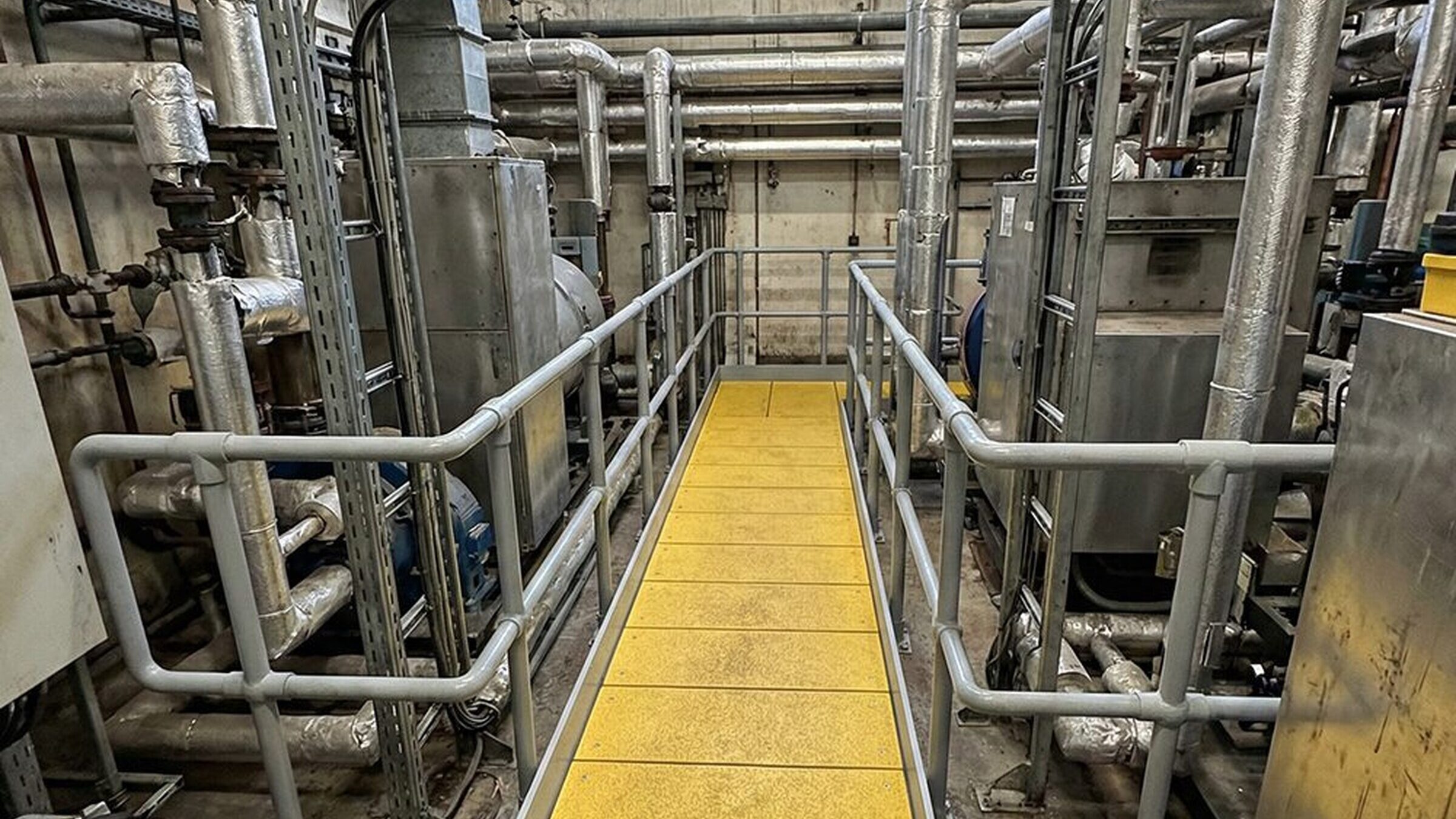
There is no single price for GRP grating. What a project costs moves with the panel type, the resin grade, the span the grating has to cross, the surface finish and the fabrication around it, so the honest way to budget is to understand the drivers rather than chase one headline rate.
We supply, fabricate and install GRP access systems alongside steel on industrial and commercial sites across the UK, and the guidance below is general information to help you scope a budget, not a specification or a quote for your project. Loadings, fire ratings and grating selection are project-specific, so confirm them with your structural engineer before anything is ordered.
How much does GRP grating cost?
GRP grating is priced by specification, not off a rate card. Two panels that look almost identical on a shelf can sit a long way apart on cost once you account for how they are made, the resin in them and the finish on top. Quoting a figure here would mislead you more than help you, because the figure that matters is the one a supplier works out against your drawings.
What this guide does instead is set out the levers that move the number. The main ones are the panel type, whether moulded or pultruded, the load-bar depth and the span it has to cross, the resin grade, the surface finish and the fabrication and installation around the panels. Work through those and you can scope a realistic budget and know exactly what to send a supplier when you ask for a price.
What drives the cost of GRP grating?
Every one of these drivers changes how much material, resin or labour goes into the finished grating, which is why two quotes for the same area can differ so widely. GRP industrial flooring and walkways are specified against BS 4592-0:2006+A1:2012, and the choices within that specification are where the cost is set.
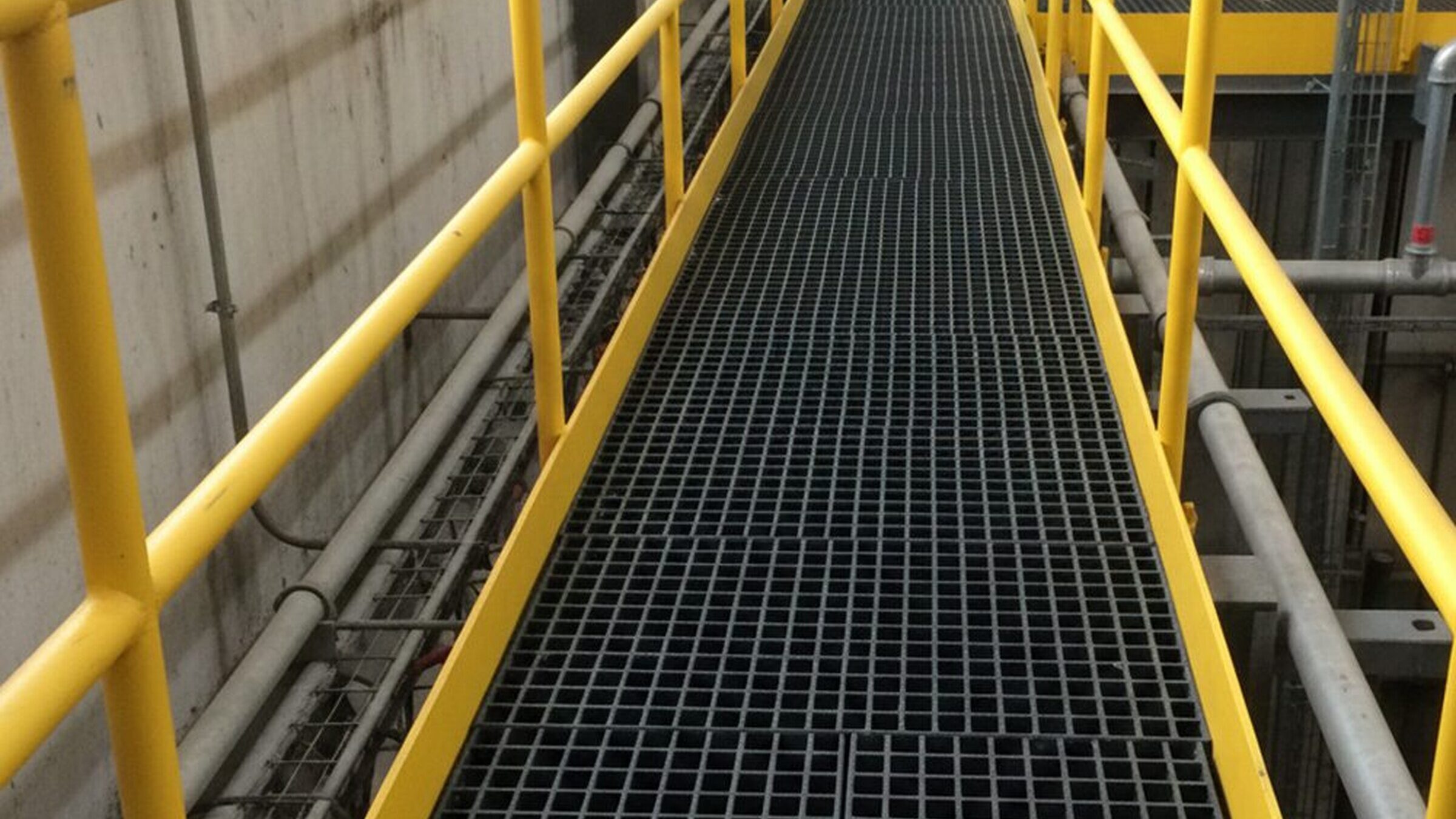
- Panel type: moulded or pultruded. Moulded grating is laid up in an open mould with continuous glass rovings running both ways, which gives balanced bidirectional strength and a higher resin content that suits corrosive immersion. Pultruded grating pulls continuous fibres through a heated die to form load bars with high strength along the bar, so it spans further between supports. Pultruded panels generally cost more per square metre and per metre of bearing bar.
- Load-bar depth and span. The further the grating spans between supports and the heavier the load on it, the deeper the load bar has to be, and a deeper bar uses more material. Depth follows the span and the load, and both feed straight into cost.
- Resin grade. Standard orthophthalic or isophthalic polyester is the baseline. Vinyl ester costs more and buys better chemical resistance for aggressive environments. Phenolic and fire-retardant grades sit at the top of the range. The grade is one of the biggest single swings in a GRP price.
- Surface finish. A gritted anti-slip top is standard on walkways and access platforms and adds cost over a plain panel. Concave and covered-top finishes add more again. The finish is a safety decision first and a cost decision second.
- Panel size, quantity and cut-outs. Cutting panels to size, forming cut-outs around pipework and plant, and sealing the cut edges all add fabrication time. Larger, simpler orders carry a better effective rate than a handful of heavily cut bespoke panels.
- Supports, fixings and edge trim. Hold-down clips, support steelwork, edge trim and nosings are part of a working installation and part of the cost. A panel price that leaves them out is not the price of a finished walkway.
- Delivery and installation. Getting the grating to site and fitted is a real line in the budget, and it is the line most often missing from a material-only figure.
Is GRP grating more expensive than steel?
To buy up front, GRP grating is often more than mild steel for the same area. The comparison that actually decides it is whole-life cost, not the panel price.
In corrosive, wet or coastal environments, carbon steel carries a recoating and eventual replacement cycle that GRP simply avoids, so the lower up-front steel price can be overtaken over the life of the asset by the cost of maintaining it. GRP is also much lighter than the steel equivalent. GRP manufacturer literature puts the weight saving at around 80 percent, and that weight difference cuts handling, craneage and installation time, which matters on rooftop plant decks where dead load is tight and on live retrofits where craneage is limited.
Steel still wins in plenty of cases. Where you have high point loads, long unsupported spans, a structural frame or heavy impact, steel is usually the better answer and often the cheaper one over the life of the structure. The right material is application-specific, and the loadings that decide it are set by your structural engineer, not by the grating supplier. We fabricate and install to whatever those loadings call for, in either material.
Why does an installed price differ from a panel-only price?
A panel-only price covers the material and nothing else. An installed, engineered solution covers the site survey, the design to your engineer's loadings, the fabrication, the fixings and edge trim and the installation itself. Those are real costs whether or not they appear on the first quote you read.
Because we keep the survey, the design, the fabrication and the installation under one team, there is no gap between trades for a problem to fall into, and no second trade to price and programme separately. That single-source control is also why the cheapest panel rarely produces the cheapest finished walkway. When the install is someone else's problem, the savings on the panel tend to reappear as extras on site.
What information does a supplier need to quote GRP grating accurately?
The more of the specification you can hand over, the closer the quote comes to the final figure. A supplier needs the area or drawings, the clear span between supports, the load the grating must carry, the environment it sits in, the surface finish, the support and fixing detail and the access for installation.
- Area, or drawings of the layout
- Clear span between supports
- The load it must carry, taken from your structural engineer
- The environment: chemical exposure, wash-down, coastal or a fire spec
- Surface finish required
- Fixing and support detail
- Site access for delivery and installation
The load figures come from the lead structural engineer on the project, and a supplier designs and fabricates the grating to meet them rather than setting them. A site visit or a set of drawings turns a rough budget into a firm number. We quote large commercial packages inside one to two weeks, and a request for a quote with the information above is the fastest route to a price you can rely on.
How can you keep a GRP grating budget under control?
The cleanest saving is specifying the grade the environment actually needs rather than the top grade by default. A standard polyester panel is right for a great many access applications, and reserving vinyl ester or a fire-retardant grade for the places that genuinely demand them keeps the resin cost where it belongs.
Designing to standard panel sizes also helps, because it cuts the offcut waste and the bespoke cut-outs that drive fabrication time. Ordering the whole package at once, rather than topping up later, tends to improve the rate as well. The one place not to economise is the grade for the environment: under-specifying it to save on the panel usually costs more over the life of the asset, in the recoating or replacement that follows.
When GRP is the right call, we design, fabricate and install GRP walkways, access decks and maintenance platforms to BS 4592, with the slip-resistance pendulum values and any fire classification issued in the project O&M pack.
When steel is the better answer for the loads or the spans involved, we will tell you that, and fabricate the steel access platform instead.
For a figure against your own drawings, including related access and stair systems and the steel fabrication around them, send the project detail through.
Universal Industrial Services has designed, fabricated and installed steelwork and GRP access systems across the UK since 1994.

Written by
Jacob Hughes
Jacob Hughes is a Director at Universal Industrial Services, one of the UK's leading specialists in structural steelwork, architectural metalwork, and bespoke fabrication. With over a decade of leadership experience in the industry, Jacob oversees all aspects of project delivery - from strategic planning and compliance to client relations and operational excellence. Following the vision set by his father, company founder Neil Hughes, Jacob plays a critical role in maintaining the high standards, safety practices, and innovative approaches that Universal Industrial Services is known for. He is deeply committed to upholding the company's BS EN 1090 certification and CHAS Advanced accreditation, ensuring that every project meets the highest quality and regulatory benchmarks. While Jacob’s day-to-day role focuses on business development and project oversight, he works closely with Universal’s highly skilled engineering and fabrication teams to deliver complex projects across the UK. His leadership supports the company’s mission to invest in people, technology, and sustainable practices, helping clients achieve outstanding results in every project. Outside of work, Jacob is passionate about driving innovation within the steel and metalwork sectors and continues to champion professional development within the Universal Industrial Services workforce.