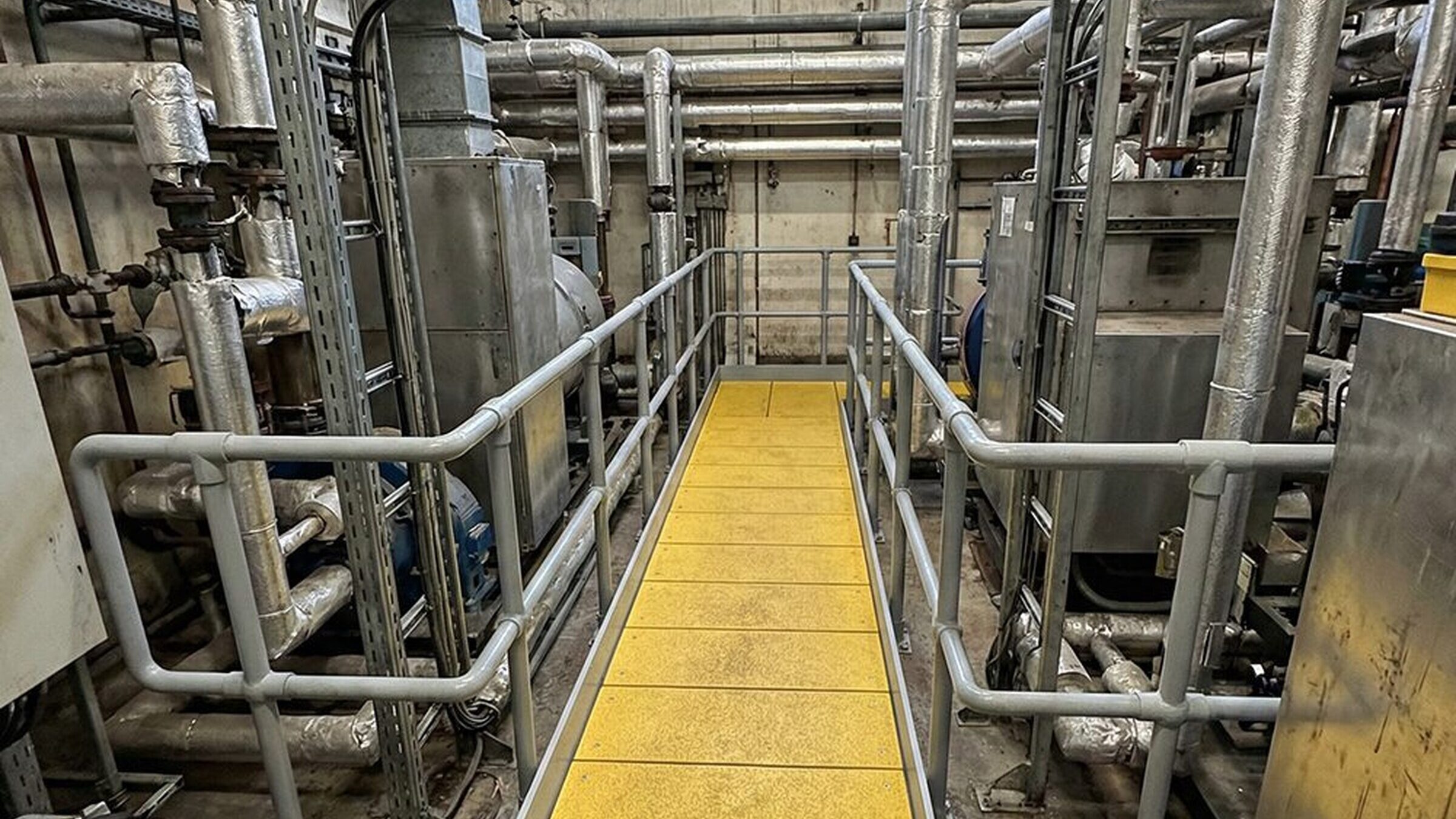
Moulded or pultruded GRP grating: which should you specify?
Neither type wins outright. The way each one is made decides which fits your job, and getting that call right matters because the wrong grating shows up on site, not on the datasheet, when a panel deflects more than the walkway allows or a cut edge sits exposed in a chemical bund.
Because we cut and assemble both grating types in our own workshop and then fix them on site, the differences below are the ones that show up in the work.
Moulded and pultruded are the two ways GRP grating is made. Both are glass-reinforced plastic, the same fibreglass material; the manufacturing route is what separates them.
Moulded grating carries load in both directions and resists corrosion well, which suits corrosive, immersed and irregular work on shorter spans. Pultruded grating is stiffer along the bar, so it spans further between supports and takes heavier or repeated traffic with less steel underneath.
This guide is general information to help you scope a choice, not a structural specification for your project; the loadings, the slip rating and any fire classification are project-specific and sit with your structural engineer and the relevant authority. What follows weighs the two on how each is made, how far it spans, how it handles corrosion, how it cuts on site, how it grips underfoot, and how it costs out over the life of the installation.
Moulded vs pultruded GRP grating at a glance
The short version: moulded is the corrosion-and-fabrication choice, pultruded is the span-and-load choice. Treat every row below as a general property of the two types rather than a figure for your job, because the allowable loads come from the manufacturer's published table and the engineer who specifies the platform.
| Property/Factor | Moulded GRP grating | Pultruded GRP grating |
|---|---|---|
| How it is made | Glass rovings laid in two directions in an open mould, cured as one piece | Rovings pulled through a heated die into load bars, then assembled with cross rods |
| Strength direction | Bidirectional, load shared both ways | Mainly along the bearing bar |
| Span between supports | Shorter spans, closer support | Longer clear spans, less support steel |
| Corrosion in immersion | Higher resin content, one-piece, very strong | Strong, with assembled joints as the detail to watch |
| Cutting and fitting | Easy to cut around penetrations and cut-outs | Stiffer to work, cut bar ends need sealing |
| Surface and slip | Integral gritted top, open mesh drains well | Gritted, covered and concave tops available |
| Relative cost | Often lower per square metre | Can win over the whole job by removing support steel |
How are moulded and pultruded GRP grating made?
The two manufacturing routes are the root of every difference that follows, so they are worth setting out plainly before comparing performance.
Moulded grating is built in an open mould. Continuous glass rovings are laid in both directions and saturated with resin, and the whole panel cures as one integrated piece, so the load bars and cross bars are fused rather than joined. That one-piece build is what gives moulded its bidirectional strength and its high resin content.
Pultruded grating starts with the bars. Continuous rovings are pulled through a resin bath and a heated die, which forms high-strength load bars with the fibres running the length of the bar. Those bars are then mechanically assembled with cross rods into a panel. Because the reinforcement runs along the bar, pultruded grating is strong and stiff in the bar direction and relies on the assembly for the cross direction.
That single difference, fibres laid both ways and cured as one versus fibres pulled straight and assembled, drives the span, corrosion and fabrication behaviour every specifier ends up weighing.
Which spans further and carries more load between supports?
Pultruded grating generally spans further for a given depth, because its continuous fibres run along the bearing bars and resist bending where it counts. Moulded grating carries load in both directions, which is useful on awkward support layouts, but it is less stiff bar-for-bar, so it wants closer support centres over a long run.
If your platform needs a long clear span and you want to keep supporting steel to a minimum, pultruded is usually the better call, because its continuous fibres carry the bending along the bar and let the panel reach further before it deflects. If the spans are short with frequent support, moulded sits comfortably there, because its bidirectional behaviour and easy fabrication matter more than reach.
The numbers behind those spans are engineer territory, and this is the line worth holding. Loadings are set by the lead structural engineer, designed under Eurocode 1 (BS EN 1991-1-1), and the allowable span for a given load and deflection limit comes from the chosen manufacturer's load table. We fabricate and install the grating to meet whatever the engineer specifies; we do not publish span or load figures of our own, because those belong to the design, not to the supplier.
Which holds up better in corrosive and immersed environments?
Both types resist corrosion far better than mild steel, and that corrosion resistance is the main reason GRP gets specified at all over a chemical bund, a wastewater channel or a coastal deck. Between the two, moulded usually has the edge in the most aggressive and immersed conditions, because its higher resin content and fully encapsulated, one-piece construction leave less to attack.
If the grating sits in a chemical bund or a wastewater channel, moulded earns its place, because its one-piece cure leaves no bar-to-rod joint for the chemistry to work on. Pultruded grating is still strongly corrosion-resistant, but on the harshest immersion duties those assembled joints are the detail to keep an eye on.
The bigger lever on either type is the resin. The grade, whether a standard polyester, an isophthalic, a vinyl ester or a phenolic, should be matched to the actual chemical environment, and the right grade does more for service life than the choice between moulded and pultruded alone.
GRP earns its keep in three places in particular: chemical plants, rooftop plant decks and coastal exposure, where steel's whole-life cost goes on recoating and replacement. Outside those, a steel access platform is often the better answer, and we will say so.
Which is easier to cut, fit and fabricate on site?
Moulded grating is generally the easier of the two to cut and fit. Its mesh forgives notching around pipe penetrations, drains and irregular openings, and a cut edge needs little more than tidying. That makes it the natural choice for platforms with a lot of cut-outs or an awkward outline.
Pultruded grating is stiffer to work, and its cut bar ends expose the fibre, so they need sealing to keep the corrosion resistance intact at the cut. It is entirely workable, but it asks for more care and a bit more time on a complex fit.
Either way, cutting GRP releases dust, so the work is done with the right respiratory and eye protection and on-tool extraction where it fits. As fabricators and installers, the fabrication difference reads straight across to programme: a panel that drops in cleanly around the services saves a day that a fiddly cut-and-seal sequence spends.
How do slip resistance and surface options compare?
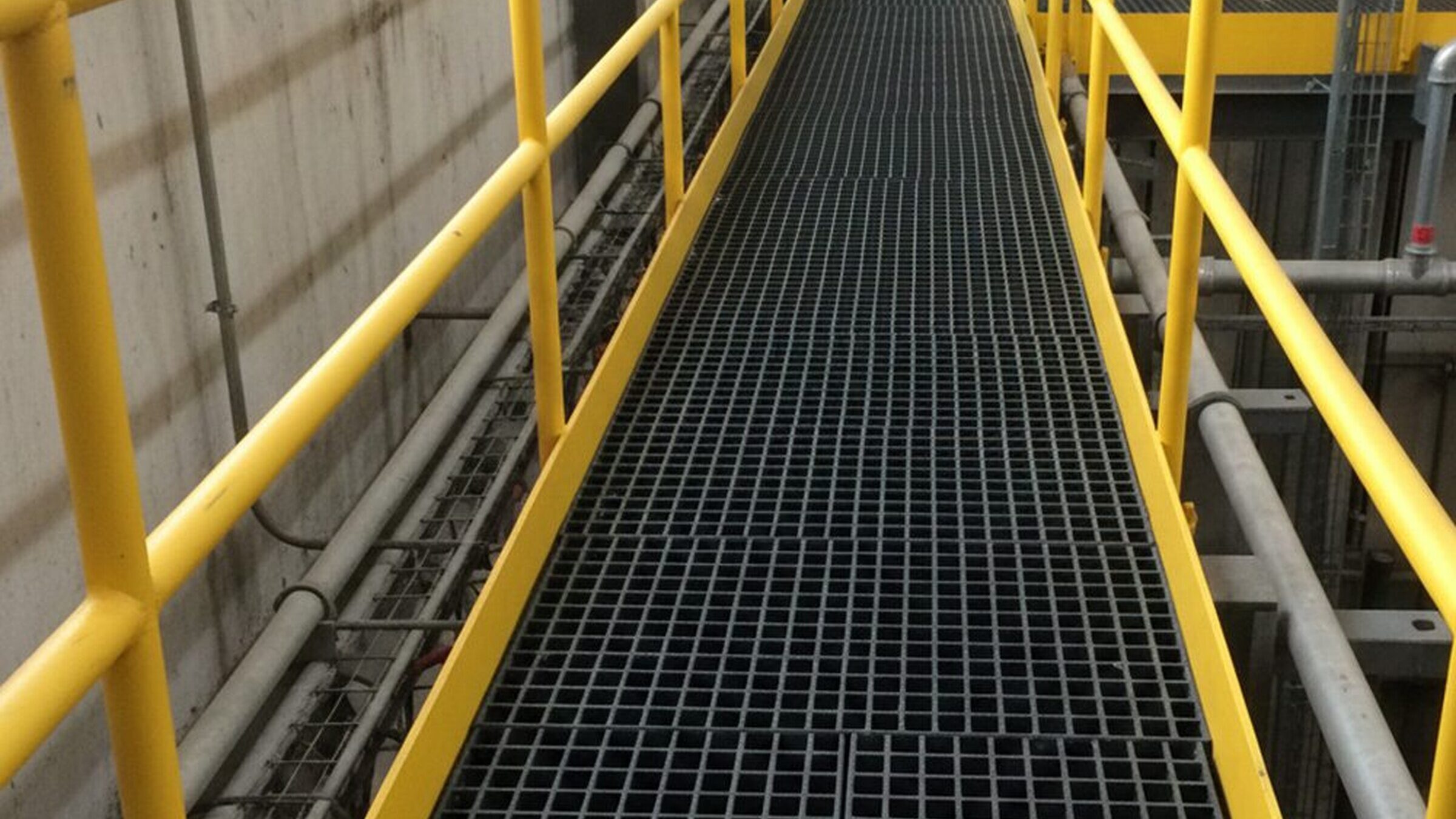
Both types take an anti-slip surface, so the question is which surface forms each offers rather than whether they grip. The standard finish on both is an integral gritted top, formed as the panel cures, which puts the grit into the surface rather than onto it.
Moulded grating adds the benefit of its open mesh, which drains well and clears underfoot in wet, oily or wash-down areas. Pultruded grating offers gritted, covered-top and concave surface options to suit the duty.
Slip performance itself is measured by the pendulum test to BS EN 16165, which gives a pendulum test value for the surface wet and dry. We issue the project's pendulum values as part of the operation and maintenance pack at handover, matched to the surface actually supplied, rather than quoting a single headline number, so the specification is auditable from day one.
How do the costs compare over the life of the installation?
This is general budgeting guidance rather than a price, and the honest comparison is over the whole life of the installation, not the panel on its own. Moulded grating is often lower cost per square metre. Pultruded can still come out ahead on the whole job where its longer span removes supporting steelwork from the design.
The cost of either type moves with the panel type, the load-bar depth and span, the resin grade, the surface finish, the cut-outs, and the supports, fixings and edge trim, which is why an installed engineered solution is a different number from a panel-only price. In a corrosive setting, the whole-life cost is where GRP makes its case against steel: of either grating type, GRP avoids the recoating and corrosion-driven replacement cycle that drives steel's lifetime cost in a wastewater or chemical environment.
To price a job properly, a supplier needs the area, the span, the loading, the environment and the finish. With those, the choice between moulded and pultruded usually settles itself on the engineering, and the cost follows the choice rather than driving it.
Who sets the loadings, and how do you read a GRP grating load table?
The loadings are set by your lead structural engineer; the grating is then specified to meet them. A blog cannot give you the allowable load for your platform, and any supplier who quotes one without your span and environment is guessing.
What a manufacturer's load table does tell you, read in general terms, is how a profile behaves. The columns to understand are the load-bar depth, the mesh or aperture, the span direction, the support span and the deflection limit, and whether the figure is a uniformly distributed load across the panel or a concentrated load at a point, such as a trolley wheel. A deeper load bar or a closer support span lets the same grating carry more; a tighter deflection limit, often quoted as a fraction of the span, lowers the allowable load because the panel is held to a stiffer feel underfoot.
In the UK, GRP industrial flooring, walkways and stair treads are specified against BS 4592-0:2006+A1:2012, and that is the standard the manufacturer's table and your engineer will both work to. Take the allowable loads from the chosen manufacturer's published table and confirm them with the engineer for your project; treat the figures here as how-to-read guidance, not a specification.
When should you choose moulded, and when pultruded?
Pulling the threads together: the right answer comes from the span, the environment and the loading taken as one, and the manufacturing method follows from those three.
- Choose moulded grating when corrosion or immersion is the dominant concern, when the platform has complex cut-outs or an irregular outline, or when the spans are short with frequent support.
- Choose pultruded grating when you need a long clear span, want to reduce the supporting steelwork, or are carrying heavier or repeated point loads such as trolley or occasional-vehicle traffic.
Where a job mixes both demands, it is common to use each type where it fits rather than forcing one across the whole platform. The access onto that platform matches it: GRP stairs and up-and-over access can be built in the same grating as the deck they serve.
When GRP is the right call, whichever type, we supply, fabricate and install GRP walkways, access decks and maintenance platforms to BS 4592, with the slip-resistance pendulum values and any fire classification issued in the project operation and maintenance pack, matched to the grade specified for the job.
Handrails, barriers and riser systems follow the same route. We did exactly that on the GRP riser flooring at One Centenary Way alongside the steelwork package. When steel is the better answer, on a high point load, a long structural span or a fire-rated structure, we will tell you that too, because we fabricate and install in both materials and have no reason to push one over the other.
If you have a platform, walkway or deck to grate, request a quote with the span, loading, environment and finish, and we will work the right type up against your drawings.
Universal Industrial Services has designed, fabricated and installed steel and GRP access systems across the UK from its Rotherham base since 1994.

Written by
Jacob Hughes
Jacob Hughes is a Director at Universal Industrial Services, one of the UK's leading specialists in structural steelwork, architectural metalwork, and bespoke fabrication. With over a decade of leadership experience in the industry, Jacob oversees all aspects of project delivery - from strategic planning and compliance to client relations and operational excellence. Following the vision set by his father, company founder Neil Hughes, Jacob plays a critical role in maintaining the high standards, safety practices, and innovative approaches that Universal Industrial Services is known for. He is deeply committed to upholding the company's BS EN 1090 certification and CHAS Advanced accreditation, ensuring that every project meets the highest quality and regulatory benchmarks. While Jacob’s day-to-day role focuses on business development and project oversight, he works closely with Universal’s highly skilled engineering and fabrication teams to deliver complex projects across the UK. His leadership supports the company’s mission to invest in people, technology, and sustainable practices, helping clients achieve outstanding results in every project. Outside of work, Jacob is passionate about driving innovation within the steel and metalwork sectors and continues to champion professional development within the Universal Industrial Services workforce.