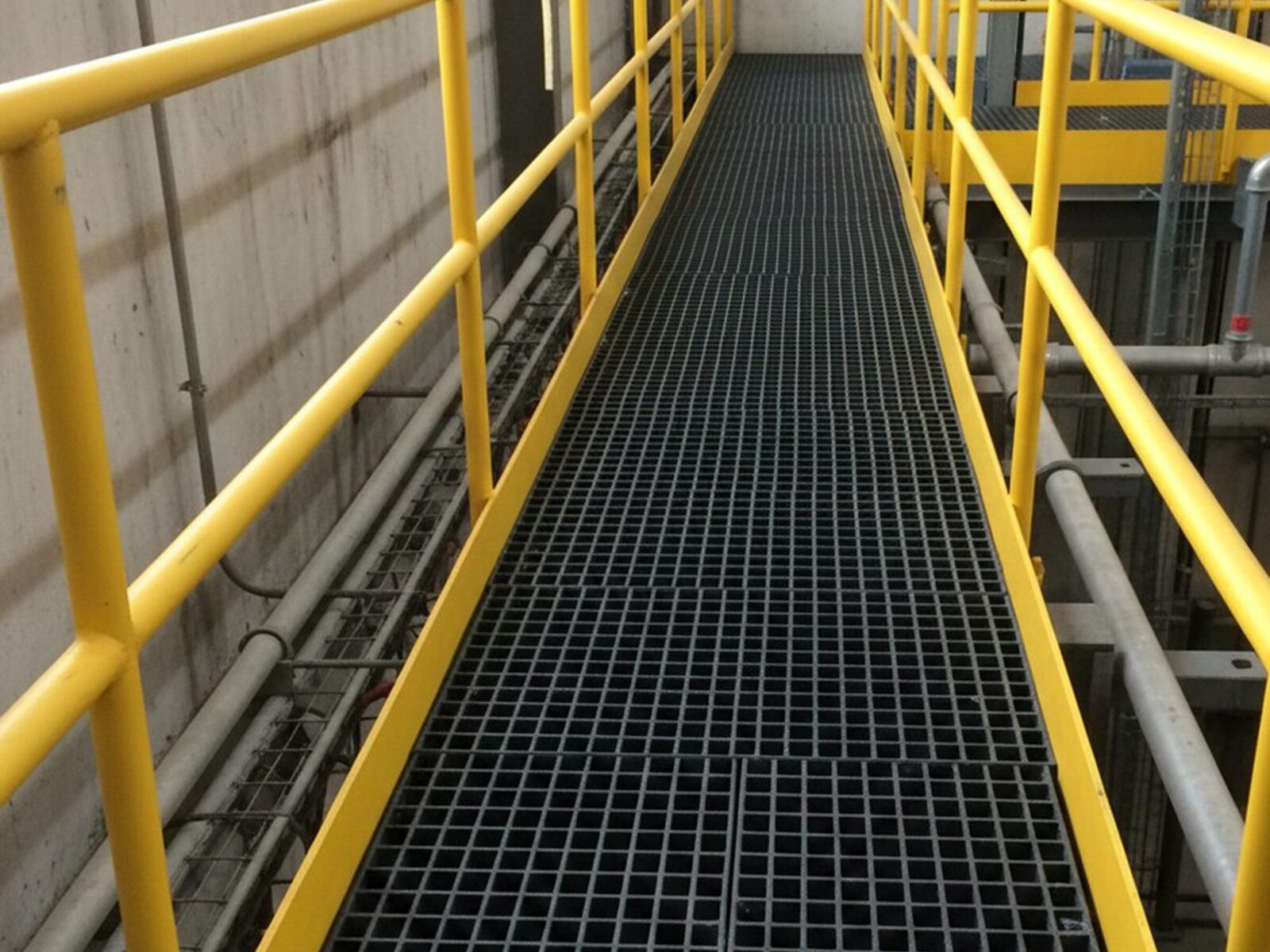
GRP grating has no single fixed service life. Manufacturers publish their own service-life figures for their products, but those figures describe what the material can achieve when it is specified correctly for its environment, installed properly and maintained. They are not guarantees, and no official body publishes a standard lifespan figure for GRP grating.
What actually decides how long a panel lasts is the specification: the resin system matched to the chemical and temperature exposure, the construction type chosen for the load case, the UV protection specified for outdoor use, and how well the grating is installed and looked after once it is in service. Get that specification right and GRP grating will commonly outlast galvanised steel in the environments that justify it: chemical plants, rooftop plant rooms and coastal installations where corrosion shortens the working life of steel decking. In other environments, galvanised steel decking is usually more cost-effective and fit for purpose.
Why GRP grating has no single lifespan figure
The figures manufacturers quote are not warranted lifespans, and they are not universal. They come from product literature and are indicative of what well-specified, properly installed grating achieves in service.
The reason there is no single number is that the service life is not a property of the material alone. It is set by the combination of:
- the resin system;
- the glass reinforcement;
- the UV protection;
- the chemical and thermal environment;
- the loading;
- the installation quality; and
- the maintenance regime.
Change any one of those and the life changes with it. A vinyl ester panel in a chemical-plant walkway and an orthophthalic panel on a rooftop access deck are both GRP grating, but they are specified for different exposures and will age differently.
What GRP grating does share across all variants is that it does not rust, does not rot and does not need repainting. Composites UK, the industry trade association, describes the material in its durability guidance as water resistant, thermally stable and unable to rust, with a long service life. That is why it outlasts steel in wet and chemically aggressive settings, and it is the reason specifiers reach for it where corrosion drives the whole-life cost of a steel alternative through regular replacement or remediation. But "does not corrode" is not the same as "lasts forever". The working life of a GRP grating installation is governed by the specification, the installation and the maintenance, and those are the factors a specifier and a facilities manager actually control.
What decides how long GRP grating lasts
Specifying correctly for the actual environment is the single biggest factor in GRP grating service life. Four things feed into that specification: the resin system and glass content, the construction type (moulded or pultruded), the service environment and loading, and the installation. The designer controls each one at specification stage.
We supply and install GRP grating as part of our access platform and walkway packages. On the One Centenary Way project for Sir Robert McAlpine, we supplied and installed GRP riser flooring specified for the service environment and fixed to the manufacturer's fixings guidance. Panels that are specified for their actual environment and installed to the manufacturer's fixings guidance need little more than regular cleaning and inspection. Panels that were under-specified or poorly installed can start showing problems early. If you are writing or checking the specification, we approach the material selection and installation as part of our GRP grating service.
The resin system and glass content
The resin family is the main driver of chemical and temperature resistance, and it is the first decision in a GRP grating specification. Four resin families cover the range of common industrial exposures:
- Orthophthalic polyester suits mild environments: indoor walkways, general-purpose access platforms, locations with no sustained chemical or UV exposure.
- Isophthalic polyester handles moderate chemical and moisture exposure and is the most widely specified resin for general outdoor industrial use.
- Vinyl ester resists a broader range of chemicals and higher temperatures, and is specified where process spillage or aggressive wash-down chemicals are part of the operating environment.
- Phenolic adds fire-performance properties and is specified where fire rating drives the material choice, typically in offshore, rail or tunnel applications.
We include the specific fire classification documentation in the project O&M pack for every GRP grating installation we supply, because the fire rating is set by the resin grade specified, not by GRP as a generic material class. That documentation ties the rating to the actual product on site, so there is no ambiguity at handover about what fire performance the panel achieves.
Specifying the wrong resin for the exposure is the fastest route to premature failure. An orthophthalic panel installed where the chemical environment calls for vinyl ester will degrade in a fraction of the time, regardless of how well it is installed.
Glass content and the quality of the fibre lay-up also matter. Higher glass content gives the panel its structural performance, and a consistent lay-up keeps that performance stable over time. The manufacturer's product datasheet states the resin system, glass content and the chemical resistance table for the product. There is more detail on how GRP's material properties are set by resin and reinforcement.
Moulded or pultruded grating
Neither moulded nor pultruded GRP grating lasts longer than the other by default. They are different construction methods, chosen for different load and corrosion requirements, and both achieve comparable service lives when specified correctly.
Moulded grating has a resin-rich surface on all faces, which gives it strong chemical resistance from every direction and makes it the usual choice in chemically aggressive environments where spills contact the panel from above and below. The mesh construction distributes load in two directions, and the higher resin content gives better corrosion resistance at cut edges.
Pultruded grating has continuous unidirectional glass reinforcement, which gives it higher load capacity over longer spans in one direction. The bearing bars are stronger in the span direction, and the panel suits heavier-duty walkways and platforms where the structural demand is higher. The cut ends of pultruded profiles expose the fibre reinforcement and should be resin-sealed at installation.
Load case, span, corrosion environment and the panel depth available decide which method suits the job. The structural and specification differences between moulded and pultruded grating are set out in full.
The environment, loading and foot traffic
GRP grating lasts longest when the operating environment stays within what the panel was specified for. Life drops when exposure or load exceeds the specification, and three types of environmental stress account for most premature degradation:
- Chemical attack is the most common cause of resin breakdown. When the chemical environment exceeds the resistance of the specified resin, the matrix degrades from the surface inward, softening the panel and exposing the glass reinforcement. Temperature and thermal cycling accelerate the process. The manufacturer's chemical resistance table is the reference, and it is specific to the resin system, not to GRP grating as a generic material.
- Sustained loading beyond the panel's design capacity causes long-term deflection and fatigue, and impact damage from dropped loads or vehicles cracks load-bearing bars. The design loadings (pedestrian, maintenance with tools, equipment roll-through, or vehicular) are the structural engineer's remit. We fabricate and install GRP grating to those specified loadings, but the loading category and the support spacing that follows from it are set at the design stage, not at procurement.
- Foot traffic and abrasion wear the anti-slip grit surface. High-traffic walkways in gritty or sandy environments lose their surface texture faster than lightly trafficked platforms. The grit is part of the panel's slip resistance, and once it wears through, the walking surface becomes smoother and the slip risk rises. Regular cleaning slows the surface wear by clearing abrasive debris before it grinds under foot.
Installation and fixings
Most early GRP grating failures start at installation, not in service. Three installation details set the starting point for the panel's working life:
- Support spacing. GRP grating is less stiff than steel, and panels supported at the correct centres (as stated on the product datasheet for the load case) will carry their design load without excessive deflection. Increase the span beyond the specification and the panel deflects more under load, stressing the resin and reinforcement beyond their design limits. We supply GRP grating manufactured to BS 4592-0:2006+A1:2012, the British Standard for GRP flooring and stair treads, and both Part 4 (open-bar gratings) and Part 6 (moulded) establish the deflection criteria the lead structural engineer works to when specifying the panel for the load case.
- Cut-edge sealing. Every cut through a GRP panel exposes the glass reinforcement inside the laminate. If those edges are not sealed with a compatible resin, moisture and chemicals wick into the laminate from the cut face. Over time that weakens the bond between the glass and the resin, and the panel loses structural performance from the inside out. Resin-sealing cut edges at installation is straightforward and it prevents a failure mode that is invisible until the panel is already compromised.
- Fixings. GRP grating should be fixed with the manufacturer's approved stainless-steel clips and fasteners, and those fasteners should not be overtightened. GRP creeps under sustained compressive load: an overtightened bolt that feels secure at installation slowly crushes the panel locally, cracking the laminate around the fixing. Tighten to the manufacturer's stated torque and the fixing holds without damaging the panel.
Get the installation right and the grating starts its service life in the condition the manufacturer intended. Get it wrong, and no amount of cleaning or inspection recovers the lost performance.
What UV and weathering do to GRP grating outdoors
Sunlight degrades the exposed surface resin of GRP grating through UV-driven photo-oxidation. The process starts at the top surface and works inward, and the visible signs follow a predictable sequence:
- Colour fade.
- Chalking (a powdery residue on the surface).
- Roughening and surface-fibre bloom, as the resin matrix erodes and exposes the glass reinforcement beneath.
While the surface resin is degrading, the anti-slip grit bonded to the top face is also loosening. UV breaks down the resin that bonds the grit particles to the panel, and foot traffic strips them once the bond weakens. The result is a walking surface that becomes progressively smoother, and slip resistance falls over time. On outdoor walkways and platforms where anti-slip performance is specified, this is the point where cosmetic weathering becomes a safety issue.
We issue pendulum test values to BS EN 16165 with the project O&M documentation for our GRP grating installations, giving the installation a measured baseline for anti-slip performance from day one. A Pendulum Test Value of 36 or above in the wet condition is the accepted threshold for low slip potential under the HSE's preferred test method, and having that figure on record means you can track how the surface performs as it weathers rather than relying on a manufacturer's description alone.
Two specification measures slow the process:
- A UV-stabilised resin system incorporates stabiliser additives into the resin matrix at manufacture, absorbing or blocking a proportion of the UV radiation before it damages the polymer chains.
- A surface veil (a thin reinforcement layer applied to the exposed face during manufacture) adds a resin-rich barrier that takes the UV exposure first and protects the structural glass reinforcement beneath it.
Specifying both for any outdoor or rooftop installation is standard practice.
Artificial weathering tests carried out to ISO 4892 give a standardised measure of how a specific GRP product performs under accelerated UV and moisture cycling. Manufacturers use these test results to support their indicative service-life claims. The product's weathering data should be available on the manufacturer's datasheet or on request.
Indoor GRP grating, shielded from direct sunlight, is not subject to this degradation path. Where grating is installed indoors with no UV exposure, the surface resin and grit last significantly longer, and the practical service life is governed by chemical exposure, loading and maintenance rather than by weathering.
How to clean GRP grating without damaging it
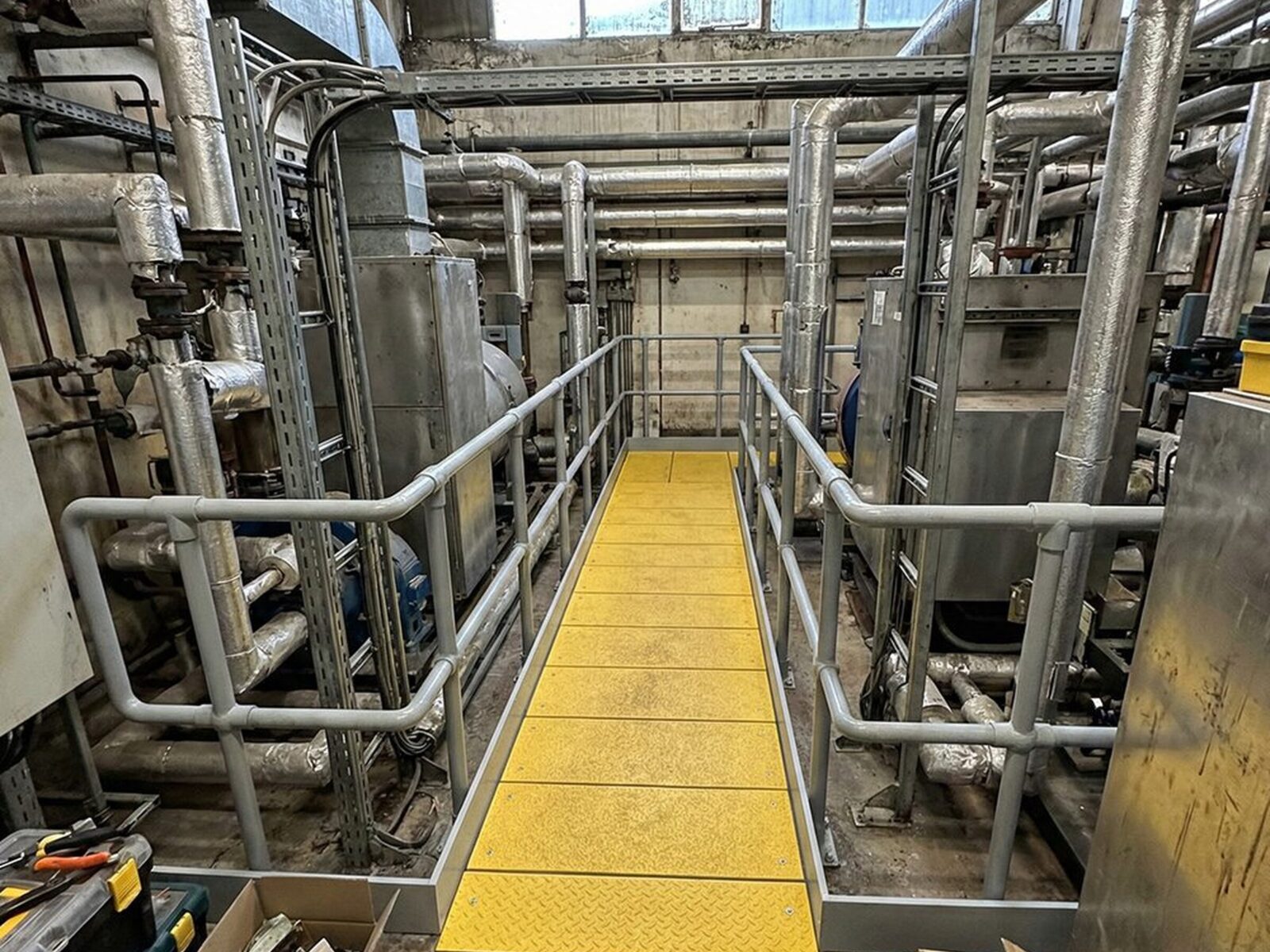
To clean GRP grating without damaging it, wash it down with warm water and a mild detergent. It is low-maintenance, but it is not maintenance-free. Regular cleaning preserves the anti-slip grit, keeps the mesh openings clear for drainage, and removes debris that would otherwise trap moisture against the panel surface and accelerate localised degradation.
The method is straightforward: clear loose debris with a stiff non-metallic brush, wash down with warm water and a mild detergent, and rinse. Keep the mesh openings clear so that water drains freely and does not pond on the panel surface. Where chemical spills are part of the operating environment, follow the manufacturer's cleaning guidance for the specific resin system.
Pressure washing is acceptable at low pressure, but keep the jet away from fixings, cut edges and any areas where the surface is already worn or damaged. A concentrated high-pressure jet at a fixing point can drive water into the laminate around the bolt hole, and at a worn area it strips the remaining grit and exposes the resin beneath. Use a fan nozzle rather than a pinpoint jet, and keep the pressure moderate.
Three things will damage GRP grating and should never be used on it:
- Strong acids or alkalis attack the resin matrix.
- Aggressive solvents soften it.
- Abrasive cleaning tools, including wire brushes, steel wool and abrasive pads, strip the grit and score the surface.
If you are using an unfamiliar cleaning product, test it on a small inconspicuous area first and check the surface after 24 hours before applying it to the full installation.
Inspecting GRP grating and knowing when to replace it
Inspect GRP grating on a risk-based schedule set by the site risk assessment and the manufacturer's guidance, not on a fixed statutory interval. Higher-traffic walkways and grating in chemically aggressive environments need more frequent inspection. Any panel should be inspected immediately after an impact event or severe weather.
The signs to look for, roughly in the order they appear as degradation progresses:
- Colour fade, chalking or surface roughening (cosmetic, but a leading indicator of UV degradation on outdoor panels).
- Worn, thinning or missing anti-slip grit (slip resistance is falling; the panel may still be structurally sound but the walking surface is compromised).
- Chips, cracks or surface crazing in the resin.
- Cracked or delaminated load-bearing bars (serious: the panel is losing structural capacity).
- Exposed glass fibres at the surface or at cut edges (the resin barrier is breached and moisture is reaching the reinforcement).
- Loose, corroded or missing fixings.
- Excessive deflection or movement underfoot.
- Degraded or unsealed cut edges.
- Blocked mesh openings holding standing water.
Under the Workplace (Health, Safety and Welfare) Regulations 1992, regulation 12, floors and traffic routes in a workplace must be kept in a condition that is safe for use and properly maintained. HSE guidance on slips, trips and safe access reinforces the duty. The regulations do not prescribe a specific inspection interval for GRP grating, but they place the duty on the employer to maintain safe conditions, and a documented inspection regime is the practical way to meet it.
When an inspection finds cracked load-bearing bars, exposed fibres in structural areas or excessive deflection, restrict access to the affected panel and arrange an engineering assessment. The structural sign-off is the structural engineer's. Do not assume a panel is safe because it looks intact from above: delamination and internal fibre damage are not always visible from the walking surface.
Replace a panel when:
- its structural integrity or safe performance is compromised;
- the engineering assessment calls for it; or
- the anti-slip surface has degraded to the point where slip resistance no longer meets the site requirement.
Specify the right product for the actual environment, install it correctly, clean it regularly, inspect on a risk-based schedule and keep records. That is the route to the service life the manufacturers quote, and it is what separates a GRP grating installation that lasts from one that fails early. If you are specifying or maintaining GRP grating in Yorkshire or anywhere in the UK, our GRP team can walk you through the options.
FAQs
Is GRP grating stronger than steel?
GRP grating is not stronger than steel grating in every property, and steel grating is not stronger than GRP grating in every property. The two materials win on different measures, and the right choice depends on the load case, the span and the environment.
GRP grating has a higher strength-to-weight ratio. A GRP panel weighs roughly a fifth of an equivalent steel panel, which makes it easier to handle, reduces dead load on the supporting structure and simplifies installation where crane access or manual handling are constrained. GRP grating does not corrode, so it outperforms steel over time in wet, chemically aggressive and salt-air environments where galvanised steel loses its protective coating. The Galvanizers Association's durability data puts the maintenance-free life of hot-dip galvanizing at 50 years or more in most atmospheric environments across the UK and Ireland, so GRP's advantage opens up specifically where aggressive chemical exposure, sustained moisture or coastal salt air strips that zinc coating faster than normal atmospheric weathering would.
Steel grating has higher absolute stiffness and handles concentrated point loads and impact better than GRP grating of the same depth. Where the load case involves heavy point loads, vehicular traffic or high-energy impacts, steel is usually the more suitable material.
| Property | GRP grating | Steel grating |
|---|---|---|
| Weight | Roughly a fifth of an equivalent steel panel; higher strength-to-weight ratio | Around five times the weight of equivalent GRP |
| Corrosion | Does not corrode; outperforms steel in wet, chemically aggressive and salt-air environments | Hot-dip galvanizing: 50 years or more before first maintenance in most UK atmospheric environments, according to the Galvanizers Association, but aggressive chemicals, sustained moisture or coastal salt air strip the zinc faster |
| Stiffness and point loads | Lower absolute stiffness at the same depth | Higher absolute stiffness; handles concentrated point loads and impact better |
For many industrial and commercial access applications, the longest service life comes from a steel frame with GRP decking: the steel frame carries the structural load and the GRP deck resists the corrosion that would shorten the life of a steel deck in the same environment. A steel frame with GRP decking is common in chemical plants, rooftop plant rooms and coastal installations, and it is how we approach GRP grating where corrosion is the primary consideration. We fabricate the structural steel frames in our Rotherham workshop and supply the GRP grating decking to match, so one contractor holds the programme for both materials. That removes the coordination risk you would otherwise carry if the steel frame and the GRP panels came from separate suppliers, and it means the frame and the deck are dimensioned to the same set of drawings.

Written by
Jacob Hughes
Jacob Hughes is a Director at Universal Industrial Services, one of the UK's leading specialists in structural steelwork, architectural metalwork, and bespoke fabrication. With over a decade of leadership experience in the industry, Jacob oversees all aspects of project delivery - from strategic planning and compliance to client relations and operational excellence. Following the vision set by his father, company founder Neil Hughes, Jacob plays a critical role in maintaining the high standards, safety practices, and innovative approaches that Universal Industrial Services is known for. He is deeply committed to upholding the company's BS EN 1090 certification and CHAS Advanced accreditation, ensuring that every project meets the highest quality and regulatory benchmarks. While Jacob’s day-to-day role focuses on business development and project oversight, he works closely with Universal’s highly skilled engineering and fabrication teams to deliver complex projects across the UK. His leadership supports the company’s mission to invest in people, technology, and sustainable practices, helping clients achieve outstanding results in every project. Outside of work, Jacob is passionate about driving innovation within the steel and metalwork sectors and continues to champion professional development within the Universal Industrial Services workforce.