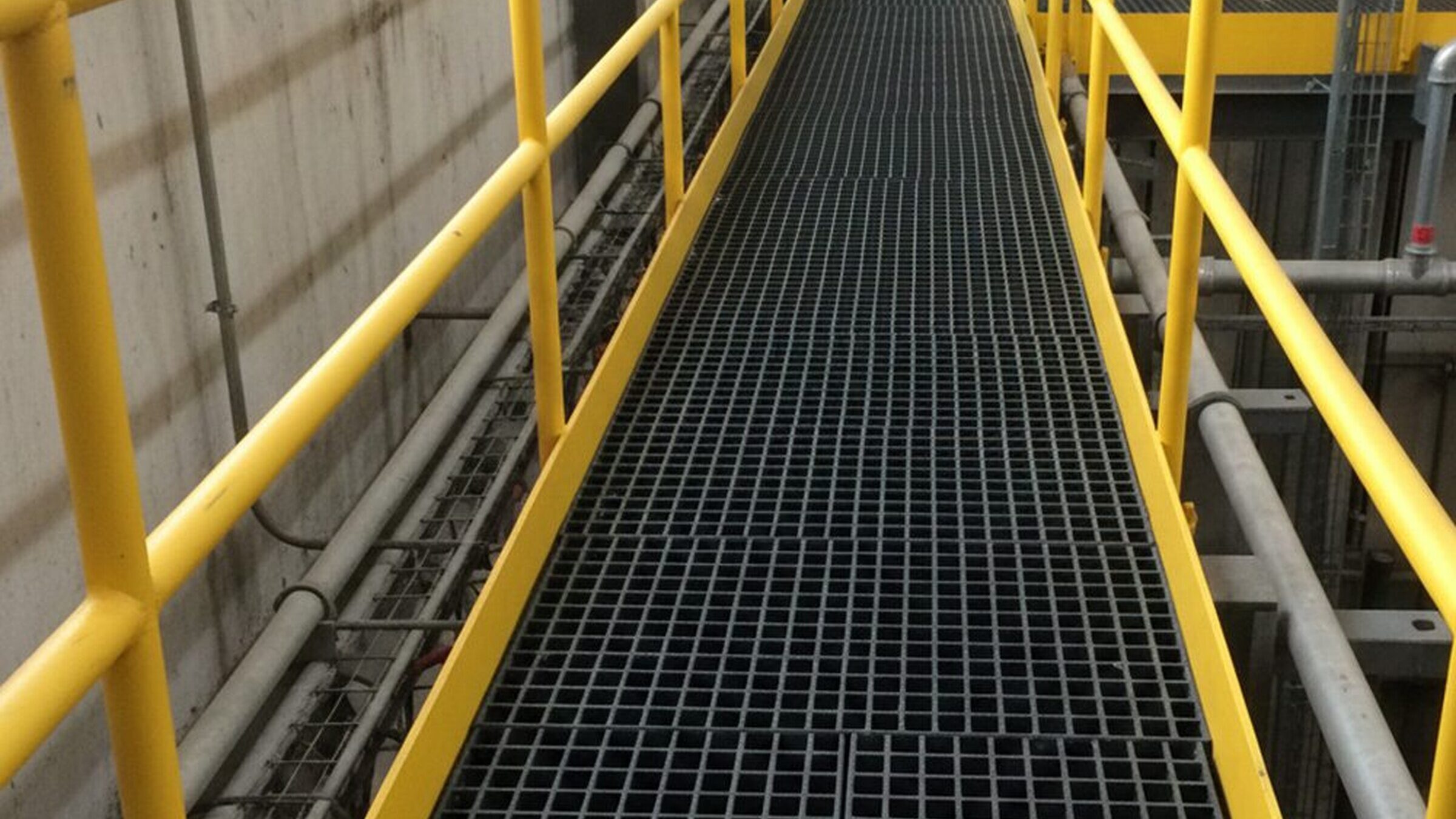
You might be specifying a walkway for a rooftop plant deck where steel would rust out, replacing a stretch of slippery galvanised grating in a wash-down bay, or checking whether the access platform your team crosses every day still grips the way it did on the day it went in.
Underneath all three sits the same question: how does GRP grating resist slipping, and how do you know it still does?
Glass-reinforced plastic (GRP, also called fibreglass) grating has become a common walking surface in industrial access because it does not corrode, weighs a fraction of steel, and carries its anti-slip surface built into the panel rather than painted on afterwards.
This post explains what GRP anti-slip grating is, how its surface and profile resist slipping, how that resistance is measured and reported, and how to keep it over the life of the surface. It is written for specifiers, safety officers, facilities and maintenance managers, and contractors making or checking that call.
Quick answer: GRP anti-slip grating grips because a hard grit, usually silica or aluminium oxide, is bonded into the resin surface as the panel cures, so it bites through the film of water, oil or dust that causes most slips. In the UK that grip is measured with the pendulum test to BS EN 16165, the standard that superseded BS 7976-2, and reported as a Pendulum Test Value (PTV), read in the wet, because that is when slips happen. The rating only lasts while the surface stays clean and the open mesh keeps draining, so cleaning and inspection matter as much as the original specification.
What is GRP anti-slip grating?
GRP anti-slip grating is industrial flooring made from glass fibres set in a cured resin, with a textured anti-slip surface formed into the top of the panel. It is used for walkways, access decks, maintenance platforms, stair treads and handrail infill, mostly where steel would corrode or where weight and electrical conductivity rule steel out.
Two things make it suit those settings. It resists corrosion, so it holds up in wet, salt or chemical exposure that would have steel back on a recoating cycle.
And it is non-conductive and light, which matters around live electrical plant and on structures where dead load is tight. The grating comes in two main forms, moulded and pultruded, and the difference between them shapes both how the surface grips and how far a panel can span. Both are covered below.
Why does slip resistance matter on walkways and access platforms?
Slips and falls on access surfaces are a recognised workplace and work-at-height risk, which makes the walking surface a safety decision rather than a finish choice.
Falls from height remain one of the leading causes of serious and fatal workplace injury in Great Britain, according to the Health and Safety Executive, and a walkway or platform that loses its grip in the wet is exactly the kind of everyday hazard that sits behind those figures.
That is why the surface is specified, tested and documented rather than assumed. An access platform built to the right standards, with edge protection planned into the sequence and a walking surface chosen for the conditions it will actually face, is the practical end of taking that risk seriously.
The point is not to dramatise the danger. It is to treat the grip of the surface as something you can specify and verify, not hope for.
How does GRP grating achieve its slip resistance?
GRP grips because the grit is part of the panel, not a coating on top of it. During manufacture a hard aggregate, typically silica or aluminium oxide, is bonded into the resin surface as the panel cures, which gives a coarse texture that breaks up the thin film of water, oil or dust that lets a foot slide.
Because the grit is cured in rather than sprayed on, it wears down slowly and evenly instead of peeling away in patches.
The surface comes in a few profiles for different conditions.
- A gritted top gives the most aggressive texture for greasy or heavily contaminated areas.
- A concave (dimpled) top holds grip while staying easier on the knees and on wheeled loads.
- A covered top gives a solid plate surface where you want to stop tools or debris dropping through.
On moulded grating the grit sits on the tops of an open mesh, and that open area does a second job: it lets water and debris drain off the walking line, because standing water is itself a slip risk. On pultruded grating the anti-slip surface is usually a gritted cover plate or moulded top bonded to the load bars.
How is the slip resistance of GRP measured?
In the UK the recognised method is the pendulum test to BS EN 16165, which reports a Pendulum Test Value (PTV). The test swings a rubber-footed pendulum across the surface and measures how much the surface slows it: the more grip, the higher the PTV.
HSE guidance then groups surfaces into low, moderate and high slip potential by their PTV, with a wet pendulum test value of around 36 and above generally treated as low slip potential. That figure is general guidance, not a specification for your project, and the value you actually need should be confirmed against the current HSE guidance or with your engineer for the conditions you are designing for.
Two points decide whether a number means anything. The first is wet versus dry: almost any surface grips well dry, so the value that matters is the wet pendulum test value, read with water on the surface.
The second is that slip resistance is a property of the specific surface once it is installed, and it changes as the surface wears and picks up contamination rather than staying fixed for the life of the material. This is why a measured value belongs in the project documentation rather than being quoted as a single headline number.
How do moulded and pultruded grating compare for grip and span?
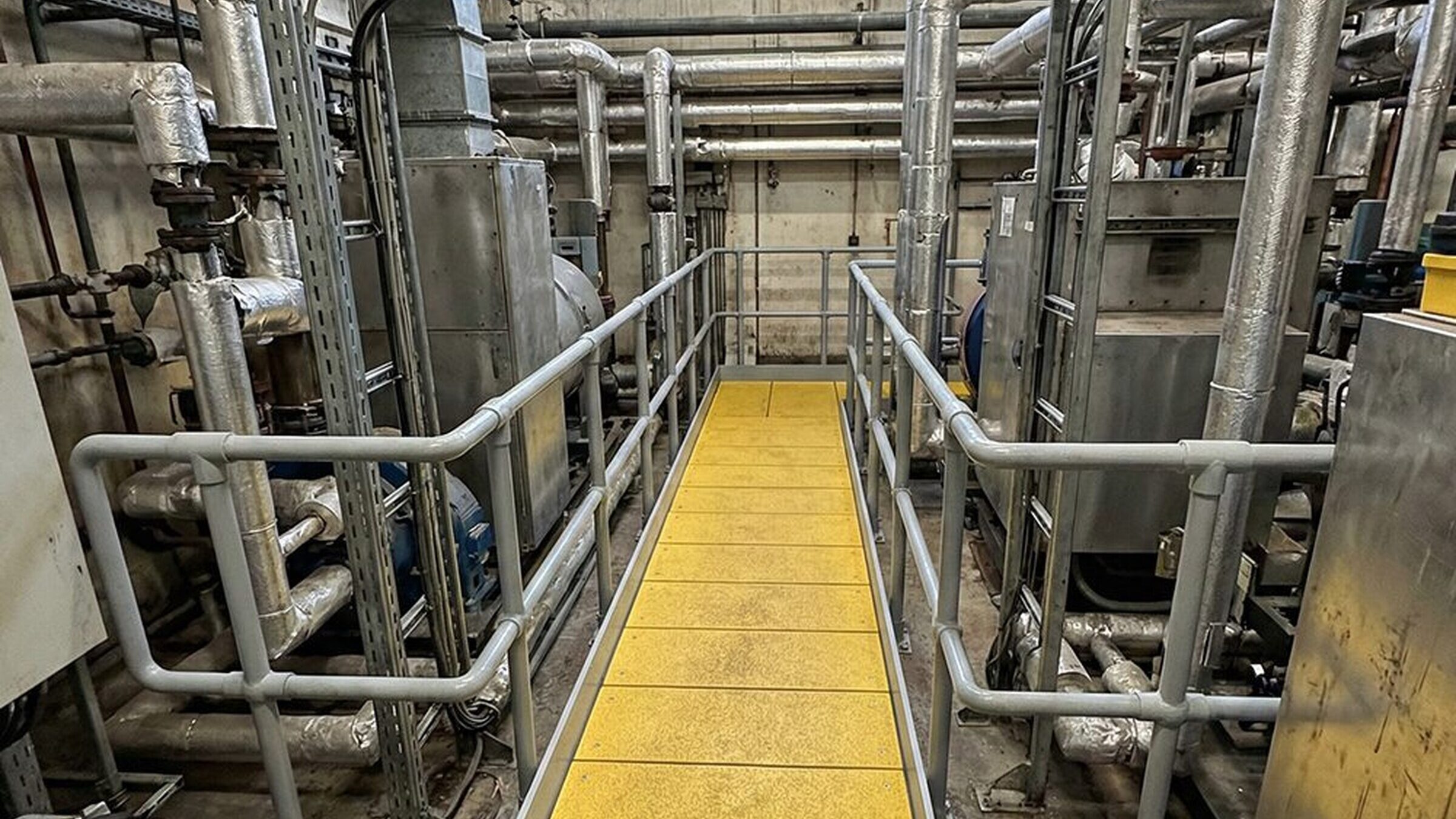
Both moulded and pultruded grating can be specified with strong anti-slip surfaces, so the honest difference between them is less about grip and more about how the panel is built. Moulded grating is an open square mesh with grit on the bar tops; it is bidirectional, drains well, and suits wash-down and corrosive areas where open area helps. Pultruded grating runs its main strength along one direction in continuous load bars, so it spans further between supports and is often the choice for longer unsupported runs.
The slip surface differs in form rather than quality. Moulded panels carry the grit on the mesh tops; pultruded panels usually take a separate gritted cover plate or concave top bonded to the bars.
Which one fits comes down to the span, the environment, and the loadings the project engineer specifies, not to grip alone. Loadings are set by the lead structural engineer on each project, and the grating is then specified and fabricated to meet whatever they have called for.
How do you maintain GRP slip resistance over time?
GRP holds its slip rating only as well as the surface is kept, because grit that clogs with grease, algae, mud or paint overspray turns a coarse panel smooth. The texture is durable, but it is not self-cleaning, and a contaminated surface can read as low slip potential on day one and still become a hazard once it fills in.
Keeping the rating is mostly housekeeping done deliberately. Clean the surface with a stiff brush or a low-pressure wash, and avoid very high-pressure jets that can drive contamination in or strip the grit.
Inspect the high-traffic lines and the stair nosings first, because that is where wear shows soonest. Where the texture has polished smooth or a panel has worn through, re-test or replace it rather than leaving it.
Because GRP does not corrode, a well-drained surface that is cleaned and checked on a routine can hold its grip for many years, but the rating follows the upkeep.
How do you choose anti-slip GRP for wet, oily or wash-down areas?
The wetter, oilier or more contaminated the environment, the harder the surface has to be specified, and the more the wet pendulum value, the drainage and the resin grade decide the choice. For a food or industrial wash-down bay, an open moulded mesh with an aggressive gritted top sheds water and resists the slip that grease and constant washing create.
If a walkway sits over a chemical bund or in constant salt spray, GRP removes the recoating cycle that steel would otherwise need, because the resin does not rust in the first place. On rooftop plant decks, GRP at around 80 per cent lighter than steel, per GRP manufacturer literature, also eases dead load and craneage.
The honest boundary is that GRP is not always the answer. For dry internal access carrying heavy point loads, steel is often the better material, and the right call is to choose for the conditions rather than to default to GRP everywhere.
Whichever surface you pick for a wet or oily area, specify it for the wet pendulum value and keep the drainage working, because a high dry grip means little once the surface is contaminated.
What standards and documentation cover GRP slip resistance?
GRP industrial flooring and stair treads are specified against BS 4592-0:2006+A1:2012, slip resistance is tested to BS EN 16165, and the measured values for a given surface belong in the project documentation rather than in a sales headline. Treat the figures and thresholds in this guide as general information to help you scope a specification, not as professional or legal advice; confirm the slip-resistance requirement for your project with your structural engineer, Building Control or the relevant authority before anything is fabricated.
The reason documentation matters is auditability. A pendulum test value issued with the project operation and maintenance (O&M) pack, matched to the surface and conditions actually installed, lets anyone reviewing the platform check the specification from day one, rather than relying on a single cherry-picked number that may have come from a dry test on a clean sample.
The same applies to fire classification, which depends on the resin grade and is issued per project rather than claimed as a blanket property of GRP.
When GRP is the right call, UIS designs, fabricates and installs GRP walkways, access decks, stair systems and handrails to BS 4592, with pendulum test values and slip-resistance data issued in the project O&M pack so the specification is auditable from handover. When steel is the better answer for the conditions, we will tell you that too. UIS has designed, fabricated and installed steelwork and GRP access systems across the UK since 1994.
If you have drawings for a walkway or platform, you can request a quote against them and we will scope it with you.

Written by
Jacob Hughes
Jacob Hughes is a Director at Universal Industrial Services, one of the UK's leading specialists in structural steelwork, architectural metalwork, and bespoke fabrication. With over a decade of leadership experience in the industry, Jacob oversees all aspects of project delivery - from strategic planning and compliance to client relations and operational excellence. Following the vision set by his father, company founder Neil Hughes, Jacob plays a critical role in maintaining the high standards, safety practices, and innovative approaches that Universal Industrial Services is known for. He is deeply committed to upholding the company's BS EN 1090 certification and CHAS Advanced accreditation, ensuring that every project meets the highest quality and regulatory benchmarks. While Jacob’s day-to-day role focuses on business development and project oversight, he works closely with Universal’s highly skilled engineering and fabrication teams to deliver complex projects across the UK. His leadership supports the company’s mission to invest in people, technology, and sustainable practices, helping clients achieve outstanding results in every project. Outside of work, Jacob is passionate about driving innovation within the steel and metalwork sectors and continues to champion professional development within the Universal Industrial Services workforce.