If you have ever had a drawing call for GRP, a supplier quote FRP, and a fitter on site call the whole lot fibreglass, you are not looking at three materials. You are looking at one material under three names.
We specify, supply and install GRP walkways, handrails and access platforms on industrial sites across the UK, and the naming question comes up often enough to be worth settling clearly.
What is the difference between GRP and FRP?
GRP and FRP describe the same kind of material. GRP is the glass-specific name. FRP is the broader term that covers any reinforcing fibre. So every GRP product is an FRP product, but not every FRP product is GRP.
Both acronyms name a composite: reinforcing fibres set in a cured resin. The resin holds the shape and handles the environment, and the fibres carry the load.
The only thing that moves between the two terms is how much they specify. GRP tells you the fibre is glass. FRP leaves the fibre open. The rest follows from that one distinction.
What does GRP stand for?
GRP stands for glass-reinforced plastic, also written glass-reinforced polymer. The glass fibre is the reinforcement. The plastic, a thermoset resin such as polyester, is the matrix that binds the fibres together and carries them through whatever the setting throws at them.
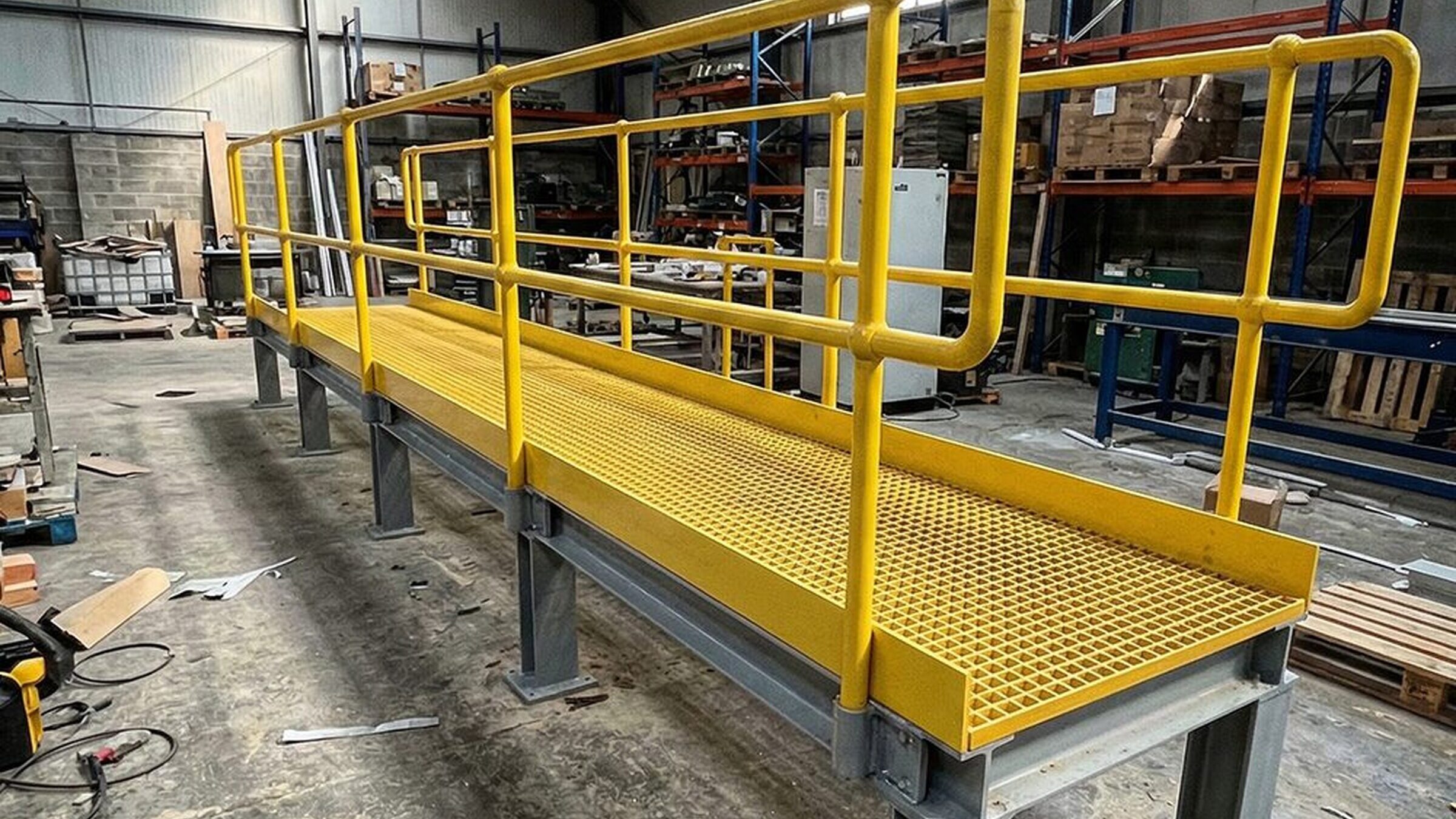
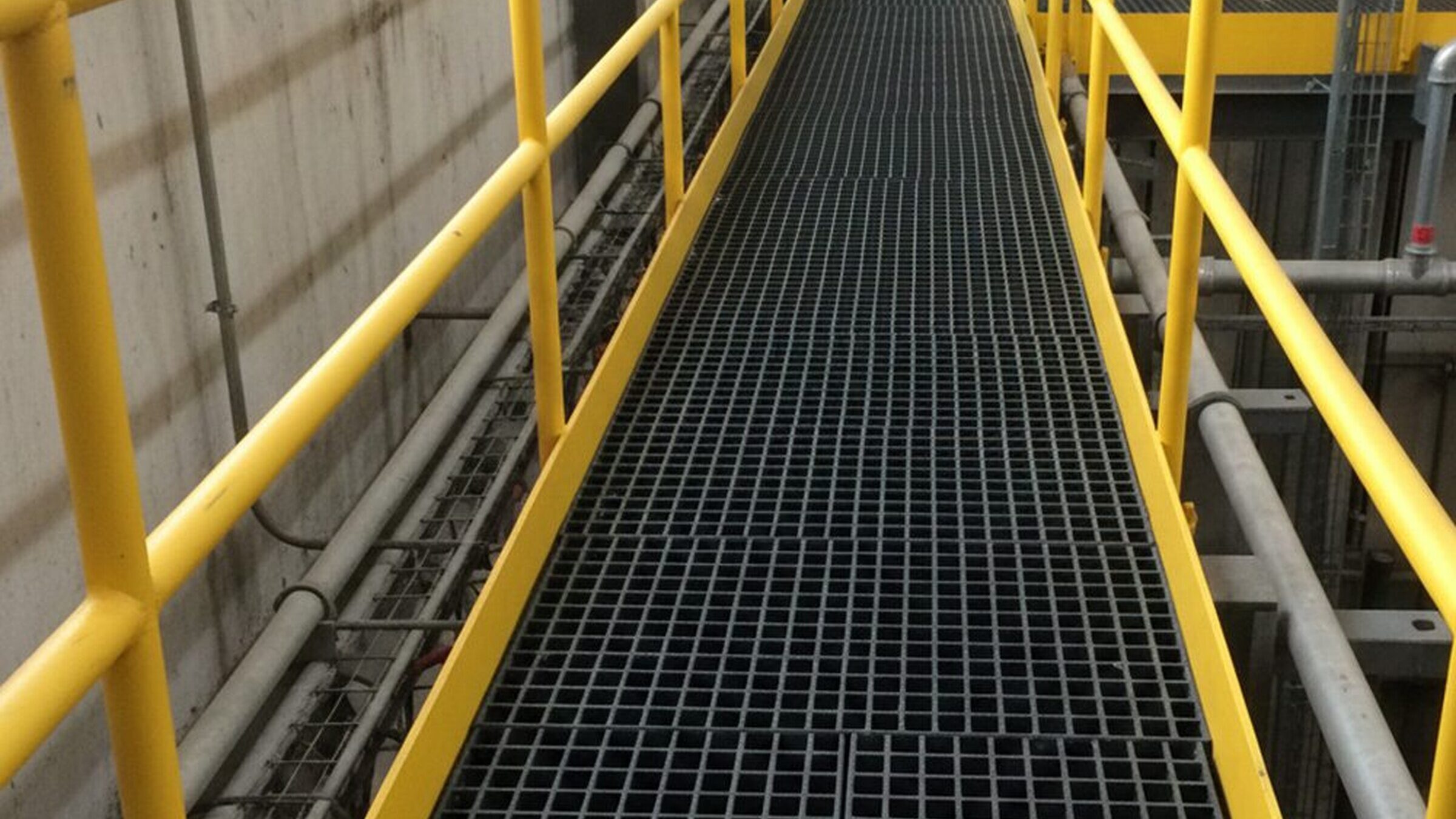
In UK industrial access, GRP turns up as gratings, walkways, handrails and platforms. The reason is what the combination gives you:
- it resists corrosion,
- it does not conduct electricity,
- and it is light to handle and to lift.
Those three properties are why it gets specified for places steel would struggle with, which is a separate question from what to call it.
What does FRP stand for, and why is it the broader term?
FRP stands for fibre-reinforced polymer, sometimes written fibre-reinforced plastic. Because the name only says fibre, it covers whatever the reinforcement happens to be: glass, carbon or aramid.
That is what makes FRP the umbrella term sitting above GRP. Change the fibre and you still have an FRP, but you no longer necessarily have a GRP.
A structural engineer writing FRP is often being deliberately open about the fibre, especially around pultruded profiles, reinforcing bar and bridge components where carbon sometimes does the reinforcing work instead of glass.
Is GRP a type of FRP?
Yes. GRP is the branch of FRP where the reinforcing fibre is glass. The relationship runs one way only, which is the part worth holding on to.
A glass walkway grating is both GRP and FRP at the same time, because its fibre is glass. A carbon-fibre component is FRP but not GRP, because its fibre is carbon.
So if a product is described as FRP, it might be glass and it might not. If it is described as GRP, the glass is confirmed.
| Term | What it means | Fibre |
|---|---|---|
| GRP | The glass-specific name; the branch of FRP where the reinforcing fibre is glass | Glass |
| FRP | The broader umbrella term that covers any reinforcing fibre | Glass, carbon or aramid |
| Fibreglass | The everyday, plain-English name for glass-reinforced plastic | Glass |
Is GRP the same as fibreglass?
Yes, effectively. Fibreglass is the everyday, plain-English name for glass-reinforced plastic. When a roofer talks about a fibreglass roof, a boatbuilder about a fibreglass hull, or a fitter about a fibreglass walkway, they are describing the same glass-and-resin product an engineer would write up as GRP.
There is one small nuance worth knowing. Strictly, the word fibreglass refers to the glass fibre itself, the spun glass filaments before they are set in resin. In normal use it has come to mean the finished composite as well. Note also the spelling: in the UK it is fibreglass, while fiberglass is the US spelling of the same thing.
What do GFRP, CFRP and the other acronyms mean?
Each of these acronyms just names the fibre inside the FRP. Once you know that, the whole family reads at a glance, and the labels stop looking like different materials and start looking like what they are, which is the same recipe with a different reinforcement.
GFRP is glass-fibre-reinforced polymer, which is the same material as GRP. CFRP is carbon-fibre-reinforced polymer. AFRP is aramid-fibre-reinforced polymer, aramid being the fibre sold under names like Kevlar.
| Acronym | Reinforcing fibre | Is it GRP? |
|---|---|---|
| GRP | Glass | Yes |
| GFRP | Glass | Yes, same as GRP |
| FRP | Any fibre | Only if the fibre is glass |
| CFRP | Carbon | No |
| AFRP | Aramid | No |
Why do GRP and FRP mean different things in the UK and US?
The terms track region and sector more than any real difference in the material. GRP is the traditional British term, and it dominates UK construction, marine work, the water industry and building services. FRP, and the spelling fiberglass, are more common in North America and in structural-engineering literature.
So a UK gratings catalogue and a US gratings catalogue can list what is essentially the same glass-and-resin product under different headings. The naming convention also tends to follow the sector: FRP shows up around pultruded structural profiles, reinforcing bar and bridge work, while GRP is the word the UK access and walkway trade has always used.
Which term should you use in a UK specification?
For a UK specification, GRP is the term most readers and suppliers expect, so it is the safer default. FRP is understood and perfectly correct where you genuinely mean the wider category, or where the fibre might not be glass.
The more useful move, though, is to specify the detail that actually governs the product rather than leaning on the acronym alone. Name the resin system, the fibre and the relevant standard. For pultruded structural profiles, that standard is BS EN 13706. For industrial flooring, walkway gratings and stair treads, it is BS 4592-0:2006+A1:2012. A line that reads "pultruded GRP grating to BS 4592, glass-reinforced polyester resin" tells a supplier far more than "GRP" on its own.
Treat this as general guidance for getting the terminology right, not as a substitute for a specification. The grade, the resin and the performance requirements for your project should be confirmed with your structural engineer, with Building Control where the regulations apply, and against the published standard itself.
The short version is that GRP, FRP and fibreglass are not a decision you have to make. They are three names for the same family of material, and GRP is simply the UK term for the glass version of it. When GRP is the right call for a job, on a rooftop plant deck, a wastewater walkway or a coastal access platform, UIS designs, fabricates and installs GRP access systems to BS 4592, with slip-resistance pendulum values and any fire classification issued in the project O&M pack. When steel is the better answer, we will tell you that too.
If GRP is on your drawings and you want it specified, supplied and installed by one team, you can request a quote.

Written by
Jacob Hughes
Jacob Hughes is a Director at Universal Industrial Services, one of the UK's leading specialists in structural steelwork, architectural metalwork, and bespoke fabrication. With over a decade of leadership experience in the industry, Jacob oversees all aspects of project delivery - from strategic planning and compliance to client relations and operational excellence. Following the vision set by his father, company founder Neil Hughes, Jacob plays a critical role in maintaining the high standards, safety practices, and innovative approaches that Universal Industrial Services is known for. He is deeply committed to upholding the company's BS EN 1090 certification and CHAS Advanced accreditation, ensuring that every project meets the highest quality and regulatory benchmarks. While Jacob’s day-to-day role focuses on business development and project oversight, he works closely with Universal’s highly skilled engineering and fabrication teams to deliver complex projects across the UK. His leadership supports the company’s mission to invest in people, technology, and sustainable practices, helping clients achieve outstanding results in every project. Outside of work, Jacob is passionate about driving innovation within the steel and metalwork sectors and continues to champion professional development within the Universal Industrial Services workforce.