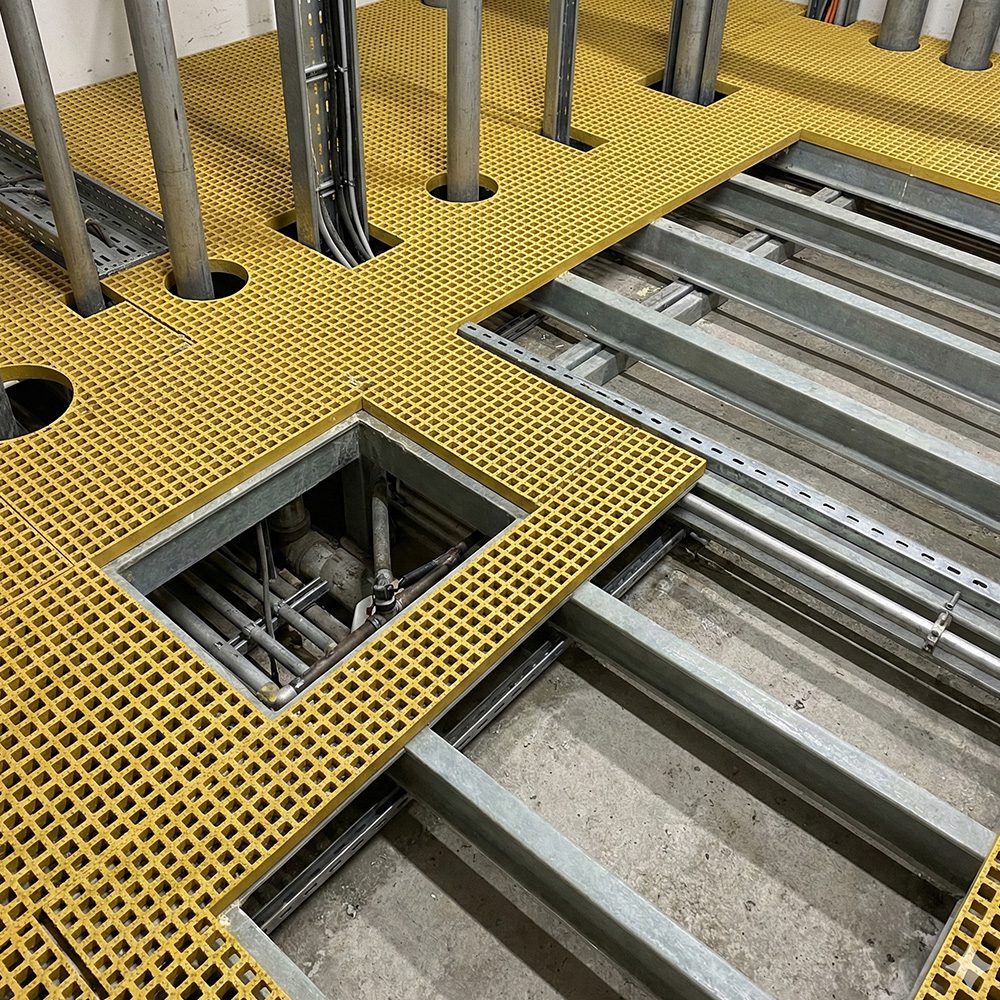
GRP grating goes down fast when the span suits the panel, the load bars face the right way, and the fixings hold everything flat on the supports. Where it goes wrong on site, you find bars running parallel to the supports instead of across them, panels cut dry with no dust extraction, field-cut edges left unsealed, or clips overtightened until the composite cracks around the bolt hole.
Get the span and support spacing right before you cut anything. Pick the right blade when you do cut. Seal every field-cut edge with resin. Fix the panels down with stainless clips tight enough to stop movement, but not so tight that you stress the GRP.
Spans, supports and load-bar orientation
There is no single maximum span for GRP grating. What a panel will carry across a given gap depends on:
- the grating thickness
- whether it is moulded or pultruded
- the mesh size
- the applied load
- the deflection limit you are working to
- how the supports are arranged
Thicker panels span further. Standard GRP grating comes in 25 mm, 38 mm and 50 mm thicknesses, with heavier sections for vehicle traffic or high point loads. But thickness alone does not set the span: the manufacturer's load table for the specific panel type gives the span and load figures for each combination of thickness, mesh and support arrangement.
Load-bearing bars run in the span direction, across the supports. Laid the other way, parallel to the supports, the grating loses most of its rated capacity. This is the most common orientation mistake on site, and it means lifting and relaying every affected panel.
Each span end needs continuous support: steel, concrete, aluminium or GRP section, with enough bearing width that the panel sits securely without overhanging the support edge.
The design order runs:
- clear span
- load
- allowable deflection
- panel thickness and type
- support and fixing detail
The governing UK standard is BS 4592-0:2006+A1:2012, with Part 4 covering open-bar grating and Part 6 covering moulded; for pedestrian areas, the deflection limit is 10 mm or span/200, whichever is smaller, and openings must not pass a 35 mm sphere. Loading categories (pedestrian, maintenance with tools, equipment roll-through) determine the deck thickness, support spacing and edge detail. The structural engineer or plant designer specifies the required loading. We fabricate and install to that specification, with the engineering calculations retained in the handover documentation. Check the load and span tables for the specific panel you are fitting before you confirm support centres.
Choosing the surface: open mesh, solid top or anti-slip
Open-mesh GRP grating drains water and lets light through, which suits outdoor walkways, platforms above occupied spaces and any application where drainage matters. Solid-top grating gives a closed walking surface where you need to stop liquids, debris or small objects falling through. Mini-mesh is between the two, with smaller openings that block most dropped items while still allowing some airflow and drainage.
The top surface on most GRP grating is gritted with quartz aggregate for anti-slip performance. Slip resistance in wet, oily or chemical environments is one of the main reasons GRP grating gets specified over open steel flooring, and that gritted surface is doing the work. A Pendulum Test Value of 36 or above in the wet condition is the accepted benchmark for low slip potential, and that is the figure building control will ask for. We include BS EN 16165 pendulum test values for our GRP grating in the project O&M pack, giving you an auditable slip-resistance specification.
Protect it during installation. The gritted face chips if panels are cut or handled carelessly, dragged across each other, or stacked grit-to-grit. Damaged grit cannot be repaired on site. Handle panels by lifting, not sliding.
Moulded GRP grating carries load in both directions, so panel orientation is more flexible when laying out a floor with irregular edges or multiple cut-outs. Pultruded GRP grating carries load in one direction only, along the load bars, which means the panel orientation is fixed by the span direction. For a closer look at the anti-slip surface options available across gritted and concave profiles, match the surface to your environment before you order.
Tools and fixings you'll need
A diamond-grit or carbide-grit blade, grade 316 stainless steel clips and fixings, edge sealer and RPE are the essentials for a clean GRP grating installation.
- Blade. Diamond-grit, carbide-grit or stone (untoothed) on a circular saw, chop saw, angle grinder or jigsaw. Not a toothed wood blade, and not a metal-abrasive disc. A toothed blade catches and splinters the composite. An abrasive disc generates excessive heat and a rough edge.
- Hold-down clips (M clips). Saddle clips that fix each panel to the support structure at the perimeter and across internal supports. Grade 316 stainless steel, with M8 or M10 stainless bolts, nuts and washers to match.
- Connecting clips (C clips). Lock adjoining panels together over the load bars at the joint, aligning the panels and stopping lateral shift before you fix the perimeter.
- Edge sealer. Resin for every field-cut edge. Vinyl ester is the usual choice.
- PPE. Eye protection, gloves, dust mask or RPE rated for fine glass-fibre dust. RPE is needed whether you cut wet or dry.
- Measuring and marking. Tape measure, chalk line or marker, straight edge, set square.
Grade 316 stainless across all fixings is not optional in the environments where steel is not the right answer. Mild steel clips corroding against the GRP defeats the purpose of the material.

Cutting GRP grating to size
Cut GRP grating on site with the correct blade, face-down, with both sides of the cut line supported.
GRP grating produces a fine glass-fibre dust when cut. The dust irritates skin, eyes and lungs. Wet cutting is the preferred method because it suppresses the dust at source. If you cut dry, run dust extraction and wear RPE. Controlling the dust is not a preference: it is the difference between a site that passes inspection and one that does not.
Cut face-down, with the gritted anti-slip surface against the bench or saw table. Any chipping from the blade happens on the underside, and the walking surface stays intact. Support or clamp both sides of the cut line. An unsupported offcut flexes under the blade, snaps early and chips the panel edge.
Seal every field-cut edge with resin. In wet, corrosive or hygiene environments this is the step that determines whether the panel lasts. Exposed glass fibres at a cut edge wick moisture into the laminate, and the degradation starts from the inside where you cannot see it until the surface fails. In a dry indoor setting, sealing is still good practice: the environment around a panel can change over its service life, and an unsealed edge from the original install cannot be fixed without lifting the grating.
For cut-outs around pipes, uprights and other penetrations, use a jigsaw with a diamond or carbide-grit blade for curves. Mark carefully and cut on the waste side of the line. Where panels can be ordered cut to size or fabricated to your drawings, that removes on-site cutting entirely.

Fixing the panels down
Seat each panel flat and square on clean, level supports, bearing correctly on both span ends, and aligned to its neighbours before you fix anything.
- Lock adjoining panels together first. C clips go over the load bars at the joint between panels, pulling them level and stopping lateral shift while you work along the run. Get the alignment right at this stage: it is harder to correct once the perimeter M clips are bolted down.
- Fix M clips over the load bars at every perimeter support and across every internal support. Four clips per panel is the minimum for a standard-sized panel. Larger panels, high-traffic walkways or platforms exposed to wind uplift need more. Stainless bolts through the clips into the support steelwork.
- Tighten the bolts secure, but not overtight. GRP grating carries its load by bearing on the supports, not through the fixing clips. The clips hold the panel in position and stop it lifting or shifting underfoot. Overtightening stresses the composite around the bolt hole and can crack the resin matrix, which is a failure you will not see until the panel moves.
- Walk every panel once the fixings are in. No rocking, no movement, no lift underfoot. Fixings tight, edge clearances uniform, gritted surface undamaged. If a panel rocks, the support beneath it is uneven or the bearing is not sufficient. Fix the cause before you tighten harder. Grating installed as a working platform at height falls under the Work at Height Regulations 2005, and a panel that rocks or lifts is a compliance issue, not just a poor finish.
Doing it yourself or having it supplied and fitted
Three routes to a finished GRP grating floor: cut and fit the panels yourself, order them supplied cut to size and fix them on site, or have the whole job supplied and fitted. GRP grating is lighter than steel decking, needs no hot works on site, and requires less lifting gear, so the installation goes faster than an equivalent steel decking layout, whichever route you take.
- Self-install suits straightforward jobs where you have the right blade, dust control on site, and the correct stainless fixings. A standard rectangular walkway or platform with minimal cut-outs in a dry indoor environment is a good candidate. Where you do not have dust extraction, or the job involves extensive cutting around penetrations, self-install creates problems on site that cost more to fix than they would have cost to avoid.
- Ordering panels cut to size and fabricated to your drawings is the middle route. You still fix them on site, but the cutting, dust and edge sealing happen at the factory. Every panel arrives with factory-sealed edges and no offcut waste. This suits jobs where you have the install capacity but want the precision and finish of factory cutting.
- Full supply and fit suits larger or more complex layouts, corrosive or chemical environments where material selection and edge sealing have to be right first time, coastal or rooftop installations, and live sites where the work runs alongside ongoing operations. Replacing steel decking with GRP grating on a live site without a shutdown is a supply-and-fit job: the cutting, edge preparation and fixing sequence needs to happen around the facility, not on top of it.
We supply GRP grating panels cut to size, fabricated to your drawings, and installed by our own directly-employed teams. Three environments justify GRP over steel decking: chemical plants where steel corrodes under process-spill exposure, rooftop plant rooms where corrosion increases total lifecycle cost, and coastal installations where salt air accelerates galvanising degradation beyond the expected service life. In those environments, a single team handling both the GRP and the steel support structure underneath removes the coordination gap between two trades. We installed GRP flooring to risers at One Centenary Way for Sir Robert McAlpine, and on a plant-deck job over a live petrol station we worked night shifts, with lifts planned by our in-house Appointed Person to keep the store running throughout.
Installed cost depends on the area, the panel type and thickness, site access, and whether cutting and fitting is included. For a closer look at what GRP grating costs across different supply routes, the pricing page has the breakdown. If you want the panels supplied and cut to your drawings, have the panels supplied and cut to size through us and take the on-site cutting out of your programme.
FAQs
What does GRP grating stand for?
GRP stands for glass reinforced plastic. GRP grating is a flooring product made from glass fibres set in a resin matrix, moulded or pultruded into open-mesh or solid-top panels used for walkways, platforms, risers and trench covers.
Is GRP grating the same as FRP grating?
GRP is the UK term. FRP (fibre reinforced plastic) is the US term for the same glass-fibre-in-resin family of products. Specifications, fixings and installation methods are interchangeable between the two.
Getting your GRP grating installed
We supply and install GRP grating with our own directly-employed teams, working from our Rotherham workshops across Sheffield, Yorkshire and the UK. One point of contact from the drawings through to the finished floor, no subcontractors on the job. We hold ConstructionLine Gold, CHAS Elite and Alcumus SafeContractor accreditations, with GBP 10m public and GBP 10m employers liability cover.
Send us a drawing, a spec, or a one-line brief, and you will get a clear, itemised quote back, not a ballpark, with a lead time scoped to your programme. For large-scale commercial projects, quotations come back in 1-2 weeks.
Talk to us about GRP grating installation in Sheffield and across Yorkshire about your project.

Written by
Jacob Hughes
Jacob Hughes is a Director at Universal Industrial Services, one of the UK's leading specialists in structural steelwork, architectural metalwork, and bespoke fabrication. With over a decade of leadership experience in the industry, Jacob oversees all aspects of project delivery - from strategic planning and compliance to client relations and operational excellence. Following the vision set by his father, company founder Neil Hughes, Jacob plays a critical role in maintaining the high standards, safety practices, and innovative approaches that Universal Industrial Services is known for. He is deeply committed to upholding the company's BS EN 1090 certification and CHAS Advanced accreditation, ensuring that every project meets the highest quality and regulatory benchmarks. While Jacob’s day-to-day role focuses on business development and project oversight, he works closely with Universal’s highly skilled engineering and fabrication teams to deliver complex projects across the UK. His leadership supports the company’s mission to invest in people, technology, and sustainable practices, helping clients achieve outstanding results in every project. Outside of work, Jacob is passionate about driving innovation within the steel and metalwork sectors and continues to champion professional development within the Universal Industrial Services workforce.